
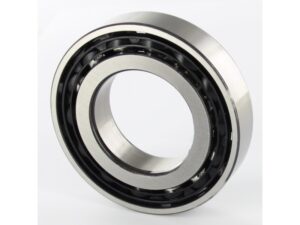
Angular contact ball bearings are a type of ball bearing designed to accommodate combined radial and axial (thrust) loads in a specific way. They are called “angular contact” bearings because the contact angle between the races and the balls is designed to be oblique or angled, allowing them to handle both radial and axial forces simultaneously. These bearings are particularly useful in applications where there is a need for high-speed operation and the capability to support both axial and radial loads. Here are some key features and characteristics of angular contact ball bearings:
- Contact Angle: Angular contact ball bearings have a defined contact angle between the inner and outer raceways and the balls. This contact angle is typically 15°, 25°, 30°, or 40°, depending on the design. The contact angle determines the bearing’s load-carrying capacity and the balance between radial and axial loads it can support.
- High-Speed Capabilities: These bearings are suitable for high-speed applications because their design reduces the centrifugal force on the balls, leading to lower heat generation and less friction. This makes them ideal for applications like machine tool spindles and electric motors.
- Axial Load Capacity: Angular contact ball bearings excel at carrying axial loads in one direction or in both directions, depending on the bearing’s design and contact angle. This capability is crucial in applications where thrust forces are present.
- Radial Load Capacity: They can also handle radial loads, making them versatile for applications where both axial and radial forces are present, such as in wheel hubs, pumps, and gearboxes.
- Precision and Accuracy: Angular contact ball bearings are known for their high precision and accuracy, which is essential in applications where positional control is critical, such as in precision machinery and aerospace equipment.
- Varieties: There are different configurations of angular contact ball bearings, including single-row, double-row, and four-point contact designs, each suited to particular applications.
Angular contact ball bearings are commonly used in various industries and applications, including:
- Machine Tools: For spindle bearings and precision machining applications.
- Automotive: In wheel hubs, transmissions, and other critical components.
- Aerospace: In aircraft landing gear, engines, and control systems.
- Robotics: In the joints and actuators of robotic systems.
- Agricultural and Construction Equipment: In applications like excavators, tractors, and cranes.
- Electric Motors: In the electric motor industry for high-speed, high-precision applications.
The selection of the right angular contact ball bearing depends on factors like the desired contact angle, the magnitude and direction of loads, speed requirements, and space constraints within the application.
Angular Contact Ball Bearings
Showing 1–15 of 1426 results
