
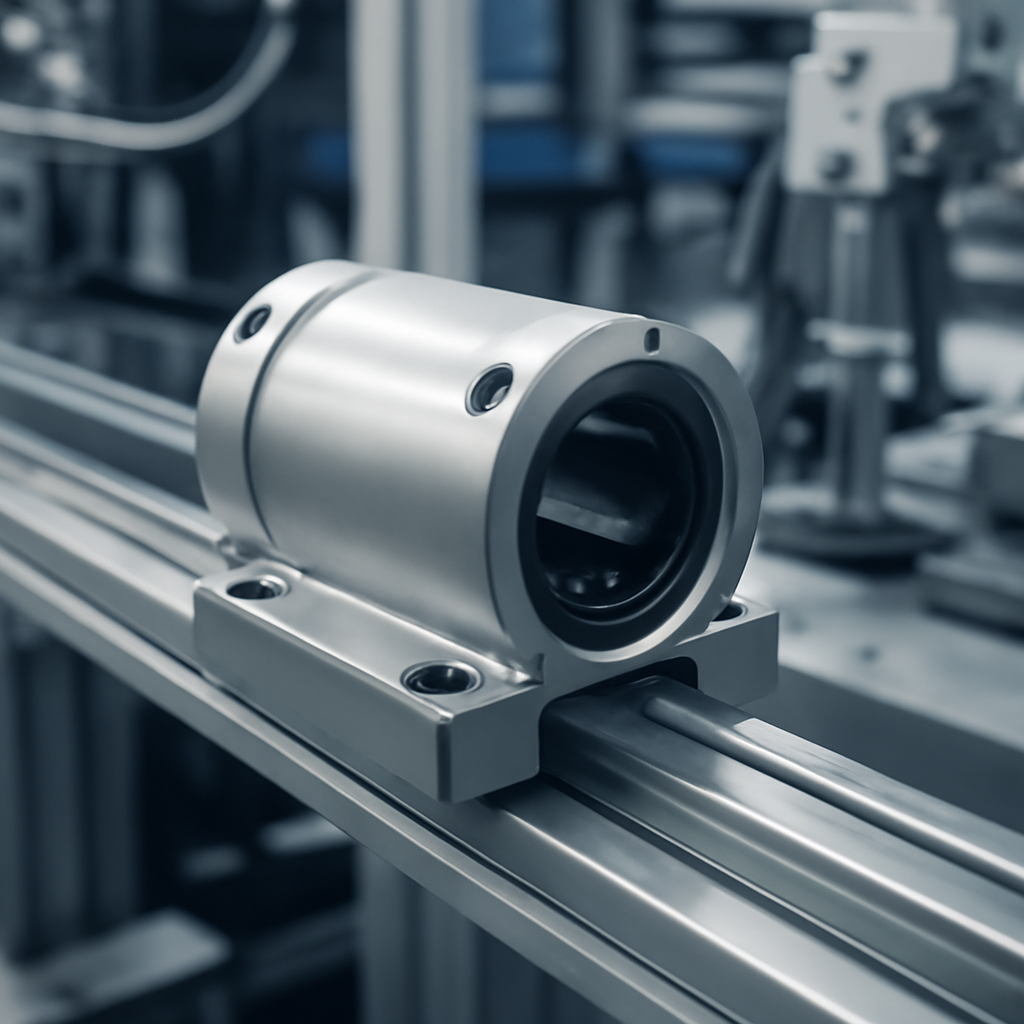
SAMICK Precision Industry, headquartered in Korea, has spent the last decade earning its way into specification on European industrial automation projects. Its linear bearing range — ball bushings, profile rail guideways, ball screws — covers most of what THK, Hiwin or Schneeberger sell, at a meaningful price discount. The question for buyers is: where does the spec match, and where does it not?
The SAMICK product range at a glance
- Ball bushings: cylindrical bushings for round shafts, both closed and open types, sealed and unsealed.
- Profile rail guideways: H, M, J series. Direct functional equivalents to THK SR/SHS and Hiwin HG.
- Ball screws: ground and rolled-thread ball screws across a broad range of diameters and leads.
- Integrated stages and modules: pre-engineered linear actuators for machine builders.
Where SAMICK is a clear win
- Cost-sensitive machine builds: 20-40% savings vs the established brands, with adequate quality for general industrial automation.
- Aftermarket replacement: when the original SKU is unavailable or has long lead time.
- Mid-tier automation: pick-and-place machines, packaging lines, conveyor sub-systems.
Where the established brands still earn the premium
- High-precision machine tools (CNC grinders, jig boring, EDM).
- Semiconductor lithography and wafer handling.
- Laboratory metrology and ultra-precision positioning.
- Applications where calculated bearing life directly drives MTBF requirements.
What buyers should verify
- Confirm dimensional interchangeability with the original — most SAMICK profile rails are direct replacements for THK/Hiwin standard sizes, but verify before ordering bulk.
- Match the preload class to the application — SAMICK uses a similar classification to the established brands.
- Check lubricant compatibility, especially when retrofitting onto existing equipment.
- For new machine designs, build the bearing supplier into the BOM consciously rather than as a late substitution.
Lead times and availability
SAMICK has steadily improved European stocking through authorised distributors. For standard sizes, off-the-shelf availability is comparable to the major brands. Custom-engineered components remain longer lead-time.
SAMICK product portfolio expansion in 2026
SAMICK has continued to expand its product portfolio through 2026, with particular focus on miniature linear motion components for medical and semiconductor applications, expanded ball screw range across precision classes, and integrated linear modules for machine builder OEM accounts. The expansion targets segments where SAMICK has been making competitive inroads against the established premium brands.
The Korean manufacturing base provides cost advantages over European premium brands while maintaining quality levels acceptable for the mid-precision market. SAMICK’s European distribution network has matured significantly over the past five years, with authorised distributors covering all major European industrial markets and standard product availability comparable to the major brands.
The SAMICK cost advantage in operational practice
The 20-40% cost advantage SAMICK offers over premium European and Japanese brands translates into meaningful savings on large machine builds with multiple linear motion axes. For machine builder OEMs producing dozens or hundreds of similar machines annually, the cumulative SAMICK cost advantage justifies the additional engineering qualification effort.
For specific applications, the cost advantage must be weighed against precision and life expectations. For high-precision applications where the calculated bearing life directly drives MTBF requirements above industry baseline, the premium brands retain a justified premium. For general-purpose industrial automation, SAMICK delivers adequate quality at meaningful cost reduction.
The competitive positioning vs HIWIN and Chinese suppliers
SAMICK competes most directly with HIWIN (Taiwan) and emerging Chinese suppliers in the mid-precision linear motion market. The competitive dynamic among these Asian manufacturers benefits European customers through pricing discipline and product innovation. SAMICK’s specific positioning: established European distribution, mature OEM relationships, and product range breadth comparable to the major brands.
For European procurement teams evaluating mid-precision linear motion suppliers, building cross-references across SAMICK, HIWIN, and Chinese alternatives provides procurement leverage and supply resilience. The cross-references are functionally interchangeable on standard products with caveats on preload and accuracy specifications.
SAMICK ball screws and complementary products
Beyond profile rail guideways, SAMICK ball screws cover ground precision (C0-C7 classes) and rolled (C7-C10) variants. The C5 ground class is the typical sweet spot for industrial automation — accuracy adequate for sub-100 micron positioning at moderate cost. The ball screw range is dimensionally compatible with the major Asian brands.
For machine builders sourcing a complete linear motion solution (guideway plus ball screw plus motor), SAMICK provides the broad range that simplifies the supplier relationship. The integrated approach delivers the cost advantage while preserving the engineering performance required for industrial automation.
Looking ahead: smart linear modules and integration
SAMICK’s 2026-2027 roadmap includes smart linear modules with integrated condition monitoring, expanded compact module range for cobot integration, and improved low-noise variants for medical and laboratory applications. The product evolution mirrors the broader industry transition from component supply to integrated motion solutions. For European industrial automation customers, SAMICK is positioning as a credible alternative to the premium brands across a widening range of applications.
Selection guidance and qualification process
For new applications considering SAMICK, the recommended qualification process: prototype build with SAMICK components, performance testing under representative load conditions, accelerated life testing where time permits, and procurement-level supplier audit. For OEM machine builders, the qualification investment is justified by the cumulative savings across production volume.
The 2026 application engineering ecosystem
Modern bearing application engineering goes beyond catalogue selection. The major manufacturers provide structured application engineering services: bearing selection consultation, calculated bearing life analysis, lubrication system design, failure mode analysis, and integrated condition monitoring programmes. For OEM equipment designers and major industrial customers, engaging these services during equipment design pays back through extended service life and reduced operational risk.
The European authorised distribution network typically provides the first layer of application engineering — sufficient for standard catalogue selection and common application questions. Manufacturer engineering centres provide deeper consultation for complex applications, specialty environments, or new equipment design. The escalation path from distribution to manufacturer is well-established and worth using for non-routine applications.
Quality assurance and traceability
For critical applications, bearing manufacturer quality assurance and product traceability matter as much as the bearing specification. Modern bearing manufacturers maintain detailed batch records, material certification documentation, and dimensional inspection records. For aerospace, medical, and food applications subject to regulatory traceability requirements, this documentation is itself a strategic asset that supports customer compliance.
For routine industrial applications, traceability is less critical but still valuable. When unusual failures occur, batch traceability supports root-cause analysis. When supplier substitution is required, traceability documentation supports engineering equivalence verification.
The strategic supplier relationship
Beyond transactional bearing supply, the strategic supplier relationship delivers value across multi-year horizons. Engineering consultation on new equipment designs, training programmes for maintenance teams, condition monitoring platform integration, and access to roadmap information for procurement planning all flow from strategic supplier relationships. For European industrial customers, building this relationship with one or two preferred manufacturers — while maintaining qualified alternatives for supply resilience — is a sound procurement strategy.
Looking ahead to 2027-2030
The next 3-5 years will see continued bearing industry evolution: smart bearing technology becoming standard rather than premium, condition monitoring platforms maturing across all major manufacturers, supplier consolidation effects flowing through to procurement choices, and end-user expectations evolving toward integrated reliability solutions rather than component supply. For European industrial customers, positioning the procurement strategy for this evolution — qualifying smart bearing platforms, building condition monitoring capability, and maintaining supplier substitution agility — is the strategic foundation for the coming decade.
Practical procurement guidance for 2026
For European industrial procurement teams operating in 2026, the practical guidance distils to a few key principles. First, build multi-supplier qualification across critical SKUs — supplier substitution agility is the most valuable procurement capability through the consolidation period. Second, lock pricing on framework agreements where leverage exists — bearing list prices continue upward trajectory through H2 2026 on most ranges. Third, invest in condition monitoring capability — the technology is mature and the ROI is documented. Fourth, build cross-reference databases that support informed substitution decisions during supply disruptions.
The cumulative effect of these procurement disciplines compounds across years. Organisations that build the capability now position themselves to outperform through the industry transition; those that delay will be implementing in 2028 against competitors who already have the foundation in place. The strategic window is open through 2026; the practical actions are well-defined.
The H2 2026 market context
Looking ahead to H2 2026, the European bearing market enters the period with several specific dynamics worth tracking. Industrial production indicators point toward moderate recovery; raw material costs remain elevated but stable; supply chain rebalancing continues as Schaeffler Yinchuan capacity reaches steady-state output. The NSK + NTN antitrust filings expected in Q3 2026 will be the most-watched ongoing story; SKF Automotive spin-off mechanics provide additional industry restructuring context.
For distributors and end-users operating in this environment, the practical posture is active engagement with supplier strategic developments combined with disciplined operational execution. Framework agreement negotiations during H2 2026 should incorporate the consolidation context; inventory positioning should reflect the lead-time normalisation; condition monitoring deployments should accelerate while implementation capacity is available. The window for proactive positioning ahead of the 2027 industry structure is narrow but real.
Related guides on Eurobearing
- Guide to SAMICK Linear Bearings
- SAMICK Linear Bearings: Innovation and Precision
- SFERAX Linear Bearings: When Precision Beats Cost
Need help choosing the right bearing for your application? Our technical team can support you with selection, cross-references, and lead-time information.