
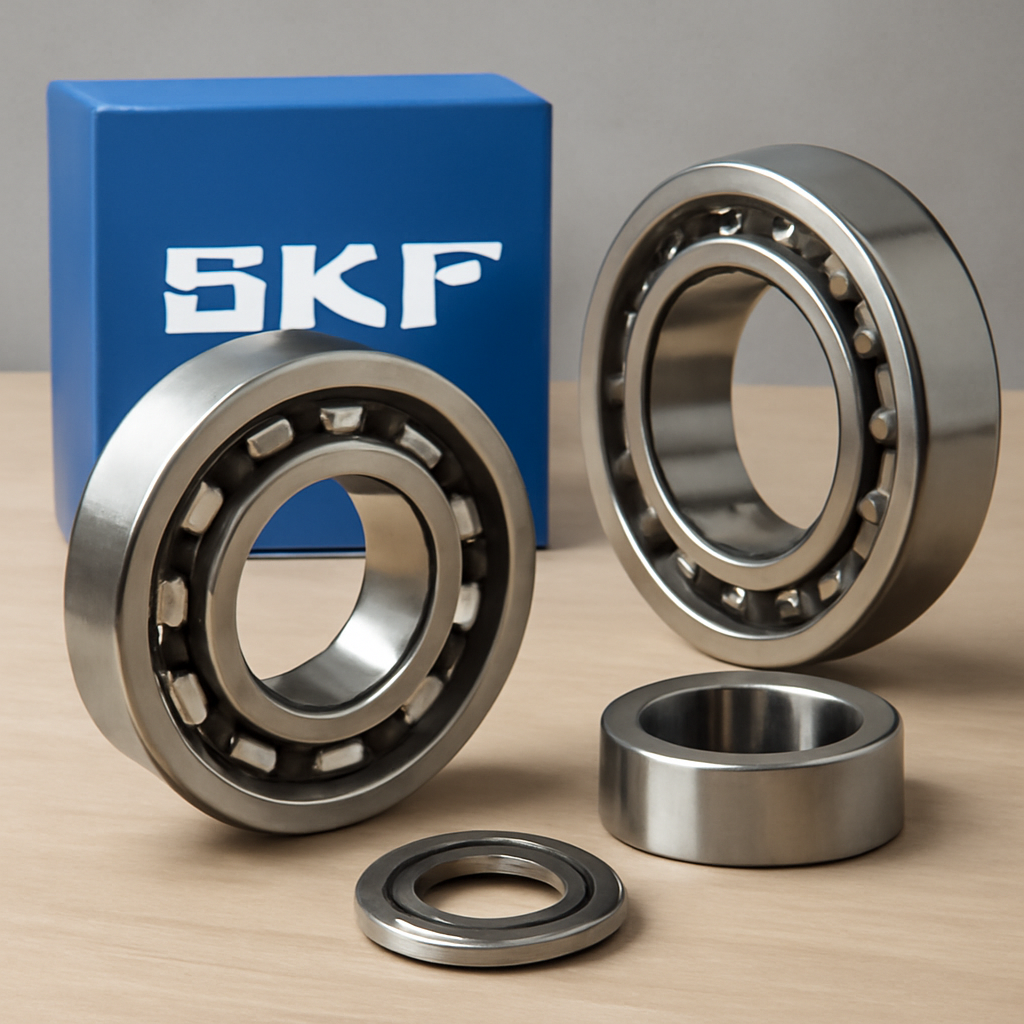
SKF, founded in Gothenburg in 1907 by Sven Wingquist, is the world’s largest bearing manufacturer by revenue and the European industry reference. The 2026 SKF is undergoing the largest strategic restructuring in its modern history: an Automotive business spin-off, a sharpened industrial segmentation, and aggressive investment in condition monitoring and smart bearings. This is the complete guide for distributors, OEMs and end-users.
1. The new SKF structure (effective 2026)
- Bearing Solutions: the historic core — deep groove, spherical, tapered, cylindrical, angular contact, super-precision bearings, and the integrated services around them.
- Specialized Industrial Solutions (SIS): magnetic bearings, marine, aerospace, wind, railway-grade products, condition monitoring (reinforced by the March 2026 G-Tech Instruments acquisition).
- Automotive: prepared for full spin-off as a standalone entity.
2. The SKF rolling bearing portfolio
Deep groove ball bearings
Series 6000, 6200, 6300, 6400. Single row, double row, and Y-bearing (insert) variants. The Generation E and Energy Efficient lines are the modern standards — lower friction torque, broader operating envelope.
Angular contact ball bearings
7000 and 7200 series, contact angles 15°, 25°, 40°. Single row, double row, four-point contact (QJ series). High-precision Super-precision range for machine tool spindles.
Spherical roller bearings
22000 and 23000 series. The workhorse of heavy industrial drives, papermaking, mining, vibrating screens. Self-aligning to compensate misalignment.
Cylindrical roller bearings
NU, N, NJ, NUP, NN series. High radial load capacity at moderate-to-high speeds. Standard in electric motor traction bearings, gearbox intermediate shafts, machine tool spindles.
Tapered roller bearings
30000 and 32000 metric series, plus full imperial range. Combined radial and axial loads. Standard in wheel hubs, gearbox shafts, heavy industrial machinery.
Spherical thrust roller bearings
29000 series. Axial loads with self-alignment capability.
Needle roller bearings
Drawn cup (HK, BK) and solid needle (NA, NK). Compact radial envelope.
Super-precision bearings
Hybrid ceramic ball bearings, ground angular contact bearings, sealed precision bearings for machine tool spindles. Where the tightest tolerances are non-negotiable.
3. Smart bearings and condition monitoring
- SKF Insight: bearings with integrated wireless sensors transmitting vibration and temperature data.
- SKF IMx and Multilog: condition monitoring hardware platforms.
- SKF @ptitude: cloud-based reliability software.
- G-Tech Instruments: acquired March 2026, reinforcing field instruments and vibration analysis.
4. Specialty product lines
- Insocoat: insulated bearings for inverter-driven motors and EV traction motors.
- NoWear: black-oxide-coated bearings for micropitting-prone applications.
- Hybrid bearings: ceramic balls for high-speed and electrical isolation.
- Explorer: SKF’s flagship enhanced-life range — equivalent to FAG X-life.
- Stainless steel and chromium steel for food/beverage.
5. Decoding SKF designations
A typical deep groove ball bearing: 6205-2RS1/C3 = series 62, bore code 05 (25 mm), 2RS1 (contact seals both sides), C3 clearance. SKF uses “2RS1” where FAG uses “2RSR” — minor convention difference, identical function.
6. SKF and the bearing market in 2026
SKF revenue ~$11.5B (2025), market cap $11.5B as of May 2026 (Nasdaq Stockholm). The company is positioning aggressively for the smart bearing and condition monitoring opportunity, and the Automotive spin-off frees the industrial segments to grow without the capital intensity drag of an automotive business.
7. SKF vs Schaeffler (FAG/INA)
The two European leaders compete head-to-head across the entire industrial portfolio. SKF strengths: complete reliability services ecosystem, broader condition monitoring portfolio, stronger marine and aerospace presence. Schaeffler strengths: FAG and INA dual-brand presence, stronger automotive, particularly strong needle and cam follower range.
8. Lead times and stocking
Standard catalogue parts are widely available through European distribution. Engineering-class bearings and large diameters can run 12+ weeks. The 2022-2024 supply tightness has eased — H2 2026 should normalise on most categories.
9. Selection guidance
- For general-purpose motor applications: deep groove 6200 or 6300 series, 2RS1 seals, C3 clearance.
- For inverter-driven motors above 11 kW: specify Insocoat on at least one position.
- For wash-down food applications: stainless Y-bearing range.
- For high-precision spindles: angular contact Super-precision range.
- For wind, marine, aerospace: engage SKF application engineering.
10. What is coming next
- Automotive spin-off completion (timeline 2026-2027).
- Expanded condition monitoring portfolio post-G-Tech integration.
- Continued investment in EV bearings, wind bearings, and smart bearings.
Conclusion
SKF remains the European bearing industry reference. The 2026 SKF is a more focused, more software-rich, more services-led company than the SKF of five years ago. For distributors and end-users, the relationship with SKF is becoming a relationship with an industrial reliability platform, not just a bearing supplier.
The 2026 reliability investment thesis
For European industrial customers in 2026, the broader reliability investment thesis is decisive. The combination of affordable IoT sensors (under $50 per node, an 85% cost reduction since 2019), mature AI analytics platforms, documented ROI cases (6-18 month payback in mid-size plants), and supplier ecosystem support makes condition monitoring deployment economically realistic for virtually any plant with critical rotating equipment. The cumulative effect across years of deployment is meaningful: 30-50% reduction in unplanned downtime, 15-25% reduction in maintenance labour, and extended equipment service life.
For procurement leadership specifically, the reliability investment changes the supplier relationship dynamic. Bearing supply becomes part of an integrated reliability conversation rather than a transactional component supply. Engineering services, condition monitoring platforms, training programmes, and roadmap visibility all flow from strategic supplier relationships. The companies building these relationships now position themselves for the post-2028 industry structure where smart bearings and integrated reliability solutions become standard rather than premium.
What the next 18 months will tell us
The next 18 months will clarify several major industry questions. NSK + NTN antitrust filings progress through Q3-Q4 2026 will reveal the regulatory burden and possible remedies. SKF Automotive spin-off mechanics will be confirmed, with implications for both the SKF industrial businesses and the new standalone automotive entity. Schaeffler Yinchuan capacity ramp will reach steady-state output, affecting standard catalogue lead times and pricing dynamics. EU industrial demand recovery will be tested through H2 2026 and into 2027.
For organisations operating in this environment, active engagement with these developments — through industry events, supplier conversations, and trade press monitoring — supports informed strategic decisions. The bearing industry in 2026-2027 is not on autopilot; the strategic decisions made during this period set competitive positioning for years to come.
Industry consolidation effects on the European market
The European bearing market in 2026 is experiencing one of the most active consolidation periods in three decades. NSK and NTN signed a Memorandum of Understanding on 12 May 2026 to integrate by October 2027, creating a combined entity that will challenge SKF and Schaeffler for the global #1 position. SKF announced and is operationally preparing the separation of its Automotive business under a new three-segment structure (Bearing Solutions, Specialized Industrial Solutions, Automotive). Schaeffler completed major capacity expansion at its Yinchuan (China) facility, doubling manufacturing capacity for high-volume FAG deep groove ball bearings. SKF acquired G-Tech Instruments in March 2026, deepening condition monitoring capability.
For European industrial customers, these consolidation effects translate into specific operational implications. Lead times on standard catalogue ranges should normalise through H2 2026 as the Yinchuan capacity reaches steady-state output. Framework agreement negotiations should incorporate the consolidation context, with provisions for SKU continuity, substitution rights, and engineering support continuity through the transition period. Multi-supplier qualification becomes more important as the industry restructures around fewer larger entities.
Raw material costs and pricing dynamics
Bearing pricing dynamics in 2026 reflect several converging cost drivers. US steel tariffs at 50% (in force since June 2025) reshape global trade flows, with Asian bearing exporters redirecting volume away from the US into Europe and other markets. Bearing-grade alloy premiums continue to widen as demand for cleaner steel chemistry grows faster than supply. EU regulatory developments (CBAM, REACH SVHC updates, steel safeguards) add complexity to import economics.
For procurement teams, the practical posture is active engagement with these dynamics. Lock pricing on top-50 SKUs in framework agreements where leverage exists. Build steel-cost adjustment mechanisms into multi-year contracts rather than fixed pricing. Verify customs classifications carefully — the difference between an HS code that captures CBAM and one that does not can be material. Document supplier origin certifications for preferential trade agreement benefits.
The smart bearing transition and procurement implications
The bearing industry’s transition from component supply to integrated reliability platform delivery represents the defining strategic shift of the decade. Every major manufacturer (SKF Insight, Schaeffler OPTIME, NSK SAT, NTN smart bearing platforms) has built or acquired platform capability. The integrated offering combines instrumented bearings, cloud analytics, AI-based anomaly detection, prescriptive workflow integration, and integrated services.
For procurement leadership, the smart bearing transition reshapes the supplier evaluation criteria. Beyond bearing specifications and pricing, evaluation now includes platform capability, integration with existing CMMS and ERP systems, data ownership and portability terms, and ongoing software roadmap visibility. The platform commitment is multi-year — selecting a smart bearing platform is more consequential than selecting a bearing brand because the platform decision is harder to reverse.
Condition monitoring deployment economics in 2026
The deployment economics for IoT-based condition monitoring in 2026 are particularly favourable for European mid-size industrial plants. Sensor hardware costs have collapsed (under $50 per node, 85% reduction since 2019). Cloud platforms have matured into turnkey SaaS offerings with predictable subscription pricing. AI analytics layer adds capability that human analysts alone cannot match. Documented payback periods converge on 6-18 months for typical deployments.
For a mid-size plant with 50-100 critical assets, deployment economics typically run: €15,000-30,000 first-year capex for sensors, gateways, and integration; €10,000-20,000 annual recurring for cloud platform and ongoing services. Total 5-year cost: €55,000-130,000. Documented savings: 30-50% reduction in unplanned downtime, typically valued at €100,000-500,000 annually. The capital justification is straightforward; the organisational change to operate alongside the technology is the actual implementation challenge.
Related guides
- SKF 2026 New Structure
- SKF Acquires G-Tech
- How to Choose SKF Bearings
- SKF Maintenance Guide
- SKF Industrial Applications
Need help with bearing selection? Our team supports you with cross-references and lead-times.