
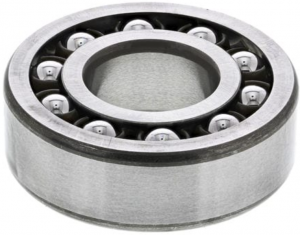
Ball bearings are components used to reduce friction between certain mechanical parts of a vehicle. Found within a car’s suspension system, they are typically located in the wheel hub and on the brake drum or disc, with the aim of making the vehicle’s movement smoother and safer.
But why is it important to ensure that your car’s wheel bearings are in good condition? And how can you tell when they need to be replaced?
⚙️ How Car Ball Bearings Work
As is well known, the main function of wheel bearings in cars is to reduce the mechanical friction of the CV joint (constant velocity joint), which rotates within the steering knuckle, allowing the drive shafts to correctly transmit rotational motion to the wheels—even during turning.
Usually, the ball bearings inserted inside the knuckles are made up of several rows of balls arranged in parallel and covered with special grease. This is why it is crucial to always choose high-quality automotive bearings and wheel hub replacement kits with the correct size and specifications.
🔍 How to Tell If Car Bearings Need to Be Replaced
So, when should the bearings be replaced? While a precise diagnosis should always be given by your trusted mechanic, a helpful method for detecting worn wheel bearings is by listening for a faint humming noise while taking a curve or as the vehicle gains speed.
If possible, you can also try lifting the car and spinning a wheel by hand: if you hear a noise during rotation and feel vibrations on the fender, it’s likely that the bearing is damaged.
In modern vehicles, any need to inspect the suspension system or replace ball bearings is often indicated by dashboard warning lights, especially those related to the ABS function—for which the bearings are a crucial component. Their proper function supports the CV joint and therefore the accurate transmission of movement to the wheels.
🔧 What to Do If Your Bearings Make Noise
If you notice that the bearings on your vehicle are making unusual noises, the best course of action is to take the car to a reliable mechanic and consider replacing them. The replacement operation is usually quick, thanks to dedicated disassembly and installation equipment, and can be scheduled without significant inconvenience.
❗ Final Notes
To conclude, it’s important to note that preventive maintenance of ball bearings is not possible, nor can their replacement interval be precisely predicted. Their durability can vary greatly and is influenced by many factors—not always within the driver’s control.
For example, in coastal areas, the salty air tends to mix with the grease that coats the bearings, shortening their lifespan and increasing the frequency of replacement.