
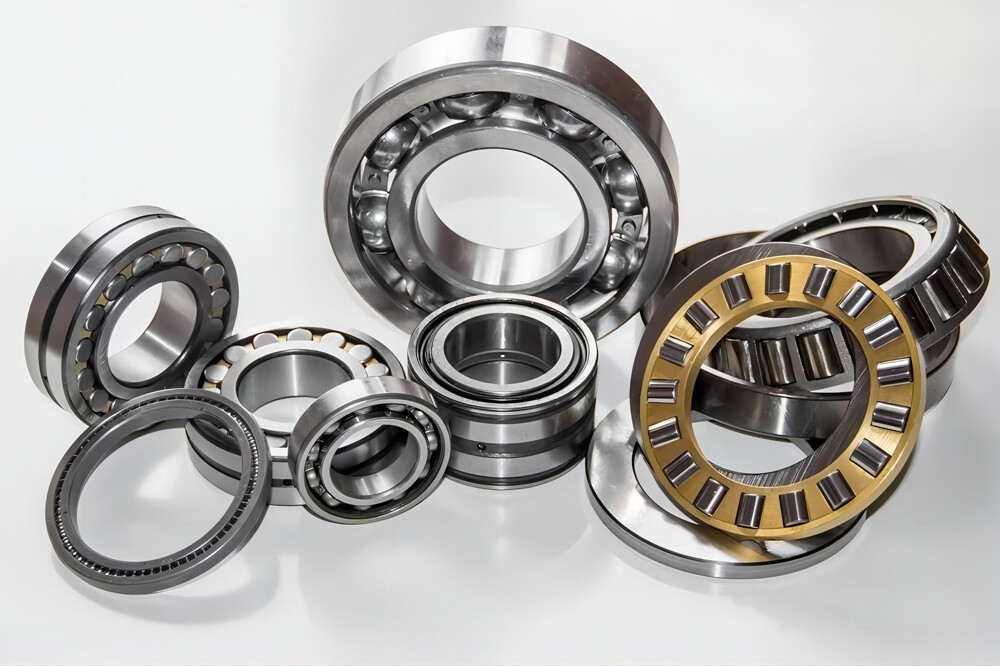
In the world of industrial mechanics and precision engineering, selecting the correct bearing is one of the most critical factors for ensuring efficiency, durability, and operational reliability.
Every application has its own unique requirements — the type of load, rotational speed, working environment, and direction of forces all determine which bearing should be used.
An incorrect selection can lead to premature wear, vibration, noise, or even mechanical failure.
This guide provides an in-depth overview of how to choose the most suitable bearing according to load and speed, analyzing key parameters such as material, geometry, and the mechanical conditions of each industrial application.
The Importance of Selecting the Correct Bearing
A bearing is not simply a component — it is a key element in power transmission and mechanical motion.
Its purpose is to reduce friction between moving parts while maintaining stability and precision.
Choosing the right bearing ensures:
-
maximum mechanical efficiency,
-
reduced energy losses,
-
extended service life of the system,
-
simplified and predictable maintenance.
Every industrial sector — from automation and metallurgy to agriculture and robotics — requires specific bearings designed to operate under different load, speed, and temperature conditions.
Types of Loads in Bearings
The first step in choosing a bearing is to understand the type of load acting on it. Loads are generally divided into three main categories: radial, axial, or combined.
Radial Load
A radial load acts perpendicular to the shaft axis. It is typical in applications such as motors, pulleys, or conveyors.
Ball bearings and cylindrical roller bearings are usually preferred for these conditions because they distribute pressure evenly along the raceways.
Axial Load
An axial (or thrust) load acts parallel to the shaft axis and pushes the bearing longitudinally.
Thrust ball bearings or tapered roller bearings are designed to handle high axial loads while maintaining alignment and smooth motion.
Combined Load
Many applications involve both radial and axial forces.
In these cases, tapered roller bearings or spherical roller bearings are recommended, as they can support forces in multiple directions and compensate for minor misalignments.
Relationship Between Load and Bearing Life
A bearing’s load capacity is defined by two parameters: the dynamic load rating (C) and the static load rating (C₀).
The dynamic load rating represents the load a bearing can endure during rotation for a nominal life of one million revolutions, while the static rating defines the maximum load before permanent deformation occurs.
The nominal bearing life (L₁₀), expressed in millions of revolutions or operating hours, is calculated based on load, speed, and operating factors.
In practical terms:
-
excessive load shortens bearing life,
-
insufficient load can cause slippage and micro-wear.
For best performance, bearings should be selected based on actual load conditions, not just theoretical ratings.
The Effect of Rotational Speed
Operating speed is another decisive factor in bearing selection.
Each bearing type has a maximum permissible speed, beyond which heat and friction increase significantly.
Ball bearings are ideal for high-speed applications due to their low rolling resistance and lighter elements.
Roller bearings, with greater contact area, are more suitable for moderate speeds and heavy loads.
Factors influencing permissible speed include:
-
bearing size and mass,
-
lubrication type and viscosity,
-
mounting precision and alignment,
-
ambient temperature and heat dissipation capacity.
For very high-speed systems — such as electric motors, turbines, or precision spindles — high-speed precision ball bearings with polymer or ceramic cages are often preferred to reduce rotational inertia.
Balancing Load and Speed
Load and speed are inversely related: as speed increases, the bearing’s load capacity decreases, and vice versa.
To properly balance these two parameters:
-
Define the application type – continuous rotation, oscillation, or reversing motion.
-
Determine the effective load – direction, intensity, and variability.
-
Identify the average and maximum operating speeds.
-
Consult load/speed diagrams provided by manufacturers to determine optimal operating ranges.
-
Select the bearing type that safely supports both parameters.
For example:
-
High speed, low load → precision ball bearings.
-
Low speed, heavy load → cylindrical or tapered roller bearings.
-
Variable or multidirectional loads → spherical roller bearings.
Bearing Types According to Operating Conditions
Ball Bearings
Versatile and compact, suitable for high-speed, low-to-medium load applications. Common in electric motors, pumps, and gearboxes.
Cylindrical Roller Bearings
Designed for heavy radial loads and moderate speeds. Ideal for reducers, industrial motors, and metalworking machinery.
Tapered Roller Bearings
Handle combined loads efficiently. Commonly used in transmissions, heavy vehicles, and machinery under axial stress.
Spherical Roller Bearings
Self-aligning and capable of withstanding vibration and shock. Perfect for demanding applications such as mills, turbines, and conveyors.
Angular Contact Bearings
Provide both radial and axial load support and ensure rigidity in applications requiring high precision, such as CNC spindles and positioning systems.
Lubrication and Heat Dissipation
Lubrication plays a critical role in both bearing performance and longevity.
Selecting the proper oil or grease affects not only friction levels but also heat generation and load capacity.
An improper lubricant leads to excessive friction, overheating, and surface degradation.
Oil viscosity must remain stable at high temperatures, while greases should offer oxidation resistance and mechanical stability.
For high-speed systems, circulating or oil mist lubrication ensures constant cooling.
For low-speed or intermittent operations, high-performance greases provide optimal protection and reduced maintenance frequency.
The Role of Temperature and Environment
Besides load and speed, environmental conditions strongly influence bearing choice.
Extreme temperatures, humidity, dust, or chemical exposure require dedicated materials and sealing solutions.
For example:
-
Stainless steel or hybrid ceramic bearings for corrosive environments.
-
Polymer or brass cages for high-temperature conditions.
-
Sealed or shielded designs for dusty or humid applications.
Proper selection of materials and sealing systems helps ensure long-term reliability and prevents premature failures.
Maintenance and Service Life
Even the best bearing will fail prematurely if not properly maintained.
The most common causes of failure include:
-
incorrect installation,
-
lack or contamination of lubricant,
-
excessive load or speed,
-
misalignment or vibration.
A predictive maintenance strategy, supported by temperature and vibration sensors, helps detect early signs of wear and prevent unexpected downtime.
Regular alignment checks and lubricant replacement are essential for maintaining peak performance.
Conclusion
Choosing the right bearing based on load and speed requires technical knowledge and careful analysis of operating conditions.
Every industrial application is unique, and understanding the relationship between load, speed, temperature, and lubrication is key to achieving maximum performance, reliability, and lifespan.
A properly selected and maintained bearing is not just a mechanical component — it is a strategic investment in productivity and operational efficiency.