
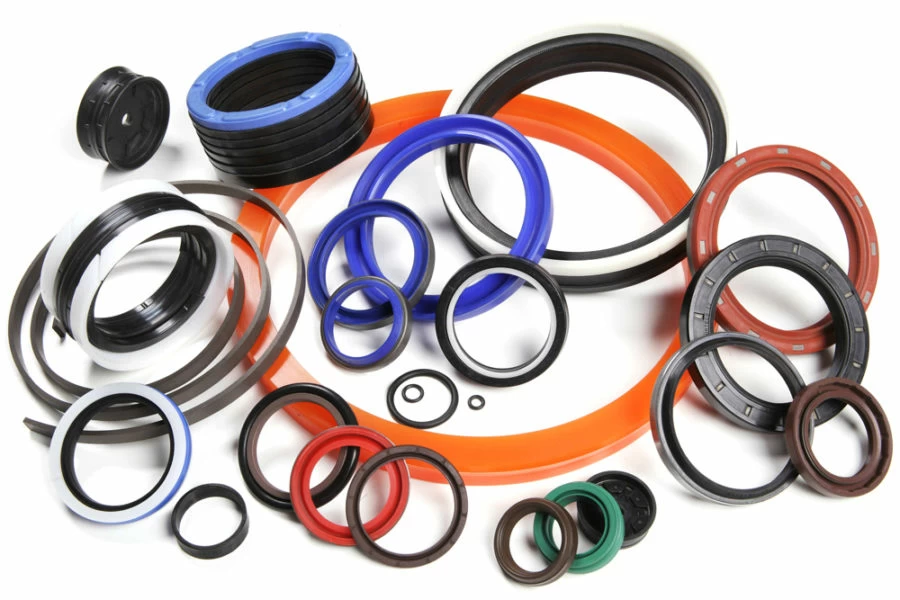
In industrial mechanics, sealing solutions play a vital role in protecting machinery and ensuring efficient operation.
Two of the most commonly used and often confused components are oil seals and gaskets. Both are essential to prevent leaks, contamination, and premature wear of rotating or static components.
Despite their similar appearance, oil seals and gaskets serve very different purposes.
This article explains the main differences between them, their materials, applications, and best practices to maximize service life and performance.
What Are Sealing Solutions?
Sealing solutions are devices designed to prevent the unwanted passage of liquids or gases between two contacting surfaces, under either static or dynamic conditions.
They are used in engines, gearboxes, pumps, compressors, and all systems involving rotation, pressure, or fluids.
Common sealing types include:
-
Oil seals (radial shaft seals) for rotating components;
-
Gaskets, used between stationary or reciprocating surfaces;
-
Mechanical seals and O-rings for high-pressure or chemically aggressive environments.
Choosing the right seal depends on factors such as fluid type, operating temperature, pressure, speed, and material compatibility.
What Are Oil Seals?
Oil seals, also known as radial shaft seals, are designed to prevent the leakage of lubricants from rotating shafts while blocking the ingress of dust or moisture.
They protect internal components like bearings and gears, maintaining lubrication and reducing friction.
Structure
A standard oil seal includes:
-
Metal or elastomer body, providing rigidity and proper fit;
-
Flexible sealing lip, in contact with the rotating shaft;
-
Garter spring, ensuring constant pressure on the shaft surface.
This structure allows oil seals to adapt to surface imperfections and maintain an effective seal during continuous operation.
Types of Oil Seals
-
Spring-loaded (Type TC) for high-speed, moderate-pressure use;
-
Non-spring (Type SC or VC) for low-friction or viscous environments;
-
Double-lip seals (Type TCN or DC) for combined internal and external sealing.
Materials
-
NBR (nitrile rubber) for standard oil applications;
-
FKM (Viton) for high-temperature and aggressive fluids;
-
Silicone and PTFE for extreme environments and high-speed operation.
What Are Gaskets?
Gaskets are static seals used to prevent leakage between two surfaces.
They can be flat, ring-shaped, or molded, and are found in a vast range of applications — from hydraulic systems to engines and industrial pipelines.
Function
Unlike oil seals, gaskets work between stationary or low-motion parts.
They rely on elastic compression to fill surface irregularities and block fluid passage.
Types of Gaskets
-
Flat gaskets for flanges and industrial joints;
-
O-rings, the most versatile and standardized sealing elements;
-
Profiled or custom gaskets for pumps, valves, and compressors;
-
PTFE or graphite gaskets for high-pressure or high-temperature conditions.
Materials
-
NBR, EPDM, FKM elastomers for oils and industrial fluids;
-
Graphite and PTFE for high thermal and chemical resistance;
-
Silicone and natural rubber for food and medical industries.
Oil Seals vs Gaskets: Key Differences
| Characteristic | Oil Seals | Gaskets |
|---|---|---|
| Motion type | Rotational | Static or reciprocating |
| Seal type | Radial | Axial |
| Structure | Flexible lip with spring | Compressed ring or flat body |
| Main materials | NBR, FKM, PTFE | NBR, EPDM, PTFE, graphite |
| Pressure range | Up to ~10 bar | Wide range, up to very high pressures |
| Temperature limit | Up to 200°C | Up to 600°C (graphite) |
| Typical use | Motors, gearboxes, shafts | Flanges, valves, covers |
How to Choose the Right Sealing Solution
-
Motion Type
Rotating elements require oil seals; static components require gaskets. -
Fluid Type
Match the material to the fluid — for example, FKM for hydrocarbons, EPDM for water or steam. -
Temperature and Pressure
Graphite or PTFE gaskets withstand extreme heat, while Viton oil seals handle high-speed friction. -
Environment
Use double-lip seals or reinforced gaskets for dusty or humid conditions. -
Maintenance
Gaskets are easier to replace; oil seals require more precise installation.
Installation and Maintenance
Installing Oil Seals
-
Clean the shaft and housing carefully.
-
Apply light lubrication to the lip.
-
Insert the seal evenly, avoiding twists or impacts.
Installing Gaskets
-
Ensure clean, flat surfaces.
-
Apply even torque to prevent deformation.
-
Replace the gasket after each disassembly.
Maintenance
-
Inspect regularly for leaks or wear.
-
Avoid aggressive cleaning agents.
-
Maintain proper lubrication for rotating assemblies.
Industrial Applications
Sealing elements are critical in:
-
Automotive and transport industries for engines, transmissions, and differentials.
-
Mechanical and process industries for pumps, valves, and reducers.
-
Energy and chemical sectors for high-temperature, high-pressure operations.
-
Food and pharmaceutical plants using silicone and PTFE gaskets for sterile environments.
Conclusion
Both oil seals and gaskets are fundamental to mechanical reliability and efficiency.
Oil seals are the choice for rotating shafts and dynamic sealing, while gaskets are ideal for static joints and pressure containment.
Selecting the right seal type and material ensures long-term protection, reduces maintenance, and guarantees system efficiency.
With proper installation and monitoring, both solutions deliver durability, safety, and consistent performance in any industrial environment.