
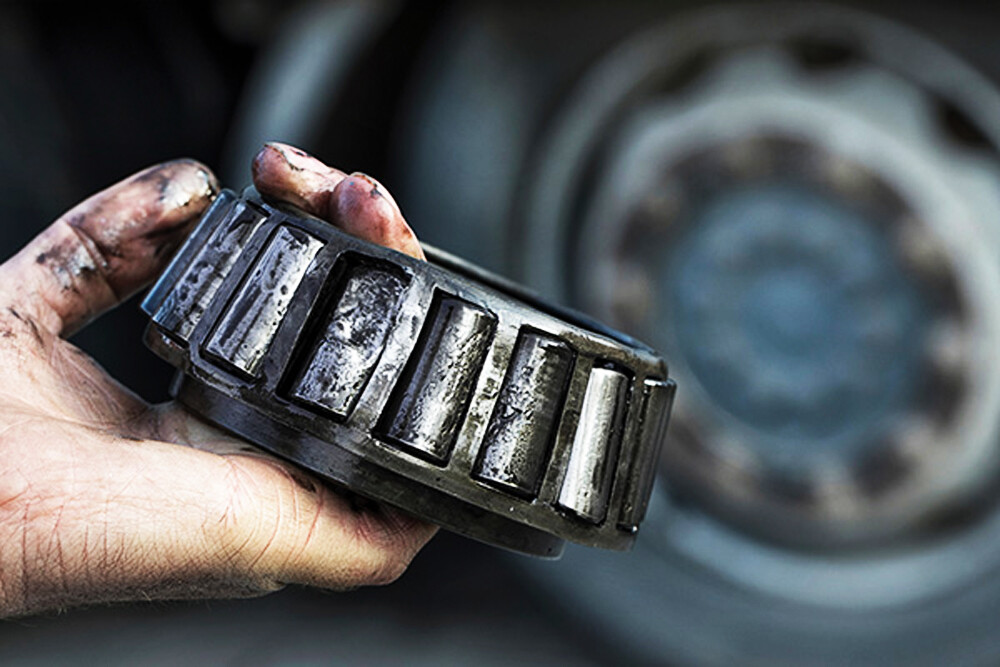
Machinery that has been stopped for an extended period — seasonal equipment, plants returning from summer shutdown, lines that ran intermittently during a slow quarter — is at higher risk of bearing damage than you might think. Vibration from nearby equipment can cause false brinelling on idle bearings, grease can drain to the lower half of the housing, and condensation can begin internal corrosion. Skipping the inspection step before restart is one of the most expensive mistakes a maintenance team can make.
1. Visual inspection of the housing and shaft seat
Before touching the bearing, look at the surrounding components:
- Signs of oil leakage or grease migration around the seal lips.
- Rust or moisture marks on the shaft seat and housing bore.
- Loose or missing fasteners on the bearing housing.
2. Rotate the shaft manually
With the drive disconnected, rotate the shaft by hand and listen. A healthy bearing rotates smoothly with a uniform feel; you are looking for:
- Notchy or rough rotation → likely indentations from false brinelling.
- Increased rolling friction → grease that has thickened or migrated.
- Audible grit → contamination ingress through degraded seals.
3. Re-lubricate before the first run
If the equipment has been idle for more than 4-6 weeks, plan a partial re-lubrication:
- Add fresh grease equal to roughly 50% of the bearing free space (not 100% — over-greasing causes overheating).
- Use the original grease specification; mixing thickeners (lithium with polyurea, for example) can cause grease breakdown.
- For oil-lubricated bearings, drain a small sample and check for water content and metallic particles before topping up.
4. Run a controlled start
The first run after a long stop should be done at reduced speed for the first 10-15 minutes, monitoring:
- Housing temperature (rise no more than 30-40 °C above ambient in the first hour).
- Audible noise (any squeal, knock or whine warrants a stop).
- Vibration trend (a handheld vibration meter is enough to catch obvious anomalies).
5. Document what you saw
The single best practice — and the one most often skipped — is to log the inspection in your CMMS or maintenance journal: who inspected, what was found, what was re-lubricated, and what the first-hour temperature trend looked like. This becomes invaluable the next time the equipment is restarted.
When to call in a specialist
If you find rust pitting on rolling elements, audible noise that does not improve in the first 30 minutes, or unexplained temperature rise, replace the bearing rather than risk a catastrophic failure mid-production. The cost of an unplanned bearing failure on a critical line is almost always 10 to 100 times the cost of a precautionary replacement.
The hidden enemy: false brinelling explained
False brinelling is the most common — and most preventable — damage mode on stored or idle bearings. The mechanism: small-amplitude vibration from nearby machinery, transport movement, or even foot traffic causes the rolling elements to oscillate in place against the raceways. There is no rolling motion to redistribute lubricant; instead, the rolling elements work through the grease film and contact the raceway directly. The result is microscopic wear at each ball or roller position, eventually visible as round indentations spaced exactly at the rolling element pitch.
The damage looks identical to true brinelling (caused by static overload) but the cause is completely different. The defining diagnostic clue: the indentations show no plastic deformation around the edges, only fretting wear. The bearing was destroyed by vibration it should never have experienced — vibration that could have been prevented with proper storage and periodic rotation.
The grease drainage problem
In horizontally-mounted bearings that sit idle for extended periods, the grease drains under gravity toward the bottom of the housing. The upper rolling elements lose lubrication; on restart they run dry against the raceway for several revolutions before grease redistribution catches up. Those few dry revolutions can initiate raceway scuffing that becomes a fatigue crack initiator within weeks of operation.
Vertical-shaft bearings have the opposite problem: grease pools at the bottom of the housing, potentially overheating during restart, while the upper bearing positions run with insufficient grease. Both orientations benefit from manual rotation during storage — typically once per month is sufficient to redistribute grease through the bearing.
Condensation and the rust risk
Temperature cycling during storage drives condensation. Moist air enters the housing during cool periods, condenses on internal surfaces as temperature drops further, then evaporates incompletely during warm-up. Each cycle deposits a microscopic amount of water on the raceways. Over months, the cumulative effect is visible as rust spots — initially cosmetic, eventually structural.
The defence: control storage temperature (ideally 15-25 °C continuous), control humidity (40-60% RH), and ensure the housing seals are intact. For bearings stored more than 12 months, plan to drain and replace the grease before restart — old grease may have absorbed water that compromises its lubricating properties.
The post-restart monitoring window
The first 24 hours after restart are diagnostically the most valuable hours in the bearing’s service life. Capture:
- Housing temperature trend: should stabilise within 30-60 minutes. Rising temperature beyond 90 minutes signals lubrication or installation problems.
- Vibration baseline: take an FFT capture or overall RMS reading after the first hour at full load. This becomes the reference baseline for future condition monitoring.
- Audible noise: any abnormal noise that does not disappear in the first 30 minutes should trigger a stop and inspection.
- Drained grease condition: if grease purges during initial running, sample it for water, particles, and viscosity. The condition tells the storage story.
When inactivity exceeds 12 months
For bearings idle more than 12 months, treat them effectively as new installations. Drain and replace the grease (or oil) with fresh lubricant per spec. Inspect seals carefully and replace any showing hardening or set. Document a complete restart commissioning including alignment verification, soft-foot check, and baseline vibration data capture.
For very long inactivity (24+ months), particularly in industrial environments with temperature swings, plan to replace the bearings as a precautionary measure if they are on critical assets. The risk-cost trade-off favours replacement once the lubricant has aged beyond its grease shelf life.
The role of vibration baseline in restart success
The vibration baseline captured immediately after a successful restart is one of the most valuable data points in the asset’s condition monitoring history. It establishes the “healthy” signature against which all future readings are compared. Without a fresh baseline, alerts based on absolute thresholds rather than baseline deviation are systematically less accurate.
Capture procedure: after the bearing has run for 1-4 hours at typical operating load, record an FFT or overall RMS at the same location, same load condition, same machine state. Annotate the reading with the date, operating conditions, and any restart anomalies observed. Store in the CMMS or condition monitoring platform. Refresh the baseline annually or after any major maintenance event.
Documentation patterns that actually pay back
The restart inspection log is the highest-leverage documentation activity in industrial reliability. Each restart entry should capture: technician name, inspection date, asset position, time since last operation, visible bearing condition, re-lubrication performed, baseline data captured, any anomalies observed, follow-up actions scheduled. The cumulative effect across years of asset history is a fleet-wide knowledge base that improves all future restart decisions.
Modern CMMS platforms simplify this with standardised inspection templates. The discipline matters more than the tooling: even a paper logbook used consistently outperforms a sophisticated system used inconsistently.
The economics of avoiding a single major restart failure
A single bearing failure on a critical production line costs typically €10,000-50,000 in unplanned downtime, plus the cost of the bearing replacement itself. The 30-60 minute restart inspection investment to avoid that failure is among the highest-ROI activities in maintenance. Scale it across hundreds of restart events annually and the cumulative savings dominate other reliability investments.
Building the restart inspection discipline into the team culture
The hardest part of restart inspection is not the technique — it is the team discipline. Under production pressure to bring equipment back online, the inspection step is the easiest to skip and the most consequential when skipped. Successful maintenance organisations build the restart checklist into mandatory standard operating procedures, with verification that the checklist was completed before sign-off on the restart event.
Industry context and supplier alignment
The European bearing industry continues to consolidate around fewer larger suppliers, more sophisticated technology platforms, and tighter integration between bearing supply and reliability services. For customers, the practical implication is supplier selection becoming a longer-term strategic decision rather than a transactional cost optimisation. The supplier relationship in 2026 carries forward a multi-year roadmap of product evolution, technology integration, and engineering partnership.
Customers who build deliberate, multi-source supplier relationships position themselves to navigate this consolidation effectively. The ability to substitute between suppliers — supported by clean cross-reference data and qualified engineering equivalence — protects against any single supplier’s strategic missteps and captures the competitive value of supplier rivalry while it persists.
Related guides on Eurobearing
- Common Bearing Installation Mistakes and How to Avoid Them
- Reducing Machine Downtime through Proper Bearing Maintenance
- Complete Checklist for Periodic Bearing Maintenance in Harsh Environments
Need help choosing the right bearing for your application? Our technical team can support you with selection, cross-references, and lead-time information.
Need help with bearing selection? Contact our technical team for a free consultation.
Related articles