
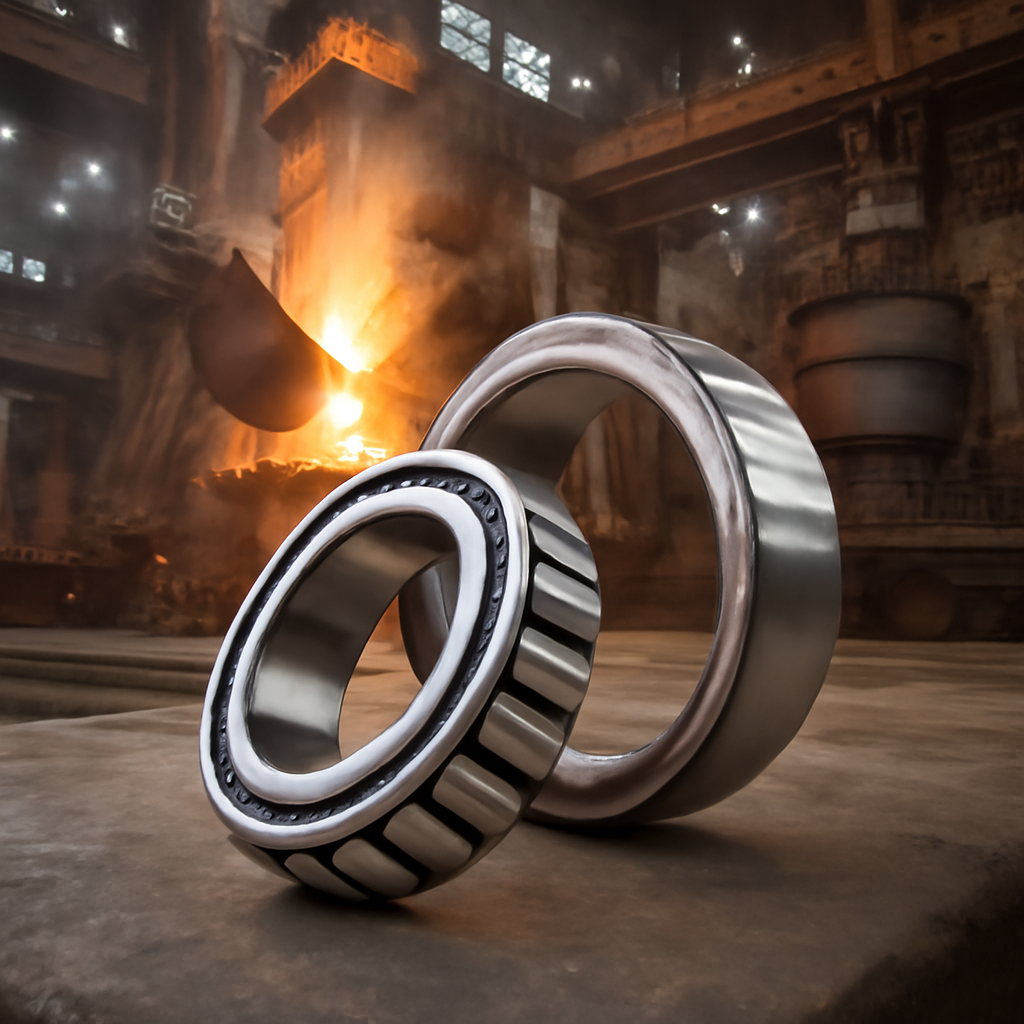
Henry Timken patented the tapered roller bearing in 1898, building a company on a single insight: tilted rollers between conical raceways could carry combined radial and axial loads far better than any ball bearing of the time. More than a century later, the TIMKEN name still dominates heavy-duty applications where bearings must survive shock loads, large temperature swings, and continuous heavy duty.
Why tapered rollers excel in heavy industry
- Combined load handling: the tapered geometry lets a single bearing carry both radial and significant axial load. A pair of tapered roller bearings in an opposed configuration carries axial load in both directions — the standard arrangement on most wheel hubs and gearbox shafts.
- High load capacity: line contact between rollers and raceways gives far higher load capacity per envelope size than ball bearings.
- Adjustable preload: the axial position of the inner ring can be adjusted to set a specific internal clearance or preload, optimising the bearing for the application.
Key TIMKEN product families
Standard tapered roller bearings
The catalogue covers metric (DIN 720) and imperial (ABMA) ranges, single-row, double-row and four-row configurations. The four-row is the workhorse of rolling mills and heavy machinery.
SPEXX tapered roller bearings
An enhanced fatigue life product line using improved steel cleanliness and refined surface finish. SPEXX bearings carry an L10 life rating up to 4x that of standard bearings in the same envelope.
Sealed and pre-lubricated tapered units
For aftermarket truck wheel ends, off-highway equipment, and rail applications, sealed pre-lubricated units eliminate the need for field re-greasing and dramatically reduce contamination ingress.
Where TIMKEN is the natural specification
- Heavy-truck and trailer wheel ends.
- Off-highway construction equipment (excavator slewing rings, axle hubs).
- Mining gearboxes and crusher mainshafts.
- Steel rolling mills (four-row tapered configurations).
- Railway axle boxes.
- Wind turbine pitch and yaw drives.
Selection guidance for tapered bearing pairs
- Determine whether you need O arrangement (face-to-face) or X arrangement (back-to-back). O is more tolerant of misalignment; X gives higher stiffness against tilting moments.
- Set the preload or clearance per the manufacturer’s spec — most tapered failures trace back to incorrect preload during assembly.
- Match the lubrication regime — high-temperature service requires synthetic-base grease or oil circulation.
- For sealed units, verify the temperature rating of the lifetime fill grease against the actual operating temperature.
Cross-reference notes
TIMKEN tapered roller bearings cross-reference cleanly with SKF, FAG, NTN, and Koyo equivalents on standard sizes. For four-row and engineering-class bearings, application engineering should be consulted — proprietary geometry details can differ in ways that matter for stiffness and service life.
TIMKEN railway and rolling mill applications in depth
Railway axle bearings carry particular operational and regulatory burden. The bearing must operate continuously for years, survive shock loading from track conditions, tolerate temperature extremes, and remain serviceable through standard depot maintenance procedures. TIMKEN’s railway range is engineered specifically for these conditions and is the established choice across European, North American, and Asian railway operators.
Rolling mill applications use four-row tapered roller bearings in very large sizes — back-up roll bearings on hot strip mills can exceed 1 metre in bore diameter. TIMKEN’s heavy industrial range covers these applications with proven service life data accumulated across decades of operation. The aftermarket for rolling mill bearings is a specialised segment served by a small number of suppliers; TIMKEN is among the leaders.
The SPEXX programme and X-life equivalent positioning
TIMKEN SPEXX bearings deliver enhanced fatigue life through refined raceway geometry, optimised material specification, and tighter manufacturing tolerances. The concept is analogous to FAG X-life and SKF Explorer — incremental improvement over standard catalogue bearings that pays back through extended service life on demanding applications. SPEXX bearings carry 10-15% price premium over standard equivalents; the operational economics favour SPEXX on most heavy-duty applications.
TIMKEN’s North American heritage and global footprint
TIMKEN’s headquarters in Canton, Ohio, USA, anchor a global manufacturing and engineering footprint. The North American heritage matters for specific applications: tapered roller bearings for North American truck wheel ends are TIMKEN’s traditional core market and remain dominant. The global expansion through acquisitions and capacity investment has broadened the portfolio while preserving the heavy-industrial specialisation.
The TIMKEN aftermarket service network
TIMKEN operates an extensive aftermarket service network supporting tapered roller bearing applications. The network includes authorised distribution, service centres for bearing maintenance and rebuilding (for very large heavy-industrial bearings), and engineering support for replacement specification. For heavy industrial customers, the service network is itself a strategic asset that reduces operational risk on critical equipment.
European TIMKEN aftermarket distribution covers major industrial markets. For heavy-duty applications (mining, mills, off-highway, railway), the service network includes specialty distributors with deep heavy-industrial expertise. The combination of broad geographic coverage and specialty expertise positions TIMKEN well in the heavy-industrial segment specifically.
The TIMKEN-SKF competitive dynamic
TIMKEN and SKF compete head-to-head across the tapered roller bearing range. Each has natural application territory where its specific strengths align: TIMKEN dominant in truck wheel ends and heavy industrial four-row; SKF dominant in European integrated industrial reliability programmes and wind energy. For European procurement teams, both brands are reasonable defaults with the choice driven by specific application strengths.
The 2026 competitive dynamic is shaped by SKF’s restructuring (Automotive spin-off, SIS focus) and TIMKEN’s continued independent strategic direction. Both companies invest in product development and capacity. The next 18 months will see continued strong competition that benefits customers through pricing discipline and product innovation.
The legacy of Henry Timken and the tapered roller bearing
Henry Timken’s 1898 patent for the tapered roller bearing was one of the foundational inventions of modern mechanical engineering. The geometric insight — tilted rollers between conical raceways that distribute combined radial and axial loads efficiently — solved problems that ball bearings of the era could not address. More than a century later, the geometric principle remains unchanged; only the materials, manufacturing, and integration have evolved.
For aerospace, automotive, and heavy industrial applications worldwide, the tapered roller bearing remains the bearing of choice for combined-load positions. The TIMKEN heritage is the brand most associated with this bearing type — a competitive asset that survives across industry generations.
What is changing in TIMKEN 2026 product roadmap
TIMKEN’s 2026 product roadmap includes continued investment in SPEXX enhanced fatigue life range expansion, broader sealed wheel hub unit availability, and condition monitoring integration on selected heavy-industrial bearing positions. The smart bearing transition is progressing on heavy-industrial applications where the operational economics justify the integration cost.
The 2026 European market environment
The European bearing market in 2026 reflects the broader industrial recovery trajectory combined with specific bearing-industry consolidation dynamics. EU industrial production indicators have improved through the first half; raw material cost pressure continues; trade defence measures (CBAM, steel safeguards, anti-dumping investigations) add regulatory complexity to import economics; and the supplier landscape continues to consolidate around fewer larger entities.
For European distributors and OEMs, the practical implications converge on three priorities: building substitution agility across suppliers to navigate the consolidation, locking pricing on framework agreements while leverage exists, and investing in condition monitoring capability that delivers documented ROI within 6-18 months. The cumulative operational impact of these investments across years compounds meaningfully.
Strategic supplier relationships in the consolidation period
Beyond transactional procurement, the strategic supplier relationship delivers value during industry consolidation. Engineering consultation on new equipment designs, training programmes for maintenance teams, condition monitoring platform integration, smart bearing roadmap visibility, and access to emerging product information all flow from mature supplier relationships. Customers who build these relationships with one or two preferred manufacturers — while maintaining qualified alternatives for supply resilience — position themselves favourably for the post-consolidation industry structure.
Looking ahead through 2030
Through the rest of the decade, the bearing industry continues structural evolution. EV adoption acceleration, wind energy expansion, humanoid robotics commercialisation, smart bearing technology maturation, and continued M&A all contribute to the industry transformation. For European industrial customers, the procurement strategy needs to evolve in parallel: smart bearing qualification, condition monitoring platform selection, supplier substitution capability, and master data discipline all become competitive differentiators.
The 2026-2030 window is one of the most consequential in modern bearing industry history. Customers who actively engage with the developments — repositioning supplier strategy, qualifying new technology, locking framework agreements — capture the value of the transition. Defensive postures yield to engaged operators systematically; the strategic question for procurement leadership is not whether to act but how aggressively and how soon.
Practical takeaways for 2026 procurement
For European industrial procurement teams operating in 2026, the actionable takeaways are: build supplier substitution agility, lock framework pricing where leverage exists, invest in condition monitoring capability, and qualify smart bearings on critical applications. These four operational priorities compound across years of execution and position the organisation for the post-consolidation industry structure emerging by 2027-2028.
The 2026 reliability investment thesis
For European industrial customers in 2026, the broader reliability investment thesis is decisive. The combination of affordable IoT sensors (under $50 per node, an 85% cost reduction since 2019), mature AI analytics platforms, documented ROI cases (6-18 month payback in mid-size plants), and supplier ecosystem support makes condition monitoring deployment economically realistic for virtually any plant with critical rotating equipment. The cumulative effect across years of deployment is meaningful: 30-50% reduction in unplanned downtime, 15-25% reduction in maintenance labour, and extended equipment service life.
For procurement leadership specifically, the reliability investment changes the supplier relationship dynamic. Bearing supply becomes part of an integrated reliability conversation rather than a transactional component supply. Engineering services, condition monitoring platforms, training programmes, and roadmap visibility all flow from strategic supplier relationships. The companies building these relationships now position themselves for the post-2028 industry structure where smart bearings and integrated reliability solutions become standard rather than premium.
What the next 18 months will tell us
The next 18 months will clarify several major industry questions. NSK + NTN antitrust filings progress through Q3-Q4 2026 will reveal the regulatory burden and possible remedies. SKF Automotive spin-off mechanics will be confirmed, with implications for both the SKF industrial businesses and the new standalone automotive entity. Schaeffler Yinchuan capacity ramp will reach steady-state output, affecting standard catalogue lead times and pricing dynamics. EU industrial demand recovery will be tested through H2 2026 and into 2027.
For organisations operating in this environment, active engagement with these developments — through industry events, supplier conversations, and trade press monitoring — supports informed strategic decisions. The bearing industry in 2026-2027 is not on autopilot; the strategic decisions made during this period set competitive positioning for years to come.
Related guides on Eurobearing
- Applications of TIMKEN Bearings in Heavy Industry
- TIMKEN Bearings: Quality and Reliability
- Guide to TIMKEN Bearing Maintenance
Need help choosing the right bearing for your application? Our technical team can support you with selection, cross-references, and lead-time information.