
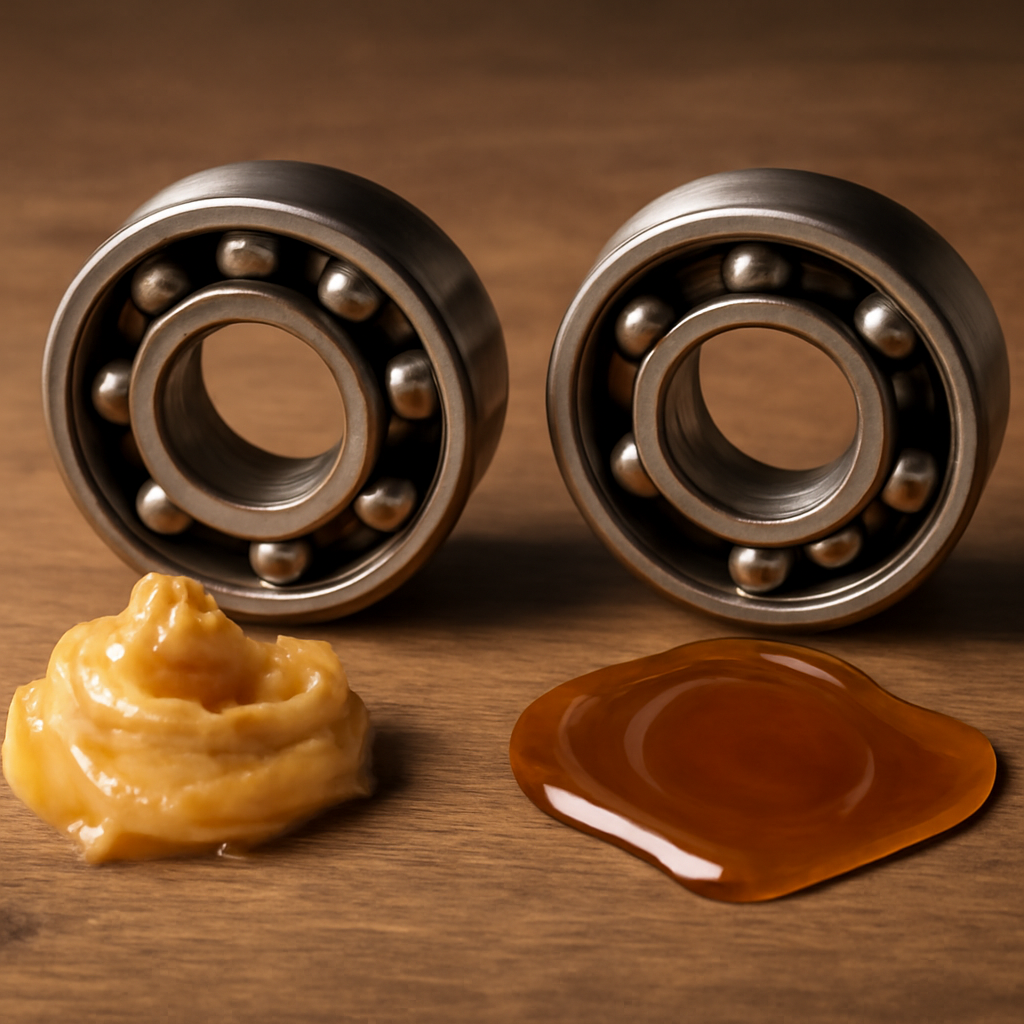
The choice between grease and oil lubrication is one of the most consequential decisions in a bearing’s life. It affects friction, heat dissipation, sealing complexity, maintenance interval, and cost. Many maintenance teams default to whatever the original equipment came with, which is fine in most cases — but understanding the trade-offs lets you optimise when the application changes or when the standard choice is failing.
The five factors that determine the choice
1. Speed
Speed is the dominant factor. Grease works well up to a speed factor (n × dm) of roughly 500,000 (n in rpm, dm in mm). Above that, the grease cannot consistently re-flow to replenish the contact zone, and oil becomes the better choice. Very-high-speed spindles (n × dm > 1,000,000) almost always run on oil mist or oil-air lubrication.
2. Operating temperature
Most general-purpose greases are happy from -20 °C to about 120 °C continuously. Above 120 °C the grease oxidises faster, drying out and forming hard residues. Above 150 °C, only specialty high-temperature greases (polyurea, fluorinated) work; above 200 °C, oil circulation with cooling is the only reliable answer.
3. Heat dissipation requirement
Oil circulation systems dissipate heat. Grease does not — it stays in place and the bearing must dissipate its own heat through the housing. If the application generates substantial heat (heavily loaded gearboxes, high-speed motors), oil circulation is often necessary purely for cooling.
4. Sealing complexity
Grease is much easier to retain in a housing — a simple lip seal does the job. Oil requires either a more sophisticated sealing arrangement or a return path back to the sump. For machinery where seal complexity is a problem (rotating shafts that pass through walls, vertical orientations), grease wins on simplicity.
5. Maintenance interval
Grease can run for very long intervals without intervention — sealed-for-life bearings on small motors are the extreme case. Oil systems require sampling, filtration, and periodic replacement. For unattended or hard-to-access locations, grease is logistically simpler.
Quick decision rules
- Motors below 30 kW, normal duty → grease, almost always.
- Gearboxes → oil, almost always (heat dissipation).
- Pumps with moderate speed → grease for general-purpose, oil for high-temperature service.
- Fans and blowers → grease.
- High-precision spindles → oil (oil mist or oil-air).
- Wind turbine main bearings → grease (re-lubricated at scheduled intervals).
The middle ground: grease re-lubrication systems
For applications that are borderline between grease and oil, automatic lubrication systems that dispense small grease quantities at scheduled intervals capture the simplicity of grease with the controlled freshness of oil systems. The economics have improved significantly in recent years.
Common mistakes
- Mixing incompatible grease thickeners during re-lubrication.
- Over-greasing — filling more than 50% of bearing free space causes overheating.
- Using a high-temperature grease at low temperatures, where its base oil viscosity is too high for proper film formation.
- Switching from grease to oil without re-engineering the seals.
Hybrid lubrication strategies for borderline applications
Some applications fall between the obvious grease and oil regimes. Examples: medium-speed gearboxes with moderate temperature, vertical-shaft pumps, and high-cycle automation with limited maintenance access. For these applications, hybrid strategies often deliver the best operational outcome:
- Grease with automatic re-lubrication: combines grease simplicity with controlled freshness via single-point dispensers or central lubrication systems.
- Oil mist or oil-air on a grease-lubricated bearing position: rare but used in specific applications combining low maintenance burden with controlled cooling.
- Sealed-for-life bearings with extended re-lubrication intervals: minimising maintenance access requirement while accepting eventual replacement-based renewal.
The selection between these hybrid approaches depends on application specifics: maintenance access, criticality, OEM recommendation, and historical performance data. For complex applications, engaging the bearing OEM application engineering team is usually worthwhile.
The grease vs oil cost comparison over equipment life
Beyond the immediate operational considerations, the cost comparison over equipment life sometimes shifts the decision in unexpected directions. Oil circulation systems carry installation cost, ongoing maintenance burden (filters, coolers, sampling), and the inventory of replacement oil. Grease systems carry simpler installation, lower maintenance burden, and the inventory of replacement grease.
For equipment with 20+ year design life, the cumulative oil system cost can exceed the cumulative grease system cost. Conversely, for equipment requiring heat dissipation that grease cannot provide, oil is the only viable choice regardless of cost. The decision is application-specific and benefits from total-cost-of-ownership analysis at the design stage.
The viscosity-speed-load triangle
Beyond the grease vs oil choice, the base oil viscosity selection within the chosen lubricant family follows a triangle of speed, load, and temperature. The relationships:
- Higher speed → lower viscosity needed to maintain hydrodynamic film without excessive friction loss.
- Higher load → higher viscosity needed to maintain film thickness under pressure.
- Higher temperature → higher viscosity needed at the operating temperature (viscosity drops with temperature, so the cold viscosity must be higher to deliver target viscosity at temperature).
For practical specification, the bearing manufacturer’s lubrication calculators incorporate these relationships. ISO VG grades from 32 (light) to 460 (heavy) cover the typical industrial range. Verify against the application speed, load, and temperature; do not default to whatever was on the previous service order.
The EP additive question
Extreme Pressure (EP) additives provide micropitting protection under heavy load. They are essential for some applications (heavily loaded gearboxes, shock-loaded mining equipment) and counterproductive for others (copper-containing components, where EP can cause corrosion). The selection depends on metallurgy of all components in contact with the lubricant.
For most ball bearing applications, EP additives are not necessary and may be counterproductive. For roller bearings under heavy load, EP additives are usually beneficial. For gearbox bearings, EP is standard. Always check the lubricant compatibility table for the specific application.
The lubrication chain of custody
Beyond selection and quantity, the operational discipline of lubrication delivery matters as much as the technical specification. Clean grease tools (dedicated per grease type, with cleaned grease nipples), sealed storage containers, clear labelling, and documented chain of custody from delivery to application prevent the most common lubrication failures.
For mid-size industrial plants, establishing this discipline is a 6-12 month maintenance culture project. The cumulative effect across years of operation is meaningful: lubrication-related bearing failures decline, lubrication quality complaints decline, and equipment reliability improves measurably.
What changes when condition monitoring is integrated
Condition monitoring data integrated with lubrication strategy enables condition-based lubrication intervention rather than schedule-based. Vibration trend changes can indicate lubrication degradation before visible symptoms appear; temperature trends can indicate insufficient lubrication or over-greasing. For maintenance organisations with integrated condition monitoring, the lubrication schedule shifts from calendar to data-driven.
The 2026 European market environment
The European bearing market in 2026 reflects the broader industrial recovery trajectory combined with specific bearing-industry consolidation dynamics. EU industrial production indicators have improved through the first half; raw material cost pressure continues; trade defence measures (CBAM, steel safeguards, anti-dumping investigations) add regulatory complexity to import economics; and the supplier landscape continues to consolidate around fewer larger entities.
For European distributors and OEMs, the practical implications converge on three priorities: building substitution agility across suppliers to navigate the consolidation, locking pricing on framework agreements while leverage exists, and investing in condition monitoring capability that delivers documented ROI within 6-18 months. The cumulative operational impact of these investments across years compounds meaningfully.
Strategic supplier relationships in the consolidation period
Beyond transactional procurement, the strategic supplier relationship delivers value during industry consolidation. Engineering consultation on new equipment designs, training programmes for maintenance teams, condition monitoring platform integration, smart bearing roadmap visibility, and access to emerging product information all flow from mature supplier relationships. Customers who build these relationships with one or two preferred manufacturers — while maintaining qualified alternatives for supply resilience — position themselves favourably for the post-consolidation industry structure.
Looking ahead through 2030
Through the rest of the decade, the bearing industry continues structural evolution. EV adoption acceleration, wind energy expansion, humanoid robotics commercialisation, smart bearing technology maturation, and continued M&A all contribute to the industry transformation. For European industrial customers, the procurement strategy needs to evolve in parallel: smart bearing qualification, condition monitoring platform selection, supplier substitution capability, and master data discipline all become competitive differentiators.
The 2026-2030 window is one of the most consequential in modern bearing industry history. Customers who actively engage with the developments — repositioning supplier strategy, qualifying new technology, locking framework agreements — capture the value of the transition. Defensive postures yield to engaged operators systematically; the strategic question for procurement leadership is not whether to act but how aggressively and how soon.
Practical takeaways for 2026 procurement
For European industrial procurement teams operating in 2026, the actionable takeaways are: build supplier substitution agility, lock framework pricing where leverage exists, invest in condition monitoring capability, and qualify smart bearings on critical applications. These four operational priorities compound across years of execution and position the organisation for the post-consolidation industry structure emerging by 2027-2028.
Related guides on Eurobearing
- Guide to Choosing Lubricants for Bearings
- SKF Bearing Maintenance and Lubrication
- Bearing Maintenance: How to Keep Performance High
Need help choosing the right bearing for your application? Our technical team can support you with selection, cross-references, and lead-time information.