
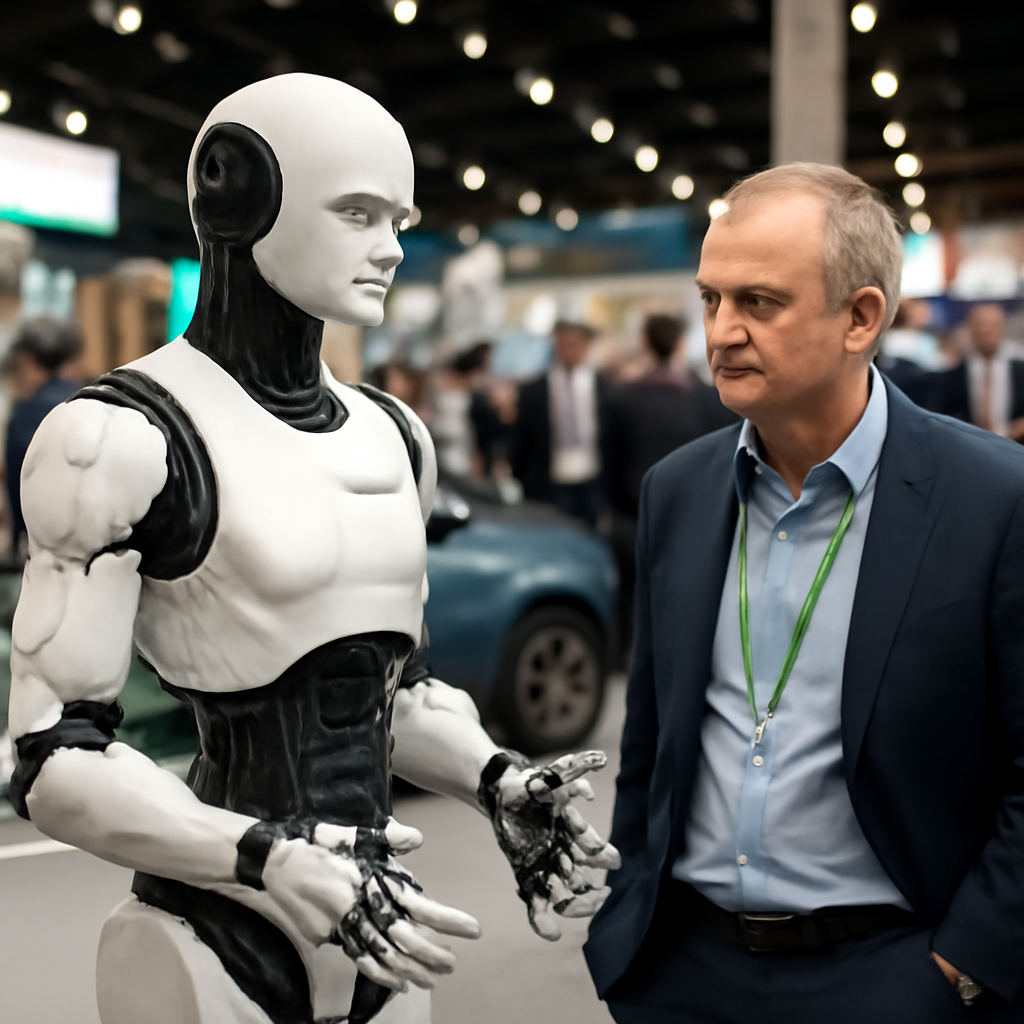
Schaeffler’s CES 2026 appearance in Las Vegas was the most explicit positioning statement the company has made on humanoid robotics. The headline product: a planetary gear actuator developed specifically for humanoid robot joints, enabling smooth back-driving capability and high precision in a compact envelope. For an industry that traces its identity to rolling bearings for industrial machinery, the move is meaningful.
Why humanoid robotics matters now
Forecasts for humanoid robot shipments diverge widely — but every credible forecast agrees on the direction: rapid growth from a small 2025 base, driven by a small number of high-volume platforms (Tesla’s Optimus, Figure 02, Apptronik Apollo, Agility Robotics Digit, several Chinese platforms). Each humanoid contains roughly 30-50 actuated joints, and each joint contains a gear, a bearing pack, sensors, and the control electronics. The bill-of-materials per humanoid is dominated by motion components.
What makes a humanoid actuator different
Industrial robot actuators are large, stiff, and built for speed and repeatability. Humanoid actuators have a different optimisation curve:
- Back-driveability: the joint must be able to comply with external force. This rules out most worm-gear or high-ratio strain-wave designs typical of industrial cobots.
- Power density: a humanoid joint must deliver high peak torque from a very small envelope; specific gravity matters.
- Series elasticity in some designs: a deliberate compliance element to handle impact safely.
- Sensorisation: torque sensing at the joint is standard.
Schaeffler’s planetary actuator addresses back-driveability directly: planetary gearing has inherently lower friction than strain-wave reducers, allowing the motor to be back-driven by external load without binding.
The bearing inside the humanoid joint
Beneath the actuator-level engineering, humanoid joints rely on miniature crossed-roller bearings, deep groove ball bearings, and thin-section bearings. These are not high-volume commodity parts; they are specified, qualified, and supplied under long-term agreements. The first vendors to qualify on the major humanoid platforms will capture decade-long supply positions.
What this means for the broader bearing industry
- The humanoid robotics segment is still small in revenue but strategically significant. The major manufacturers (Schaeffler, SKF, NSK, Harmonic Drive) are positioning early.
- Adjacent specialties — precision angular contact bearings, miniature crossed-roller, thin-section, and slewing rings for the hip and shoulder — will see increased R&D investment.
- Industrial cobots remain by far the larger market in 2026; humanoids are a multi-year build-up.
The Schaeffler signal
Schaeffler is communicating that it intends to be a system-level supplier in the next robotics wave, not just a component vendor. The planetary actuator is a tangible product, not a slide. CES 2026 is the second consecutive year Schaeffler has used the show to communicate its non-automotive ambitions.
Related guides on Eurobearing
- Robotics and Automation: The Role of Bearings
- THK Systems Applications in Robotics
- How AI Is Revolutionising Mechanical Transmission Monitoring
Need help choosing the right bearing for your application? Our technical team can support you with selection, cross-references, and lead-time information.