
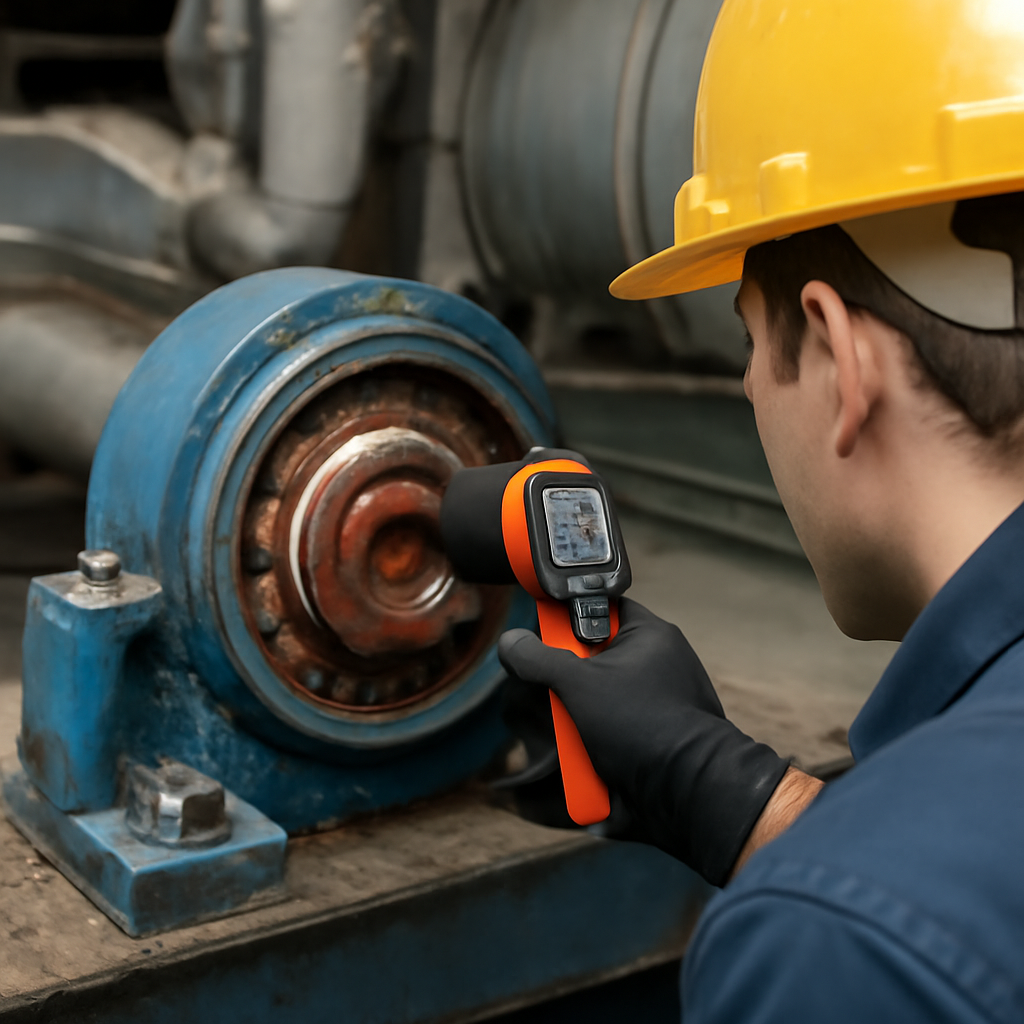
A bearing running hot is rarely a mystery. There are six common causes, each leaves a recognisable fingerprint, and a skilled technician can identify the right one in about fifteen minutes. Acting at the overheating stage is the difference between a €50 grease change and a €5,000 unplanned breakdown. This is the practical playbook for diagnosis and remedy, with the 2026 enablers (IoT temperature monitoring, AI-assisted diagnostics) integrated where they pay off.
1. What “too hot” actually means
A bearing operating at 30-40 °C above ambient is normal under steady-state load. Above 50 °C above ambient, start to investigate. Above 70 °C above ambient, intervene. Sustained operation above 100 °C bulk grease temperature accelerates lubricant degradation dramatically — grease that should last 12 months degrades in weeks.
The single most useful number is the baseline temperature trend: measure the housing temperature on a healthy bearing under normal load and log it. Any sustained 10 °C rise above the baseline is the actionable signal — regardless of absolute value.
2. The six common causes
Cause 1 — Over-greasing
The most frequent culprit by a wide margin. A housing filled with too much grease forces the rolling elements to churn through it continuously, generating heat that has nowhere to go.
- Symptom: temperature climbs within minutes of re-greasing, then stabilises high.
- Remedy: open the housing drain (or remove the grease purge plug), run the machine for 15-30 minutes to let excess grease purge out.
- Prevention: target 30-50% bearing free space, not 100%. Use a grease gun with calibrated stroke rather than “until it comes out the other side”.
Cause 2 — Insufficient lubrication
The mirror image. Either the grease has drained out, the seal has failed and grease has escaped, or the re-lubrication interval is too long.
- Symptom: heat plus rising noise plus a vibration trend that worsens.
- Remedy: re-grease per spec, monitor for return to normal temperature. If noise persists after re-greasing, the bearing is likely already damaged — plan a replacement.
- Prevention: follow manufacturer’s re-lubrication calculator (SKF DialSet, Schaeffler GreaseApp).
Cause 3 — Misalignment
Shaft misalignment generates parasitic axial and radial loads on the bearing, which appear as heat.
- Symptom: heat is uneven — one end of the housing hotter than the other by 10 °C or more. Coupling shows accelerated wear. Axial vibration is elevated.
- Remedy: laser or dial alignment to bring the shaft back into tolerance. Re-check thermal trend after alignment to confirm.
- Prevention: include alignment in commissioning protocol, re-verify after any disassembly or base movement.
Cause 4 — Excessive load
The bearing is undersized for the actual duty, or the application has changed since installation.
- Symptom: heat scales with load; vibration spectrum shows no defect frequencies (the bearing is structurally healthy, just overworked).
- Remedy: upgrade to a higher load class, or reduce duty. Verify the L10 calculated life of the new selection against the application duty profile.
Cause 5 — Wrong grease
Base oil viscosity too low for the speed/load combination, or thickener that breaks down at the operating temperature.
- Symptom: rapid lubricant degradation, dark or burned grease at next inspection, distinctive acidic odour.
- Remedy: purge and switch to a grease with appropriate base oil viscosity and thickener for the operating envelope.
- Prevention: cross-check grease selection against speed, temperature and load using manufacturer calculators.
Cause 6 — Internal bearing damage
If raceway spalling, cage damage or roller damage has started, friction and heat rise.
- Symptom: vibration spectrum shows defect frequencies (BPFO, BPFI, BSF, FTF); audible noise; heat trend rising.
- Remedy: replace the bearing. Do not try to “save” it — the failure trajectory is now committed.
3. The fast diagnostic protocol
- Measure housing temperature with an IR thermometer; map the gradient across the housing.
- Check vibration overall RMS; if elevated, capture an FFT and identify defect frequencies.
- Take a grease sample if accessible; visual colour and consistency reveal lubricant condition.
- Verify shaft alignment if the machine has been running long enough to be hot.
- Cross-reference findings against the six causes above.
4. The 2026 advantage: continuous monitoring
With IoT vibration nodes now under $50 per unit (an 85% cost reduction since 2019), continuous housing temperature and vibration monitoring is realistic for any plant with critical rotating equipment. The new generation captures overall RMS, peak acceleration, envelope demodulation and skin temperature — uploading data every 15 minutes or on alarm. Combined with cloud-based trend analysis and AI alerts, the time between problem onset and intervention shrinks from days to minutes.
5. Prevention at the design stage
- Specify the bearing for the actual duty profile, not the nameplate.
- Plan the lubrication system at design time; retrofitting auto-lubrication is more expensive than building it in.
- Design the housing for accessible re-greasing and drain access.
- Include a temperature sensor port if the application is critical.
- Document the baseline temperature and vibration immediately after commissioning.
6. When to call in a specialist
If you cannot identify the cause from the six-cause table, or if the temperature trend keeps rising after intervention, get a vibration analyst in to capture and interpret an FFT. The cost of a half-day specialist visit is far below the cost of a wrong root-cause call leading to an unplanned breakdown.
Conclusion
Bearing overheating is one of the most diagnosable maintenance issues. The six common causes account for the vast majority of field cases, and each leaves a recognisable signature. Combine the diagnostic protocol with continuous condition monitoring (now affordable for any plant) and you eliminate the most expensive class of bearing failures — the unexpected, unplanned, full-stop kind.
The H2 2026 market context
Looking ahead to H2 2026, the European bearing market enters the period with several specific dynamics worth tracking. Industrial production indicators point toward moderate recovery; raw material costs remain elevated but stable; supply chain rebalancing continues as Schaeffler Yinchuan capacity reaches steady-state output. The NSK + NTN antitrust filings expected in Q3 2026 will be the most-watched ongoing story; SKF Automotive spin-off mechanics provide additional industry restructuring context.
For distributors and end-users operating in this environment, the practical posture is active engagement with supplier strategic developments combined with disciplined operational execution. Framework agreement negotiations during H2 2026 should incorporate the consolidation context; inventory positioning should reflect the lead-time normalisation; condition monitoring deployments should accelerate while implementation capacity is available. The window for proactive positioning ahead of the 2027 industry structure is narrow but real.
The application engineering depth
Beyond catalogue selection, application engineering for this product category benefits from manufacturer engineering consultation. Specialised duty profiles, non-standard environments, and integrated multi-component solutions all benefit from manufacturer engineering involvement during the design phase. The investment pays back through extended service life and reduced operational risk across the equipment lifecycle.
The 2026 European market context
The European bearing market in 2026 enters a period of structural change. Industry consolidation (NSK + NTN, SKF Automotive spin-off), capacity expansions (Schaeffler Yinchuan), regulatory evolution (REACH, CBAM, trade defence), and end-market shifts (EV, wind, robotics) all reshape the operational environment. For procurement teams, the strategic posture is active engagement rather than passive reaction.
Supplier relationships and substitution capability
Beyond product specification, the supplier relationship and substitution capability matter as much as the bearing choice. Multi-supplier qualification, cross-reference database maintenance, and engineering equivalence documentation deliver procurement leverage and supply resilience. For European industrial customers, this capability investment is one of the highest-ROI strategic decisions available in 2026.
The 2026 reliability investment thesis
For European industrial customers in 2026, the broader reliability investment thesis is decisive. The combination of affordable IoT sensors (under $50 per node, an 85% cost reduction since 2019), mature AI analytics platforms, documented ROI cases (6-18 month payback in mid-size plants), and supplier ecosystem support makes condition monitoring deployment economically realistic for virtually any plant with critical rotating equipment. The cumulative effect across years of deployment is meaningful: 30-50% reduction in unplanned downtime, 15-25% reduction in maintenance labour, and extended equipment service life.
For procurement leadership specifically, the reliability investment changes the supplier relationship dynamic. Bearing supply becomes part of an integrated reliability conversation rather than a transactional component supply. Engineering services, condition monitoring platforms, training programmes, and roadmap visibility all flow from strategic supplier relationships. The companies building these relationships now position themselves for the post-2028 industry structure where smart bearings and integrated reliability solutions become standard rather than premium.
What the next 18 months will tell us
The next 18 months will clarify several major industry questions. NSK + NTN antitrust filings progress through Q3-Q4 2026 will reveal the regulatory burden and possible remedies. SKF Automotive spin-off mechanics will be confirmed, with implications for both the SKF industrial businesses and the new standalone automotive entity. Schaeffler Yinchuan capacity ramp will reach steady-state output, affecting standard catalogue lead times and pricing dynamics. EU industrial demand recovery will be tested through H2 2026 and into 2027.
For organisations operating in this environment, active engagement with these developments — through industry events, supplier conversations, and trade press monitoring — supports informed strategic decisions. The bearing industry in 2026-2027 is not on autopilot; the strategic decisions made during this period set competitive positioning for years to come.
Related guides on Eurobearing
- Reducing Machine Downtime
- How to Detect Bearing Wear by Vibration
- Guide to Choosing Lubricants for Bearings
- Bearing Damage: Misalignment Diagnosis
- IoT Vibration Sensors Under $50
Need help with bearing selection or maintenance? Our technical team supports you with cross-references, selection and lead-times.