
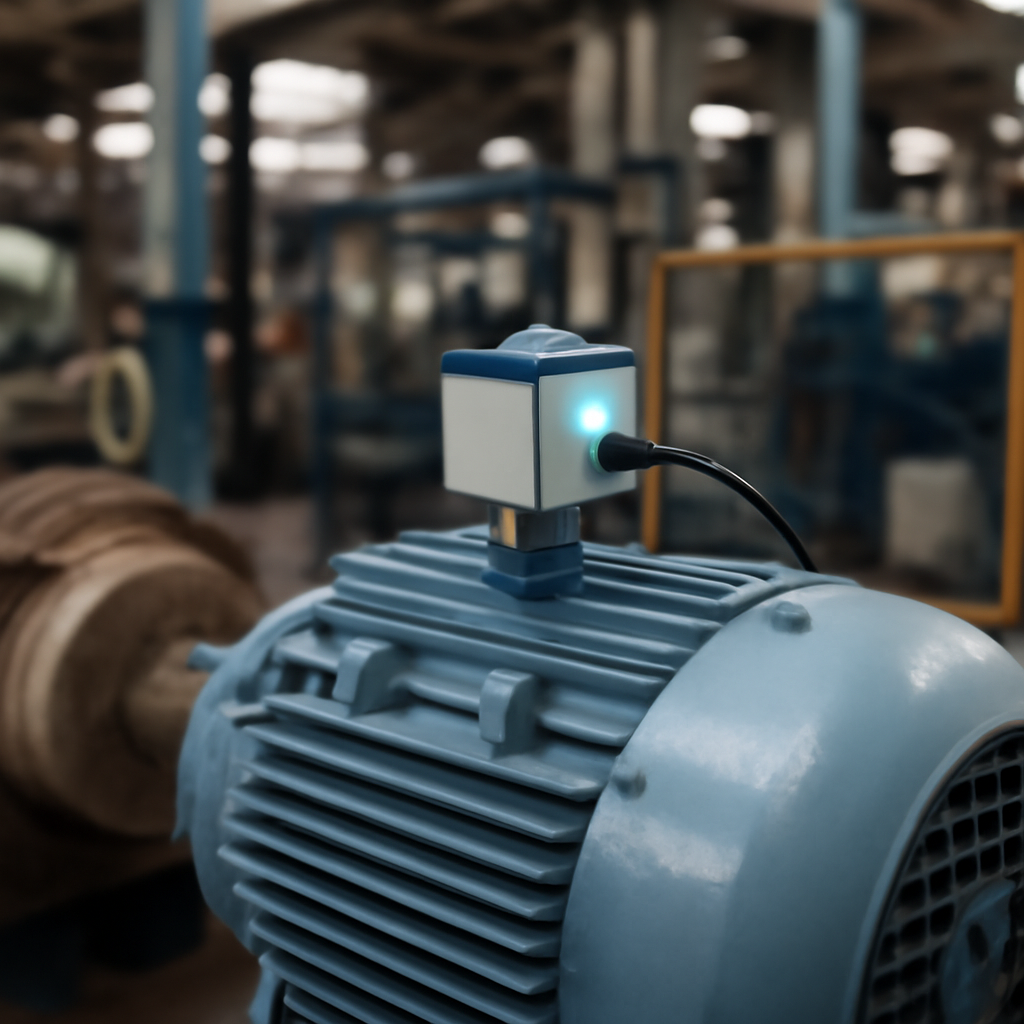
The math of industrial condition monitoring has changed. In 2019 an industrial-grade wireless vibration node cost over $600, and a deployment of a few hundred nodes was a six-figure capital project that needed a CFO-grade business case. In 2026 the same nodes are under $50, the gateways and cloud services are a small fraction of the historical cost, and a plant-wide deployment is sometimes funded out of operating budget. This is the single most consequential cost reduction industrial maintenance has seen in a decade.
Where the 85% cost reduction came from
- MEMS accelerometer chips that previously cost $20-30 are now under $2.
- Low-power wireless radios (LoRa, BLE 5, sub-GHz proprietary stacks) at scale.
- Cellular and Wi-Fi gateways that connect 100+ nodes per gateway.
- SaaS pricing for the cloud platform, instead of perpetual licences with maintenance contracts.
What you can actually do with $50/node sensors
The new generation captures the same fundamental measurements that mattered ten years ago: overall RMS vibration, peak acceleration, envelope demodulation for bearing defect frequencies, and skin temperature. The data is aggregated to the cloud at low duty cycle (typically once every 15 minutes or on alarm). For most mid-size industrial assets, that is enough.
Where these sensors fall short
- High-frequency stress wave detection (the very earliest stage of bearing degradation) usually requires a higher-spec sensor.
- True FFT analysis at sub-Hertz resolution is still a higher-end feature.
- Critical, safety-related applications still warrant tethered, continuous-streaming sensors with sub-second latency.
A realistic deployment for a mid-size plant
- Start with the 20 highest-criticality rotating assets: motors, gearboxes, pumps, fans, compressors that would stop production if they failed.
- One node on each bearing position (typically 2 per asset = 40 nodes).
- One gateway per 100 nodes; cellular backhaul.
- SaaS platform for alerting + trending.
- Total capex: under $5,000. SaaS cost: $2-5/node/month.
Where the technology is heading next
The 2026-2027 wave is agentic AI on top of the sensor data: systems that do not just alert on threshold crossings, but autonomously plan and execute multi-step responses — issuing work orders, ordering spare parts, generating root-cause analyses. Predictive maintenance is becoming prescriptive.
The buyer’s checklist
- Verify the bandwidth and sampling rate against your machinery (a 1 kHz sampling rate is fine for slow-speed assets, you need 10+ kHz for high-speed spindles).
- Check the battery life claim under realistic duty cycle, not the marketing claim.
- Choose a platform with an open API — vendor lock-in on the SaaS layer can be expensive.
- Make sure the alert logic is configurable, not just black-box.
The platform integration ecosystem
Modern IoT vibration sensors increasingly integrate with cloud platforms, CMMS systems, ERP integrations, and AI analytics platforms. The integration layer often determines total operational value as much as the sensor itself. The best sensors paired with poor platform integration deliver limited value; modest sensors paired with strong integration capability deliver substantial operational benefit.
Vendor selection for plant-wide deployment should consider the full stack: sensor capability, gateway architecture, cloud platform features, integration capability, and ongoing software roadmap. The decision is multi-year — switching platforms after deployment is expensive and disruptive.
The mid-size plant deployment math
For a typical European mid-size industrial plant (50-200 critical assets), the IoT vibration sensor deployment economics in 2026 are compelling: €15,000-30,000 first-year capex covering sensors, gateways, integration; €10,000-20,000 annual recurring for cloud platform and ongoing services. Total 5-year cost: €55,000-130,000. Documented savings: 30-50% reduction in unplanned downtime, typically valued at €100,000-500,000 annually for a mid-size plant.
The payback period is typically 6-18 months. The cumulative 5-year ROI is substantial. The capital justification is straightforward; the organisational change to operate alongside the technology is the actual implementation challenge.
What the AI analytics layer actually contributes
The AI analytics layer is where the recent step-change in capability has happened. Pattern recognition trained on labelled bearing failure data catches subtler patterns than human analysts. Anomaly detection in unsupervised mode flags signals diverging from healthy baseline. Severity classification assigns Stage 1-5 ratings consistently. Severity-based work order prioritisation routes maintenance attention efficiently.
For maintenance organisations adopting AI-based condition monitoring, the AI does not replace skilled vibration analysts — it elevates them. The analyst’s time concentrates on the cases AI flags as ambiguous, the novel failure modes, and the cross-system root-cause investigations. Productivity per analyst rises substantially.
The 2026 supplier landscape and procurement strategy
The European industrial bearing supplier landscape continues to consolidate through 2026 with the NSK + NTN integration, SKF Automotive spin-off, and Schaeffler capacity expansion all reshaping the competitive dynamics. For procurement teams, the practical implications are: multi-supplier qualification becomes more important, framework agreement provisions need explicit substitution clauses, and supplier relationships shift toward longer-term partnerships rather than transactional cost optimisation.
The substitution agility — the ability to switch between supplier sources without operational disruption — is the most valuable procurement capability through the consolidation period. Building the cross-reference database, qualifying multiple sources on critical SKUs, and documenting engineering equivalence delivers protection against supplier strategic missteps and competitive pricing leverage during normal operation.
Total cost of ownership across the equipment lifecycle
Beyond purchase price, total cost of ownership across the equipment lifecycle frequently shifts procurement decisions toward higher-specification bearings. The cumulative cost components: acquisition, installation, lubrication and maintenance, downtime cost during failures, replacement, and end-of-life disposal. For applications with significant downtime cost or extended service intervals between maintenance windows, premium specifications routinely pay back across the lifecycle.
For European industrial customers operating under tight maintenance budgets, the TCO analysis sometimes reveals that the “cheaper” bearing produces higher total cost. The discipline of working through the lifecycle math — rather than defaulting to acquisition price comparisons — is one of the highest-leverage procurement capability investments available.
Smart bearing integration roadmap
The next generation of industrial bearings integrates sensors for predictive maintenance: temperature, vibration, sometimes current monitoring built into the bearing itself. Major manufacturers (SKF, Schaeffler, NSK, NTN) are all developing smart bearing platforms with progressive commercial rollout through 2027. For specifying engineers and procurement teams, the question is when to begin qualifying smart bearings on new equipment and how to integrate with existing condition monitoring infrastructure.
The smart bearing economics favour critical assets where the integrated sensor delivers more value than the price premium represents. For routine industrial bearing positions, standard products remain the right choice. The strategic decision is on critical assets where the smart bearing investment positions the customer for the post-2028 industry where smart bearings will be standard rather than premium.
The 5-year structural outlook
Looking through 2030, the structural drivers of bearing market evolution remain robust. EV adoption acceleration, wind energy capacity expansion, industrial robotics growth, linear motion market expansion, and smart bearing technology maturation all combine to drive sustained demand growth above the broader industrial GDP rate. The bearing market projection (from $151.8B in 2026 to $301B by 2033) reflects these structural drivers operating in parallel.
For distributors and OEMs operating in this environment, the strategic question is not whether the market grows but how to position to capture share of the growth. Investment in smart bearing capability, condition monitoring platforms, EV-specific product knowledge, and integrated reliability services positions the participant for the post-2028 industry structure.
Risk factors and scenario planning
Beyond the base case, scenario planning identifies the risk factors that could change the trajectory. Downside scenarios include: global recession affecting industrial production, supply chain disruption from geopolitical events, trade barrier escalation reshaping competitive economics, or technology adoption slower than forecasted. Upside scenarios include: accelerated EV adoption, faster humanoid robotics commercialisation, sustained wind capacity expansion above current forecasts.
For sound strategic planning, the appropriate posture is preparation for multiple scenarios with strategies that perform reasonably across scenarios rather than optimisation for any single scenario. Build supplier substitution agility, condition monitoring capability, and master data discipline — these pay back regardless of which scenario unfolds.
Regional dynamics and supply chain implications
The bearing market dynamics vary by region. Asia Pacific dominates volume; Europe leads premium positioning; North America benefits from tariff protection but faces smaller scale. The competitive interplay across regions affects pricing, technology adoption, and supplier strategic positioning. For European distributors and OEMs, navigating the regional dynamics — particularly the impact of US tariff regime and EU regulatory complexity — is increasingly part of strategic planning.
The investment thesis for industrial reliability
For European industrial customers, the broader investment thesis for reliability capability — smart bearings, condition monitoring, predictive maintenance — is decisive. The economic case is documented; the technology is mature; the implementation pathway is well-understood. The strategic question is the pace and depth of investment, not whether to invest.
The cumulative effect across years of investment is meaningful: 30-50% reduction in unplanned downtime, 15-25% reduction in maintenance labour, extended equipment life, and operational benefits across virtually every dimension. The reliability investment is the single highest-leverage operational improvement available to most industrial plants in 2026.
Related guides on Eurobearing
- Predictive Maintenance: How Sensors Help
- How to Detect Bearing Wear by Vibration
- Reducing Machine Downtime
Need help choosing the right bearing for your application? Our technical team can support you with selection, cross-references, and lead-time information.