
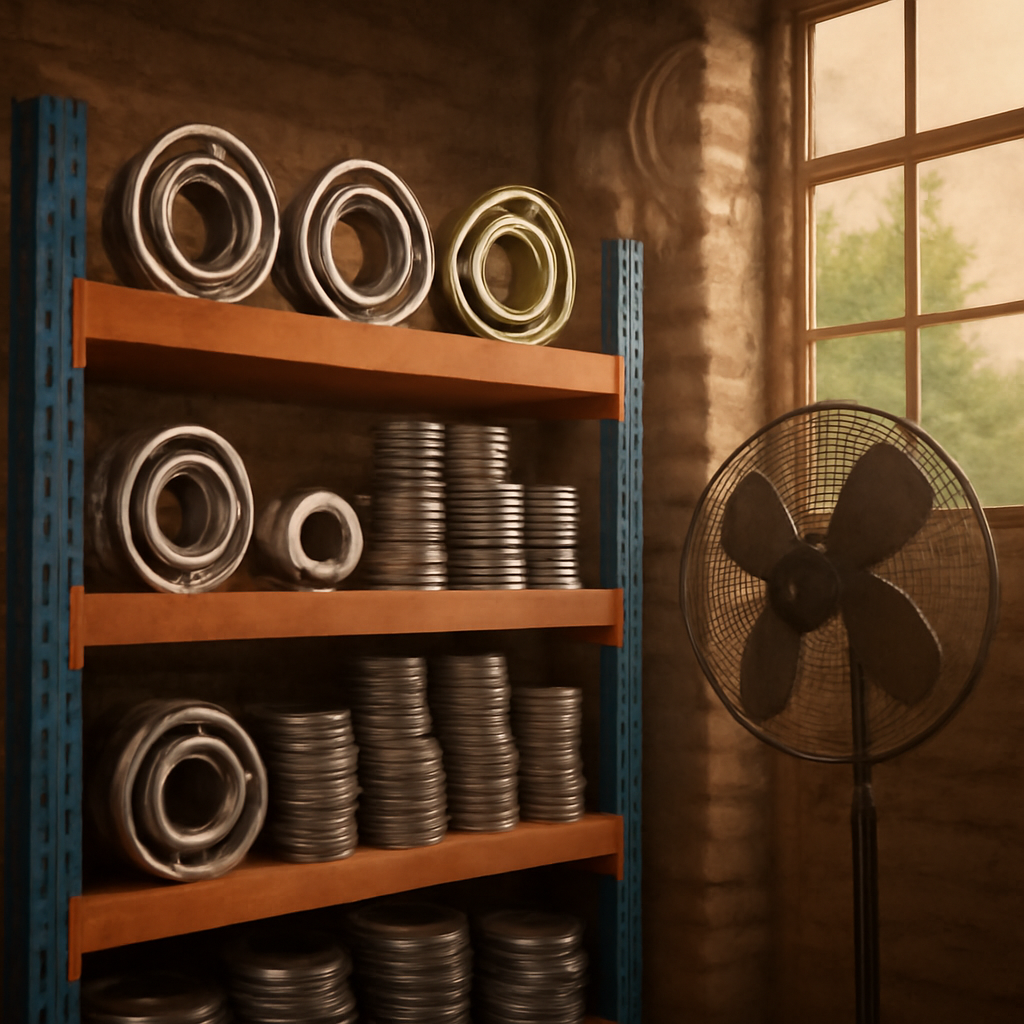
Distributors and maintenance warehouses lose more inventory to poor storage than most people realise. The two main villains in summer storage are condensation (driven by temperature swings) and grease oxidation (driven by sustained high temperature). Both are easy to control once you understand the mechanism.
Why condensation is the silent killer
Bearings move from a cool morning warehouse (22 °C) to an afternoon warehouse (32 °C) and back, day after day. Each cycle, atmospheric moisture condenses on the cooler internal surfaces of the bearing — including the unprotected raceways inside open bearings or under loose-fitting seals. Microscopic rust spots begin within weeks. After a season they are visible to the naked eye, and the bearing is no longer fit for installation.
The storage protocol that actually works
1. Keep packaging intact
Factory packaging includes vapour-corrosion-inhibitor (VCI) paper or wrap specifically designed for long storage. Never open it until installation time. Re-wrap with VCI paper if a partial inspection requires opening.
2. Control temperature, not just humidity
A warehouse at 20-25 °C with 40-60% relative humidity is the target. Most storage failures come from temperature swings, not absolute values. If you cannot air-condition, at least insulate the storage area to flatten the diurnal swing.
3. Keep bearings off the floor
Concrete floors stay cooler than the air, and condensation forms preferentially on cold surfaces. Store bearings on shelves at least 100 mm above the floor.
4. Rotate stock with FIFO discipline
Newer stock to the back, older stock to the front. The grease inside a bearing has a usable shelf life of 3-5 years for standard greases, 5-7 for synthetic at controlled storage. After that, the lubricant should be refreshed before installation.
5. Inspect periodically
Once a quarter, sample-check older inventory: rotate the bearing by hand, look for rust spots through the seal lip, smell the grease (acidic odour = oxidation). Discard or downgrade compromised stock.
Special cases
- Large-diameter bearings: store on their sides on shaped wood supports, never on a single point. The weight of the inner ring can cause permanent deformation if loaded over a single point for months.
- Pre-greased units: more sensitive to long storage than open bearings, because the grease is captive.
- Stainless steel bearings: more tolerant of humidity, but still vulnerable to corrosion in salt-air environments.
If a bearing has been stored too long
Test rotation, sample the grease, and if there is any sign of corrosion or grease degradation, refresh: open, clean with a compatible solvent, repack with fresh grease per the manufacturer’s spec. Better to spend an hour on inspection than install a compromised bearing into critical equipment.
Long-term storage considerations
For bearings stored more than 24 months, the grease shelf life becomes a concern. Standard lithium grease has typical shelf life of 3-5 years at controlled storage; synthetic greases can extend to 5-7 years. Beyond these intervals, the grease may have separated, dried, or oxidised — even if the bearing itself remains visually pristine.
The practical approach for long-stored bearings: inspect rotation by hand (should be smooth), check seal integrity, and if the grease appears questionable, plan to refresh the lubricant before installation. For critical applications, the precautionary approach is to replace the lubricant regardless — the cost is minimal vs the risk of installation failure.
The VCI packaging chemistry
Volatile Corrosion Inhibitor (VCI) packaging includes chemical compounds that vaporise slowly within the sealed packaging, forming a protective layer on metal surfaces. The packaging is engineered for a specific protection duration — typically 24 months under controlled storage. Beyond this, the VCI may have depleted, leaving the bearing exposed to atmospheric corrosion.
For stored inventory, monitoring VCI packaging integrity is part of the storage discipline. Re-wrap bearings opened for partial inspection. Replace VCI packaging that has been compromised. For very long-stored bearings, plan periodic re-packaging to maintain protection.
Climate-controlled storage economics
For distributors carrying significant bearing inventory, the economics of climate-controlled storage favour the investment for any inventory above modest volumes. A controlled environment (20-25 °C, 40-60% RH) extends usable bearing shelf life by years and prevents corrosion losses that otherwise become inventory write-offs. The capital cost of climate control is typically recovered within 18-24 months for distributors handling industrial bearing volumes.
Insurance and risk management
For high-value bearing inventory (specialty wind, aerospace, large diameter), the storage conditions affect insurance terms and recoverable value in any damage claim. Climate-controlled storage with documented procedures supports better insurance pricing and clearer claim resolution. For distributors, the storage discipline is itself a risk management investment beyond the operational benefits.
The 2026 supplier landscape and procurement strategy
The European industrial bearing supplier landscape continues to consolidate through 2026 with the NSK + NTN integration, SKF Automotive spin-off, and Schaeffler capacity expansion all reshaping the competitive dynamics. For procurement teams, the practical implications are: multi-supplier qualification becomes more important, framework agreement provisions need explicit substitution clauses, and supplier relationships shift toward longer-term partnerships rather than transactional cost optimisation.
The substitution agility — the ability to switch between supplier sources without operational disruption — is the most valuable procurement capability through the consolidation period. Building the cross-reference database, qualifying multiple sources on critical SKUs, and documenting engineering equivalence delivers protection against supplier strategic missteps and competitive pricing leverage during normal operation.
Total cost of ownership across the equipment lifecycle
Beyond purchase price, total cost of ownership across the equipment lifecycle frequently shifts procurement decisions toward higher-specification bearings. The cumulative cost components: acquisition, installation, lubrication and maintenance, downtime cost during failures, replacement, and end-of-life disposal. For applications with significant downtime cost or extended service intervals between maintenance windows, premium specifications routinely pay back across the lifecycle.
For European industrial customers operating under tight maintenance budgets, the TCO analysis sometimes reveals that the “cheaper” bearing produces higher total cost. The discipline of working through the lifecycle math — rather than defaulting to acquisition price comparisons — is one of the highest-leverage procurement capability investments available.
Smart bearing integration roadmap
The next generation of industrial bearings integrates sensors for predictive maintenance: temperature, vibration, sometimes current monitoring built into the bearing itself. Major manufacturers (SKF, Schaeffler, NSK, NTN) are all developing smart bearing platforms with progressive commercial rollout through 2027. For specifying engineers and procurement teams, the question is when to begin qualifying smart bearings on new equipment and how to integrate with existing condition monitoring infrastructure.
The smart bearing economics favour critical assets where the integrated sensor delivers more value than the price premium represents. For routine industrial bearing positions, standard products remain the right choice. The strategic decision is on critical assets where the smart bearing investment positions the customer for the post-2028 industry where smart bearings will be standard rather than premium.
Training and certification for the maintenance technician
The skills required for proper bearing service work benefit from formal training. Bearing manufacturer training programmes (SKF Bearing School, Schaeffler Academy, NSK Training Center) provide structured instruction. Industry certifications (ISO 18436 for vibration analysis, manufacturer-specific certifications for installation and maintenance) document the competencies that distinguish skilled technicians from those who learned on the job. For maintenance organisations, investing in technician certification is a high-ROI capability investment.
The role of standard operating procedures
Documented standard operating procedures (SOPs) standardise maintenance work across the team and shifts. SOPs cover: pre-work safety checks, equipment-specific procedure variations, required tools and materials, step-by-step work instructions, post-work verification requirements, and documentation expectations. Maintenance organisations with mature SOP discipline routinely outperform organisations relying on individual technician knowledge.
CMMS integration for closed-loop maintenance
Modern Computerised Maintenance Management Systems (CMMS) integrate work orders, parts inventory, equipment history, and condition monitoring data. The integration enables closed-loop maintenance: condition monitoring triggers work orders, work orders consume parts and labour, completed work updates equipment history, and the history informs future predictive analytics. For maintenance organisations, mature CMMS use is the operational foundation for moving from time-based to condition-based maintenance.
The trend toward predictive maintenance integration
Predictive maintenance combines condition monitoring data, AI analytics, and integrated workflow to deliver maintenance interventions just before failure rather than on fixed schedules. The 2026 affordability of IoT sensors (under $50/node) and maturity of AI platforms make predictive maintenance economically realistic for mid-size industrial plants. The deployment process is well-documented; the operational benefits are well-demonstrated; the strategic question for maintenance organisations is when and at what scale to deploy.
Cumulative cost-benefit across years of operation
The cumulative cost-benefit of disciplined maintenance practice compounds across years of operation. A maintenance organisation that consistently applies the documented best practices — bearing selection, installation, lubrication, condition monitoring, replacement scheduling — delivers measurably superior equipment reliability over a 10-year horizon compared to an organisation operating without the discipline. The cumulative savings in avoided downtime, extended equipment life, and reduced spare parts inventory typically exceed all the capability investments combined.
Related guides on Eurobearing
- Common Bearing Installation Mistakes
- Bearing Maintenance: How to Keep Performance High
- How to Inspect Bearings After Long Inactivity
Need help choosing the right bearing for your application? Our technical team can support you with selection, cross-references, and lead-time information.