
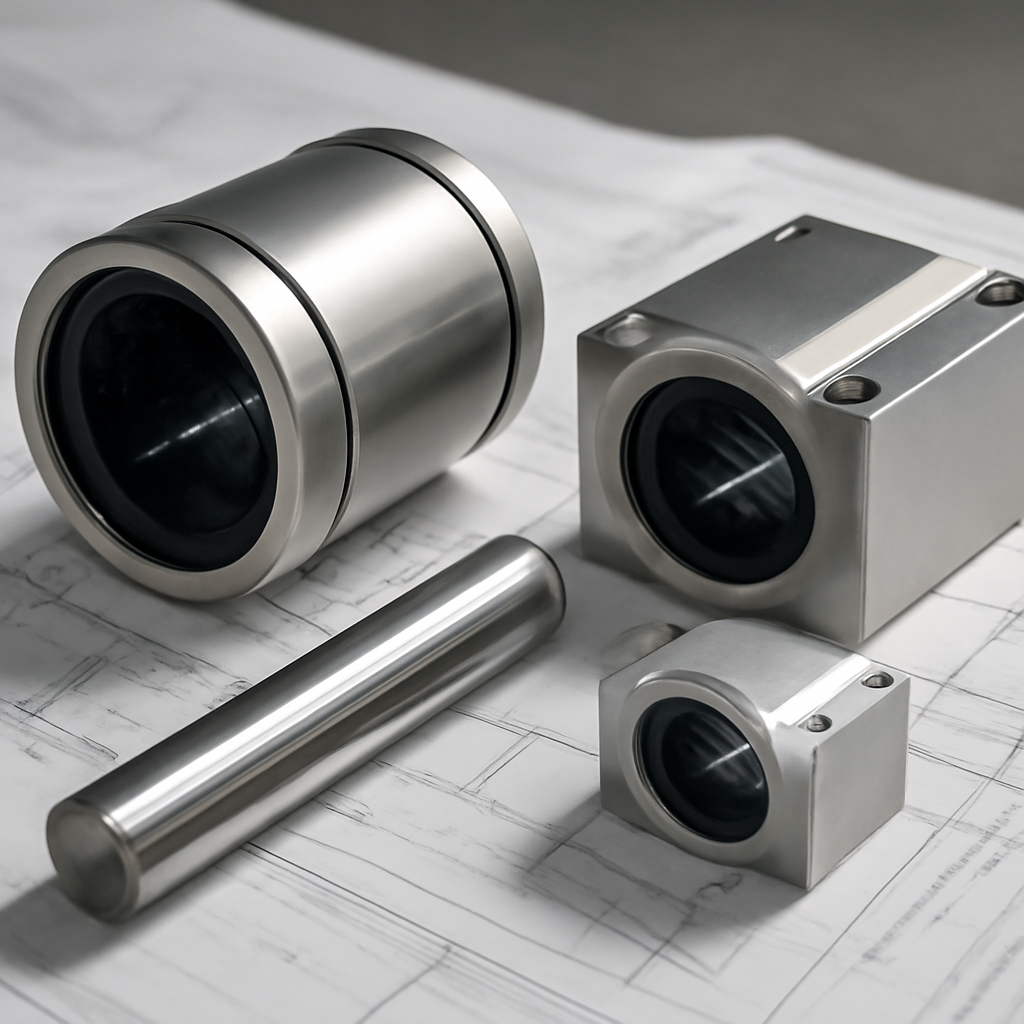
SFERAX, based in Cortaillod (Switzerland), is one of the longest-established names in linear ball bushings. The product line covers ball bushings for shafts from 3 mm to 80 mm, both standard and oversized configurations, and the company has built its reputation on one thing: precision and consistency batch-to-batch. SFERAX is not the cheapest option in the catalogue — but in the right application the cost difference disappears against the service life gained.
What makes a SFERAX ball bushing different
From the outside, a SFERAX ball bushing looks identical to dozens of competitors. The differences are in the details:
- Raceway grinding finer than the typical commodity specification, producing lower friction and lower noise.
- Tighter dimensional tolerance on the bore and outer diameter, so the bushing fits its housing precisely.
- Higher consistency between samples in the same production batch — important when stocking multi-unit assemblies.
- Cage materials and ball steel specifically chosen for the duty profile rather than for assembly cost.
The SFERAX product families
Standard linear ball bushings
Sealed and unsealed; carbon steel and stainless raceways; metric and imperial shaft sizes. The bread-and-butter range.
Open-type bushings for supported shafts
Where the shaft is supported along its length by a rail (the “supported shaft” or “shaft-and-rail” configuration), open-type bushings ride on top with the rail clearance through a slot. Slightly higher load capacity, very common in industrial automation.
Slide units
Pre-engineered carriages combining the bushing, a housing, and seals. The drop-in solution for machine builders.
Custom-engineered configurations
SFERAX accepts custom shaft sizes, cage materials, and seal configurations. For specialised metrology, optical instruments, and precision laboratory equipment, the custom catalogue is the actual product range.
Where the SFERAX premium pays back
- Precision metrology and inspection equipment: micron-scale repeatability is impossible with commodity bushings.
- Optical instrumentation: low friction means the motion is smooth at very low speeds.
- Medical and laboratory automation: long life with minimum servicing.
- Anywhere noise matters: lower-noise raceways produce noticeably quieter machines.
Where commodity bushings are fine
For light-duty general automation — pick-and-place that moves a few hundred times per shift, slow-speed manual adjustments, prototyping — a commodity bushing from a recognised Asian supplier is perfectly adequate. The SFERAX premium would not pay back over the asset’s useful life.
Selection tips
- Match the bushing seal style to the environment: sealed for industrial, unsealed for clean rooms where particles from the seal are unacceptable.
- For longer shafts, use multiple bushings spaced for stability rather than a single long bushing.
- Verify shaft hardness and finish: SFERAX bushings perform to spec only on properly hardened, finely ground shafts.
The SFERAX manufacturing process
SFERAX manufactures ball bushings at the Cortaillod facility in Switzerland. The manufacturing process emphasises consistency: tight tolerance control on raceway grinding, careful selection of cage materials, batch-to-batch dimensional verification. The result is the consistency that custom-equipment builders specifying SFERAX value most.
For precision metrology and instrumentation applications, the manufacturing consistency directly affects measurement repeatability of the finished equipment. Specifying SFERAX rather than commodity equivalents reduces the calibration burden during machine commissioning and the recalibration intervals during service life.
SFERAX product range in detail
The SFERAX product range covers:
- Standard ball bushings: cylindrical bushings for round shafts, sealed and unsealed variants, sizes from 3 mm to 80 mm shaft diameter.
- Open-type bushings: for supported shafts with rail clearance through slot — slightly higher load capacity.
- Pre-engineered slide units: bushing plus housing plus seals for drop-in machine builder integration.
- Custom configurations: non-standard shaft sizes, special cage materials, modified seal configurations for specialised applications.
- Stainless steel variants: for clean room, food, medical, and aggressive-environment applications.
Application engineering and custom solutions
For applications outside the standard catalogue, SFERAX accepts custom engineering requests. Specialised metrology, optical instruments, medical robotics, and precision laboratory equipment all benefit from this capability. Custom engineering lead times typically run 8-12 weeks; the engineering investment is part of the SFERAX value proposition for premium applications.
The Swiss industrial heritage advantage
SFERAX is part of the broader Swiss precision engineering ecosystem. The proximity to Swiss machine tool builders, watchmaking traditions, and medical device manufacturers shapes the company’s product development. For customers in these industries, the SFERAX cultural fit is itself a competitive advantage — the company “speaks the language” of precision instrumentation.
SFERAX vs commodity alternatives revisited
For applications where precision matters and the duty cycle justifies the premium, SFERAX is the natural choice. For commodity automation where adequate quality is sufficient, the price differential favours alternatives. Match the supplier to the precision requirement and the operational economics align naturally with the supplier choice.
The 2026 supplier landscape and procurement strategy
The European industrial bearing supplier landscape continues to consolidate through 2026 with the NSK + NTN integration, SKF Automotive spin-off, and Schaeffler capacity expansion all reshaping the competitive dynamics. For procurement teams, the practical implications are: multi-supplier qualification becomes more important, framework agreement provisions need explicit substitution clauses, and supplier relationships shift toward longer-term partnerships rather than transactional cost optimisation.
The substitution agility — the ability to switch between supplier sources without operational disruption — is the most valuable procurement capability through the consolidation period. Building the cross-reference database, qualifying multiple sources on critical SKUs, and documenting engineering equivalence delivers protection against supplier strategic missteps and competitive pricing leverage during normal operation.
Total cost of ownership across the equipment lifecycle
Beyond purchase price, total cost of ownership across the equipment lifecycle frequently shifts procurement decisions toward higher-specification bearings. The cumulative cost components: acquisition, installation, lubrication and maintenance, downtime cost during failures, replacement, and end-of-life disposal. For applications with significant downtime cost or extended service intervals between maintenance windows, premium specifications routinely pay back across the lifecycle.
For European industrial customers operating under tight maintenance budgets, the TCO analysis sometimes reveals that the “cheaper” bearing produces higher total cost. The discipline of working through the lifecycle math — rather than defaulting to acquisition price comparisons — is one of the highest-leverage procurement capability investments available.
Smart bearing integration roadmap
The next generation of industrial bearings integrates sensors for predictive maintenance: temperature, vibration, sometimes current monitoring built into the bearing itself. Major manufacturers (SKF, Schaeffler, NSK, NTN) are all developing smart bearing platforms with progressive commercial rollout through 2027. For specifying engineers and procurement teams, the question is when to begin qualifying smart bearings on new equipment and how to integrate with existing condition monitoring infrastructure.
The smart bearing economics favour critical assets where the integrated sensor delivers more value than the price premium represents. For routine industrial bearing positions, standard products remain the right choice. The strategic decision is on critical assets where the smart bearing investment positions the customer for the post-2028 industry where smart bearings will be standard rather than premium.
The 2026 application engineering ecosystem
Modern bearing application engineering goes beyond catalogue selection. The major manufacturers provide structured application engineering services: bearing selection consultation, calculated bearing life analysis, lubrication system design, failure mode analysis, and integrated condition monitoring programmes. For OEM equipment designers and major industrial customers, engaging these services during equipment design pays back through extended service life and reduced operational risk.
The European authorised distribution network typically provides the first layer of application engineering — sufficient for standard catalogue selection and common application questions. Manufacturer engineering centres provide deeper consultation for complex applications, specialty environments, or new equipment design. The escalation path from distribution to manufacturer is well-established and worth using for non-routine applications.
Quality assurance and traceability
For critical applications, bearing manufacturer quality assurance and product traceability matter as much as the bearing specification. Modern bearing manufacturers maintain detailed batch records, material certification documentation, and dimensional inspection records. For aerospace, medical, and food applications subject to regulatory traceability requirements, this documentation is itself a strategic asset that supports customer compliance.
For routine industrial applications, traceability is less critical but still valuable. When unusual failures occur, batch traceability supports root-cause analysis. When supplier substitution is required, traceability documentation supports engineering equivalence verification.
The strategic supplier relationship
Beyond transactional bearing supply, the strategic supplier relationship delivers value across multi-year horizons. Engineering consultation on new equipment designs, training programmes for maintenance teams, condition monitoring platform integration, and access to roadmap information for procurement planning all flow from strategic supplier relationships. For European industrial customers, building this relationship with one or two preferred manufacturers — while maintaining qualified alternatives for supply resilience — is a sound procurement strategy.
Looking ahead to 2027-2030
The next 3-5 years will see continued bearing industry evolution: smart bearing technology becoming standard rather than premium, condition monitoring platforms maturing across all major manufacturers, supplier consolidation effects flowing through to procurement choices, and end-user expectations evolving toward integrated reliability solutions rather than component supply. For European industrial customers, positioning the procurement strategy for this evolution — qualifying smart bearing platforms, building condition monitoring capability, and maintaining supplier substitution agility — is the strategic foundation for the coming decade.
Related guides on Eurobearing
- SFERAX Linear Bearings Guide
- SFERAX Linear Bearings: Precision and Reliability
- Applications of SFERAX Linear Bearings
Need help choosing the right bearing for your application? Our technical team can support you with selection, cross-references, and lead-time information.