
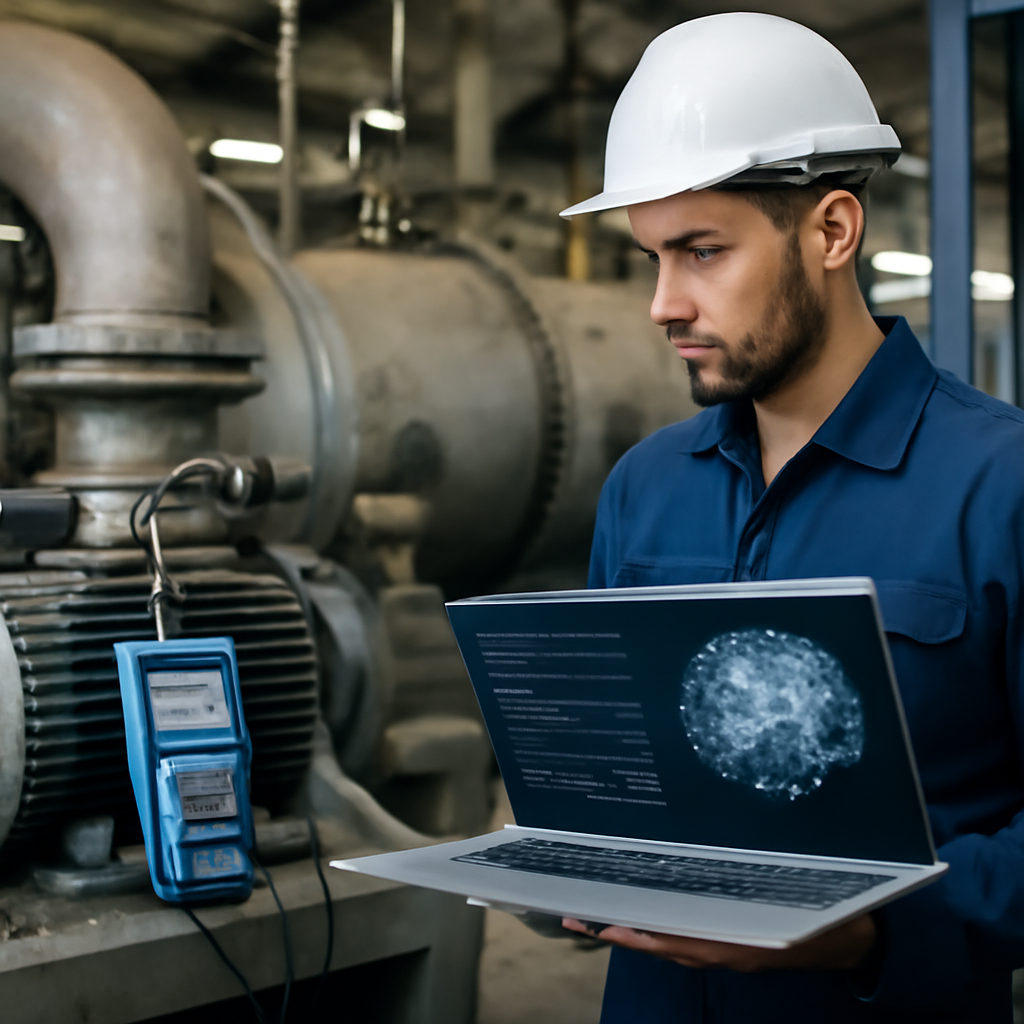
Vibration analysis has been a specialist craft for forty years. The technician captures an FFT, identifies the defect frequencies, interprets the harmonic patterns, and writes the report. It is skilled work, in short supply, and expensive. In 2026 the picture is changing fast: AI tools are picking up bearing defect signatures faster, more consistently, and at scale that was impossible with human analysts alone.
1. What the human analyst does
A trained vibration analyst:
- Captures a vibration signal under a defined load condition.
- Computes the FFT spectrum.
- Identifies peaks at bearing defect frequencies (BPFO, BPFI, BSF, FTF).
- Examines sidebands and the overall noise floor.
- Cross-references with the bearing model, shaft speed, and load.
- Produces a condition classification and recommended action.
This is craft expertise. A good analyst is rare and expensive.
2. What AI does differently
Modern condition monitoring platforms apply a layered AI pipeline:
- Signal preprocessing: envelope demodulation, order tracking against shaft speed.
- Defect-frequency calculation from bearing model and rotation speed (automated).
- Pattern recognition: ML models trained on labelled bearing failures recognise the characteristic harmonic patterns and sideband structures.
- Anomaly detection: unsupervised models flag any signal that diverges from the asset’s healthy baseline.
- Severity classification: trained classifiers assign stage 1-5 severity automatically.
- Action recommendation: prescriptive layer suggests inspection, re-lubrication, or replacement.
3. Where AI outperforms human analysts
- Scale: an AI system can analyse thousands of assets continuously; a human analyst can review tens per day.
- Consistency: the AI does not get tired, distracted, or have an off day.
- Early detection: ML models pick up subtle precursor patterns that often slip past a human’s first-pass review.
- Trend correlation: AI correlates vibration with temperature, current, load and ambient data in real time — a level of cross-signal integration that is hard manually.
4. Where humans still outperform AI
- Novel failure modes: AI is only as good as its training data. A new failure mode that the model has not seen is sometimes missed or misclassified.
- Mechanical context: knowing that this asset has been running on a worn coupling for three months and the vibration is caused by that, not bearing fatigue, requires plant knowledge the AI does not have.
- Root-cause analysis: AI flags the defect frequency; the human builds the root-cause story.
5. The practical 2026 deployment
- Install sub-$50 IoT vibration nodes on the 20-50 most critical assets.
- Backhaul to a cloud platform (SKF, Schaeffler, Augury, Senseye, IO-tahoe, Movus, etc.).
- Configure the asset profile (bearing model, shaft speed, expected load).
- Establish baseline over 4-6 weeks of healthy operation.
- Let the AI monitor; alert on threshold crossings; escalate to human analyst only when the AI flags a Stage 2 or higher condition.
6. Cost vs traditional analysis
A traditional walk-around vibration programme costs roughly €30-50/asset/month at industrial scale. An AI condition monitoring deployment after capex amortisation is €2-5/asset/month. For an industrial plant with 100 critical assets, the savings are substantial.
7. Vendor landscape
- Established players: SKF Insight, Schaeffler OPTIME, Brüel & Kjær, Emerson AMS.
- AI-first newcomers: Augury, Senseye (Siemens), Movus, ABB Ability Smart Sensor.
- Open-platform options: AWS IoT SiteWise, Azure IoT Hub with bearing-specific ML libraries.
8. What is coming next: prescriptive AI
The 2026-2027 transition is from predictive (alert on defect) to prescriptive (suggest or auto-execute the next action). Examples: auto-issued work orders, auto-ordered spare bearings, AI-drafted root-cause analyses. Studies show 65% of maintenance teams plan to adopt AI by year-end 2026.
Conclusion
The skilled vibration analyst is not disappearing — they are being elevated to handle the cases the AI flags. But the routine monitoring layer, the early-warning detection, and the at-scale trending are moving to AI permanently. For maintenance organisations, the question is no longer whether to adopt; it is when and on which platform.
The integrated technology layers in modern bearing applications
Modern bearing applications operate within an integrated technology ecosystem: bearing hardware, condition monitoring sensors, cloud analytics platforms, CMMS work order integration, and ERP procurement integration. For end-users adopting this integrated approach, the technology stack delivers value beyond any single component. The bearing supplier ecosystem in 2026 increasingly provides integrated solutions rather than discrete components.
The market signal for sustained growth
Multiple independent market signals point to sustained bearing industry growth through the end of the decade. The market size forecast (from $151.8B in 2026 to $301B by 2033, a 9.8% CAGR) reflects structural drivers operating in parallel: EV adoption acceleration, wind energy capacity expansion, industrial robotics growth, linear motion market expansion, and smart bearing technology maturation. For procurement teams, the implications are: bearing list prices likely continue upward trajectory, supplier strategic moves continue to reshape the landscape, and reliability technology investment continues to deliver documented ROI.
The strategic procurement priorities
For European industrial procurement leadership in 2026, the strategic priorities distil to: supplier substitution agility, framework pricing locks where leverage exists, condition monitoring capability investment, smart bearing qualification on critical applications, and master data discipline that supports informed substitution decisions. These five priorities compound across years of execution and position the procurement organisation for the post-consolidation industry structure.
Looking ahead to 2027-2030
The next 3-5 years will see continued bearing industry evolution: NSK + NTN integration completing and reshaping competitive dynamics, SKF Automotive spin-off mechanics clarified, Schaeffler humanoid robotics commercialisation, condition monitoring platform maturation across major manufacturers, and end-user expectations evolving toward integrated reliability solutions. For European industrial customers, positioning the procurement strategy for this evolution now — rather than reacting in 2028 — is the strategic foundation for competitive operational performance through the coming decade.
The smart bearing transition impact
Beyond standard procurement considerations, the smart bearing transition reshapes the broader supplier relationship. Smart bearings come with platform commitments (which analytics platform supports the sensors), software licensing implications (cloud platform subscriptions), and integration requirements (CMMS, ERP connections). For procurement teams, the smart bearing decision involves more than the bearing — it involves the broader reliability ecosystem.
The companies positioning early on smart bearing platforms capture multi-year operational advantage. The technology is mature enough for deployment on critical applications today; the economics are clear; the strategic question is platform selection and deployment pace rather than whether to deploy. For European industrial customers, engaging with the major manufacturer smart bearing roadmaps during 2026 positions the organisation for the 2027-2028 industry structure.
The 2026 reliability investment thesis
For European industrial customers in 2026, the broader reliability investment thesis is decisive. The combination of affordable IoT sensors (under $50 per node, an 85% cost reduction since 2019), mature AI analytics platforms, documented ROI cases (6-18 month payback in mid-size plants), and supplier ecosystem support makes condition monitoring deployment economically realistic for virtually any plant with critical rotating equipment. The cumulative effect across years of deployment is meaningful: 30-50% reduction in unplanned downtime, 15-25% reduction in maintenance labour, and extended equipment service life.
For procurement leadership specifically, the reliability investment changes the supplier relationship dynamic. Bearing supply becomes part of an integrated reliability conversation rather than a transactional component supply. Engineering services, condition monitoring platforms, training programmes, and roadmap visibility all flow from strategic supplier relationships. The companies building these relationships now position themselves for the post-2028 industry structure where smart bearings and integrated reliability solutions become standard rather than premium.
What the next 18 months will tell us
The next 18 months will clarify several major industry questions. NSK + NTN antitrust filings progress through Q3-Q4 2026 will reveal the regulatory burden and possible remedies. SKF Automotive spin-off mechanics will be confirmed, with implications for both the SKF industrial businesses and the new standalone automotive entity. Schaeffler Yinchuan capacity ramp will reach steady-state output, affecting standard catalogue lead times and pricing dynamics. EU industrial demand recovery will be tested through H2 2026 and into 2027.
For organisations operating in this environment, active engagement with these developments — through industry events, supplier conversations, and trade press monitoring — supports informed strategic decisions. The bearing industry in 2026-2027 is not on autopilot; the strategic decisions made during this period set competitive positioning for years to come.
The reliability ecosystem in 2026
For European industrial customers, the bearing supply relationship in 2026 increasingly extends beyond transactional component supply into a broader reliability ecosystem. Engineering consultation, condition monitoring platform integration, training programmes, and access to product roadmap information all flow from strategic supplier relationships. Building these relationships with preferred manufacturers — while maintaining qualified alternatives for supply resilience — is the foundation for navigating the industry consolidation period through 2027-2028.
Looking ahead through 2030
The bearing industry continues structural evolution through the rest of the decade, driven by EV adoption acceleration, wind energy expansion, industrial robotics growth, humanoid robotics commercialisation, and smart bearing technology maturation. The market projection from $151.8B in 2026 to $301B by 2033 reflects these structural drivers operating in parallel. For European industrial customers, positioning the procurement strategy for this evolution now, rather than reacting in 2028, is the strategic foundation for competitive operational performance through the coming decade.
Related guides
- How to Detect Bearing Wear by Vibration
- IoT Vibration Sensors Under $50
- Predictive Maintenance
- Reducing Machine Downtime
- Bearing Industry Next Era 2026
Need help with bearing selection? Our team supports you with cross-references and lead-times.