
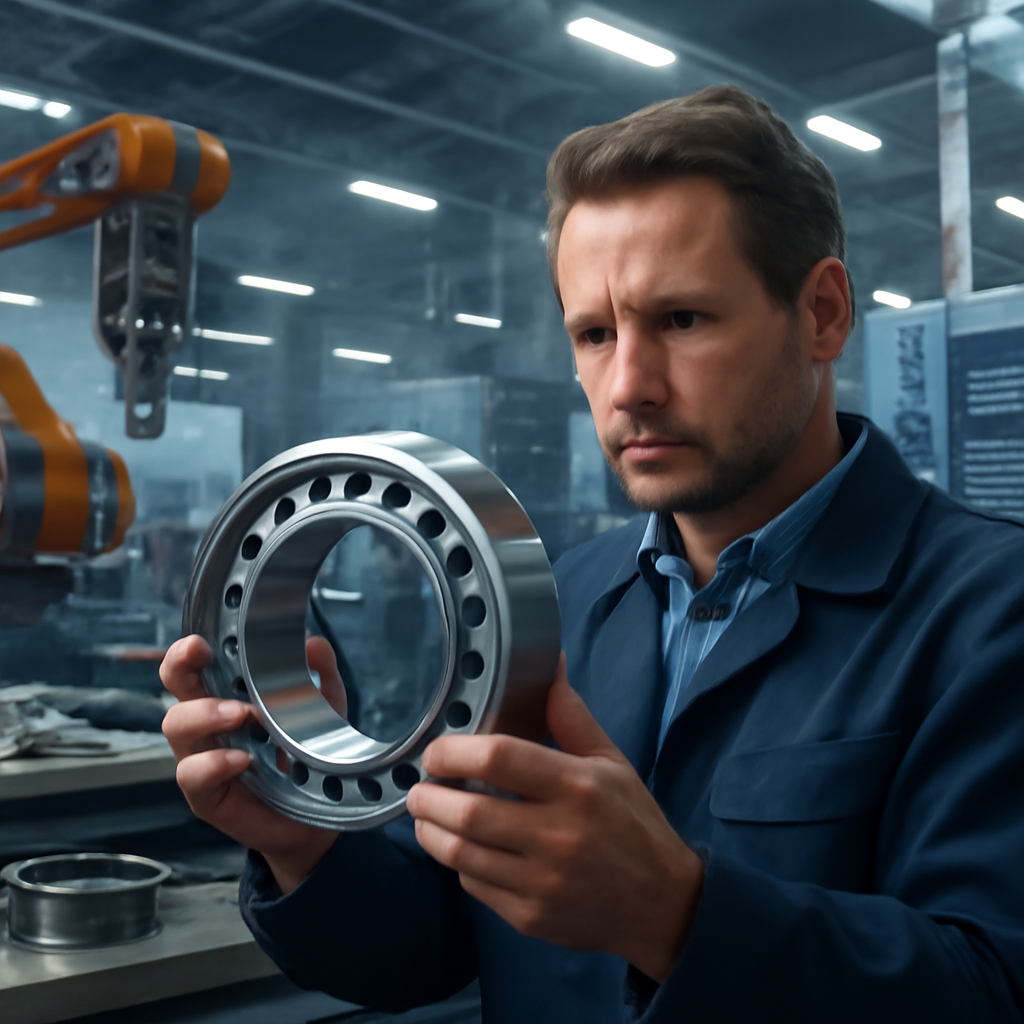
The bearing industry is in a generational transition. Three forces are reshaping it simultaneously: industrial consolidation at a scale not seen in 30 years, technology absorption that turns the bearing from a part into a system, and demand patterns shifting from internal combustion to electric mobility and renewable energy. This is the comprehensive 2026 status report for distributors, maintenance engineers and procurement teams who need to understand where the industry is heading.
1. The structural numbers
- Global market size 2026: USD 151.8 billion.
- Forecast 2033: USD 301 billion (CAGR 9.8%).
- Roller bearings: 43% of revenue (2025).
- Automotive: largest end-segment by share.
- Asia Pacific: dominant region by volume.
2. M&A: the largest consolidation wave since the 1990s
NSK + NTN integration
Announced 12 May 2026. Joint holding company by October 2027 (pending antitrust). Combined revenue ¥1.7T (~$10.9B), ~50,000 employees. Becomes a credible challenger to SKF and Schaeffler for global #1.
SKF restructuring
Automotive spin-off in progress. New segments: Bearing Solutions, Specialized Industrial Solutions (SIS), Automotive. March 2026 acquisition of G-Tech Instruments adds condition monitoring depth.
Schaeffler positioning
Capacity expansion in Yinchuan (China) doubling FAG deep groove capacity. CES 2026 humanoid robotics push. BSA 2025 Innovation Award for INA stainless inserts. Aggressive on smart-bearing roadmap.
3. Technology: from part to system
The defining transition: bearings are becoming nodes in a connected reliability system. Three layers:
- Insulated and hybrid (ceramic) bearings for EV traction motors and inverter-driven industrial motors — the fastest-growing technical segment.
- Instrumented bearings with integrated temperature, vibration and load sensors. SKF Insight, NSK SAT, FAG SmartCheck families.
- IoT condition monitoring as a separate market layer. Sub-$50 vibration nodes (85% cost reduction since 2019) move predictive maintenance from large-enterprise tool to mainstream capability.
4. Demand: where the growth is coming from
- Electric vehicles: insulated wheel-hub and traction-motor bearings. Higher value than ICE equivalents.
- Wind energy: 110+ GW per year of new capacity, each turbine carries 1-2 tonnes of bearings.
- Industrial robotics: $54B market in 2026 → $94B 2031. Each robot uses 30-60 individual bearings.
- Linear motion: $12.8B → $22B by 2033. Linear motors fastest sub-segment.
- Humanoid robotics: nascent in 2026, structural growth ahead.
5. Supply: capacity adjustments and lead-time normalisation
Capacity expansions at Schaeffler Yinchuan and elsewhere are easing the supply tightness of 2022-2024. Standard catalogue lead times normalising through H2 2026. Larger bearings (above 200 mm bore) and specialty wind-grade slewing rings remain constrained.
6. Pricing: structural upward pressure
Five forces:
- Bearing-grade steel alloy premiums widening.
- US 50% steel/aluminum tariffs in force since June 2025.
- Higher long-term logistics and energy costs.
- Industry consolidation tightening pricing discipline.
- Product mix shift toward higher-margin smart and insulated products.
7. Geographic dynamics
- Asia Pacific: 42.8% of the market in 2025; dominant in volume.
- Europe: premium positioning under pressure from Asian competition.
- North America: tariff-protected but smaller scale; reshoring tailwind.
- China: bearing-grade local production scaling fast and rising in quality.
8. Regulatory and compliance
REACH in Europe continues to evolve. Restrictions on lubricant additives, sealing compounds, and surface coatings reshape product specifications. For distributors and OEMs, REACH compliance is a 2026-2027 procurement priority.
9. The 2026-2027 watch list
- NSK + NTN antitrust filings — EU, US, China decisions.
- SKF Automotive spin-off timing and structure.
- Schaeffler humanoid robotics commercialisation.
- EU steel safeguards evolution.
- Wind turbine main bearing reliability — industry-wide retrofit programme implications.
10. What this means for distributors and end-users
- Tag master data by manufacturer and segment — the catalogue is going to rationalise.
- Lock pricing on framework agreements while the upward trajectory continues.
- Build cross-references across NSK, NTN, SKF, FAG, TIMKEN — substitution agility will pay off.
- Invest in condition monitoring now — the ROI math has flipped.
- Watch the smart-bearing roadmap and qualify on at least one platform.
Conclusion
The bearing industry in 2026 is in active transition. The next 24-36 months will produce more structural change than the previous decade. Distributors and end-users who navigate this period actively — not defensively — will be the ones positioned to win when the new structure settles.
The integrated technology layers in modern bearing applications
Modern bearing applications operate within an integrated technology ecosystem: bearing hardware, condition monitoring sensors, cloud analytics platforms, CMMS work order integration, and ERP procurement integration. For end-users adopting this integrated approach, the technology stack delivers value beyond any single component. The bearing supplier ecosystem in 2026 increasingly provides integrated solutions rather than discrete components.
The market signal for sustained growth
Multiple independent market signals point to sustained bearing industry growth through the end of the decade. The market size forecast (from $151.8B in 2026 to $301B by 2033, a 9.8% CAGR) reflects structural drivers operating in parallel: EV adoption acceleration, wind energy capacity expansion, industrial robotics growth, linear motion market expansion, and smart bearing technology maturation. For procurement teams, the implications are: bearing list prices likely continue upward trajectory, supplier strategic moves continue to reshape the landscape, and reliability technology investment continues to deliver documented ROI.
The strategic procurement priorities
For European industrial procurement leadership in 2026, the strategic priorities distil to: supplier substitution agility, framework pricing locks where leverage exists, condition monitoring capability investment, smart bearing qualification on critical applications, and master data discipline that supports informed substitution decisions. These five priorities compound across years of execution and position the procurement organisation for the post-consolidation industry structure.
Looking ahead to 2027-2030
The next 3-5 years will see continued bearing industry evolution: NSK + NTN integration completing and reshaping competitive dynamics, SKF Automotive spin-off mechanics clarified, Schaeffler humanoid robotics commercialisation, condition monitoring platform maturation across major manufacturers, and end-user expectations evolving toward integrated reliability solutions. For European industrial customers, positioning the procurement strategy for this evolution now — rather than reacting in 2028 — is the strategic foundation for competitive operational performance through the coming decade.
The smart bearing transition impact
Beyond standard procurement considerations, the smart bearing transition reshapes the broader supplier relationship. Smart bearings come with platform commitments (which analytics platform supports the sensors), software licensing implications (cloud platform subscriptions), and integration requirements (CMMS, ERP connections). For procurement teams, the smart bearing decision involves more than the bearing — it involves the broader reliability ecosystem.
The companies positioning early on smart bearing platforms capture multi-year operational advantage. The technology is mature enough for deployment on critical applications today; the economics are clear; the strategic question is platform selection and deployment pace rather than whether to deploy. For European industrial customers, engaging with the major manufacturer smart bearing roadmaps during 2026 positions the organisation for the 2027-2028 industry structure.
The 2026 reliability investment thesis
For European industrial customers in 2026, the broader reliability investment thesis is decisive. The combination of affordable IoT sensors (under $50 per node, an 85% cost reduction since 2019), mature AI analytics platforms, documented ROI cases (6-18 month payback in mid-size plants), and supplier ecosystem support makes condition monitoring deployment economically realistic for virtually any plant with critical rotating equipment. The cumulative effect across years of deployment is meaningful: 30-50% reduction in unplanned downtime, 15-25% reduction in maintenance labour, and extended equipment service life.
For procurement leadership specifically, the reliability investment changes the supplier relationship dynamic. Bearing supply becomes part of an integrated reliability conversation rather than a transactional component supply. Engineering services, condition monitoring platforms, training programmes, and roadmap visibility all flow from strategic supplier relationships. The companies building these relationships now position themselves for the post-2028 industry structure where smart bearings and integrated reliability solutions become standard rather than premium.
What the next 18 months will tell us
The next 18 months will clarify several major industry questions. NSK + NTN antitrust filings progress through Q3-Q4 2026 will reveal the regulatory burden and possible remedies. SKF Automotive spin-off mechanics will be confirmed, with implications for both the SKF industrial businesses and the new standalone automotive entity. Schaeffler Yinchuan capacity ramp will reach steady-state output, affecting standard catalogue lead times and pricing dynamics. EU industrial demand recovery will be tested through H2 2026 and into 2027.
For organisations operating in this environment, active engagement with these developments — through industry events, supplier conversations, and trade press monitoring — supports informed strategic decisions. The bearing industry in 2026-2027 is not on autopilot; the strategic decisions made during this period set competitive positioning for years to come.
The reliability ecosystem in 2026
For European industrial customers, the bearing supply relationship in 2026 increasingly extends beyond transactional component supply into a broader reliability ecosystem. Engineering consultation, condition monitoring platform integration, training programmes, and access to product roadmap information all flow from strategic supplier relationships. Building these relationships with preferred manufacturers — while maintaining qualified alternatives for supply resilience — is the foundation for navigating the industry consolidation period through 2027-2028.
Looking ahead through 2030
The bearing industry continues structural evolution through the rest of the decade, driven by EV adoption acceleration, wind energy expansion, industrial robotics growth, humanoid robotics commercialisation, and smart bearing technology maturation. The market projection from $151.8B in 2026 to $301B by 2033 reflects these structural drivers operating in parallel. For European industrial customers, positioning the procurement strategy for this evolution now, rather than reacting in 2028, is the strategic foundation for competitive operational performance through the coming decade.
Related guides
- NSK + NTN Merger Analysis
- Bearing Market Outlook 2026-2033
- SKF 2026 Structure
- Schaeffler CES 2026
- Why Bearing Prices Are Still Rising
Need help with bearing selection? Our team supports you with cross-references and lead-times.