
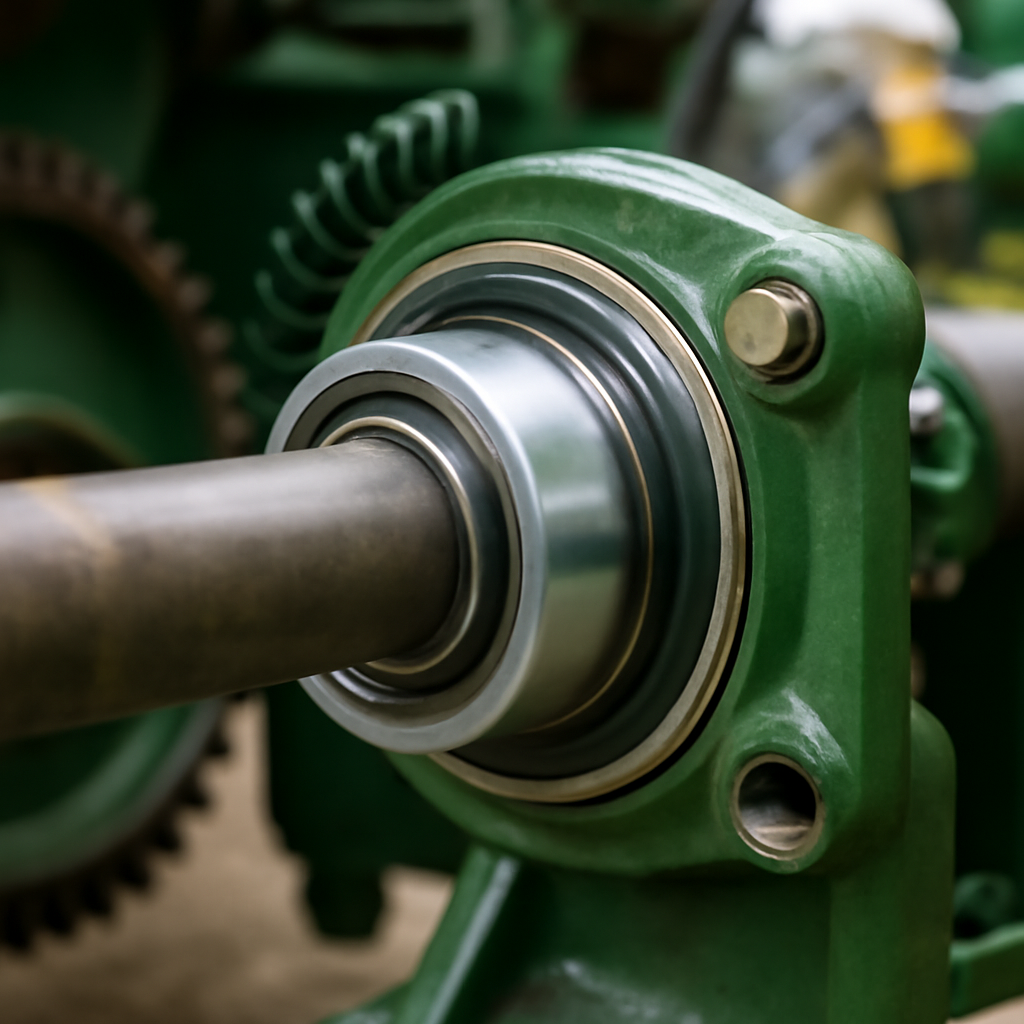
Insert bearings, commonly called Y-bearings, dominate the European agricultural equipment aftermarket for transmission and drive train applications. Understanding why Y-bearings became the aftermarket standard on agricultural equipment, how the various brand implementations compare, and what specification decisions matter tells procurement teams how to structure agricultural aftermarket bearing procurement.
What Y-bearings actually are
A Y-bearing is a specific insert bearing design with a spherical outer ring and a wider inner ring that includes an extension for shaft attachment. The extension typically has set screws, an eccentric collar mechanism, or an adaptor sleeve for grip on the shaft. The spherical outer ring allows the bearing to self-align in the housing, tolerating shaft misalignment that would damage standard bearing designs. The rolling-element bearing literature covers Y-bearings under insert bearing designations across the major suppliers.
Why agricultural equipment favours Y-bearings
Agricultural equipment operates in environments that stress bearing installations differently from industrial equipment. Shaft alignment tolerances are wider due to the mechanical realities of tractor-mounted equipment. Field service conditions favour simple installation methods that work with basic hand tools rather than requiring workshop precision. Housing designs typically use pillow blocks or flange units that accept the Y-bearing self-aligning geometry.
The SKF Y-bearing range
SKF’s Y-bearing range covers the standard set screw, eccentric collar and adaptor sleeve variants across bore diameters from 12 to 100 millimetres. The range includes YAR (basic), YAT (with take-up housing), YEL (heavy-duty) and specialty variants. Cross-reference to agricultural OEM specifications from John Deere, Case IH, New Holland, Fendt and Krone is generally clean.
The FAG Y-bearing range
FAG’s Y-bearing range provides similar coverage with different suffix conventions. Cross-brand equivalency to SKF is clean on standard applications. Pricing runs 5 to 12 percent apart between the two brands depending on specific SKU. For most agricultural aftermarket applications, either brand serves acceptably.
The set screw versus eccentric collar decision
Set screw variants grip the shaft through two set screws typically at 120 degrees apart. Simple installation with basic tools. Adequate for most agricultural applications with moderate axial loads. Eccentric collar variants grip through a collar that offsets to lock the bearing to the shaft. Slightly more complex installation but delivers higher axial load capacity. Match the collar type to the specific application load characteristics.
The adaptor sleeve variant
Adaptor sleeve variants of Y-bearings serve applications where the shaft is stepped or where axial position adjustment is needed. The taper sleeve accommodates the shaft diameter variance and provides adjustable axial position. This variant costs more than set screw or eccentric collar versions but delivers installation flexibility that some agricultural applications require.
The housing type selection
Pillow block housings serve horizontal shaft applications with moderate loads. Flange housings serve vertical shaft applications or applications where the mounting bolts must be accessible from behind the housing. Take-up housings serve applications where belt or chain tension requires adjustable bearing position. Agricultural equipment typically uses combinations of all three depending on the specific machinery configuration.
Seal package considerations for agricultural service
Standard Y-bearing seal packages handle typical agricultural dust exposure adequately with lubrication maintenance. For applications with heavy contamination — silage handling, root crop equipment, manure spreading — the upgrade to FKM double-lip seals extends service life meaningfully. CORTECO matching shaft seals cover most agricultural OEM specifications.
The cross-brand stocking pattern
Distributors serving European agricultural aftermarket should carry UC205 through UC211 Y-bearing sizes in both set screw and eccentric collar variants from SKF and FAG. Add matching pillow block and flange housings in the standard sizes. This mix serves the majority of European agricultural aftermarket demand.
The takeaway for procurement teams
Y-bearings are the pragmatic aftermarket standard for European agricultural equipment. Match the shaft attachment method (set screw, eccentric collar, adaptor sleeve) to the specific application requirements. Choose between SKF and FAG on pricing and customer preference rather than technical differentiation for standard applications. Position matching CORTECO seals alongside the bearing units as complete rebuild kits.
Related coverage on Eurobearing
- SKF Y-Bearings Selection
- STI Mounted Units
- SKF Adaptor Sleeve Setup
- Agricultural Sector Bearings
- STI Food-Grade Insert
Need help stocking Y-bearings for agricultural aftermarket? Our team supports European agricultural distributors. Book a free consultation.