
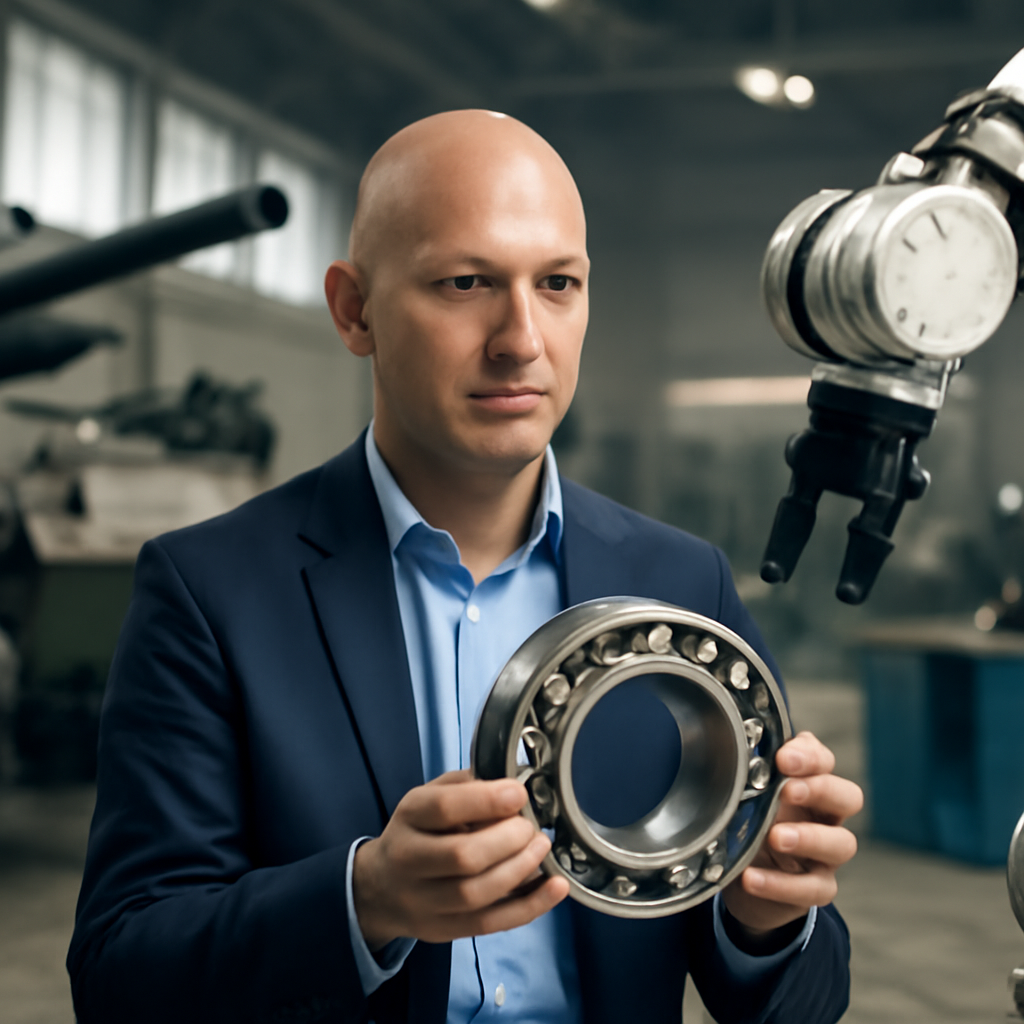
Schaeffler — one of the world’s four dominant bearing manufacturers — is executing the most far-reaching strategic pivot in its recent history, targeting humanoid robotics and defense as the sectors that will lift non-automotive revenue from 1% today to 10% by 2035. For B2B bearing buyers, the shift matters because it changes what a Big Four supplier prioritises, invests in, and prices aggressively — and where the capacity slack sits.
The facts
According to BEARING NEWS, Schaeffler is realigning its portfolio around the ambition of becoming “the leading Motion Technology Company”, explicitly targeting humanoid robotics and defense as new growth pillars. The company aims to become Europe’s leading supplier of actuators for human-like robots, with an integrated portfolio spanning lightweight rotatory and linear transmissions, bearings, sensors, and full smart actuator systems. Schaeffler expects the humanoid robotics business to build an order book in the hundreds of millions of euros by 2030. In defense, the group is aligning with sharply rising European military spending — Volkswagen and Daimler Truck have booked similar contracts — while continuing to deliver its core industrial bearing programmes. First-half 2025 revenue landed at €11.8 billion (–2.6% YoY comparable), with EBIT margin steady at 4.1%. The E-Mobility division grew 9.7% to €2.4 billion but posted a –19% EBIT margin, underlining why the group is diversifying away from automotive electrification alone.
Market implication
For bearing buyers, the pivot has three concrete implications. First, Schaeffler’s R&D and capex will increasingly flow into ultra-precision, low-friction, sensor-integrated bearings sized for actuators and rotorcraft-grade assemblies — expect faster innovation in miniature deep-groove and hybrid ceramic products in the 3–50 mm bore range. Second, standard industrial bearing programmes (INA needle rollers, FAG spherical rollers) remain the group’s cash engine but face slightly higher pricing discipline as management protects margin during the transition; buyers relying on discount volume on catalogue items should expect stricter minimum order quantities and less flexibility on rush deliveries. Third, the strategic focus on non-automotive revenue signals medium-term appetite for M&A in ancillary motion technologies — buyers should track potential integration risk on rebranded or discontinued legacy references. The move also intensifies competition with SKF and NSK-NTN (post-2027 merger) in wind, rail and heavy industry, potentially loosening pricing on tender-driven contracts.
Procurement box: what buyers should do
- Audit your Schaeffler catalogue exposure: flag references older than 10 years in the FAG/INA range; ask account managers for a discontinuation roadmap for 2026–2028.
- Negotiate multi-year framework agreements: lock volumes on standard bearing families now, before capacity is redirected to actuator programmes.
- Cross-quote SKF and NSK: use the strategic transition as leverage in tenders — both competitors have overlapping ranges in industrial deep-groove and cylindrical rollers.
- Ask for humanoid/robotics samples: even if you don’t sell into robotics, the new precision references often trickle into precision-machine markets 12–18 months later; early access buys engineering time.
- Watch dual-use export controls: a growing defense revenue share means some Schaeffler references may become subject to end-use documentation — factor this into lead-time planning.
Looking ahead
Schaeffler is expected to publish its H1 2026 results in early August, with commentary on humanoid robotics order intake and defense contract wins — both metrics will signal whether the transition is on track. In parallel, watch for partnership announcements: management has openly stated it is “searching for strategic partners” in humanoid actuation, and any deal with a Tier-1 robotics player will trigger reprioritisation of engineering resources. For bearing distributors, the medium-term takeaway is that the Big Four are diverging strategically for the first time in a decade — Schaeffler into motion technology, SKF into services and remanufacturing, NSK-NTN into scale. Procurement strategies built around interchangeable Big Four suppliers will need to become more nuanced by 2027.
Source
Schaeffler’s Metamorphosis: From Bearings to Robots and Defense — BEARING NEWS
Related on Eurobearing
- Brand insights
- Innovation & smart industry
- Industry news archive
- Company updates
- Contact our technical team
Need help with bearing selection? Contact our technical team for a free consultation.