
WD-40 provides maintenance aerosols and specialty cleaners that improve reliability and reduce downtime. This page summarizes uses, material compatibility and best practices before you download the technical sheets.
What you will find in the catalogs
- Product families – cleaners, degreasers, lubricants, protectants.
- Operating windows – service temperature and compatibility.
- Application methods – aerosol, brush, squeeze, automatic systems.
- Safety & compliance – SDS, VOC content, food‑grade options.
- Selection charts by substrate, viscosity and cure/evaporation time.
How to select the right product
- Operating conditions: load, speed, duty cycle and ambient temperature.
- Substrates: metals, plastics, elastomers and compatibility.
- Environment: moisture, dust, chemicals, food‑grade or washdown needs.
- Dimensions: space constraints, shafts, bores and mounting interfaces.
- Life & reliability: target service life, lubrication strategy and maintenance plan.
- Compliance: applicable standards, certifications and industry requirements.
- Health & safety: PPE, ventilation and curing/flash times.
Key advantages
- Reliable performance under demanding industrial duty cycles.
- Interchangeable dimensions compliant with international standards.
- Material and coating options for corrosion, wear and noise reduction.
- Clear documentation to speed up maintenance and procurement.
Typical industries
Maintenance, repair and overhaul (MRO), workshops and service centers, assembly lines, utilities and facility management.
Need a cross-reference?
Send the current code (OEM or competitor), key dimensions and operating data. We will propose the closest WD-40 equivalent and any matching accessories.
WD-40 – Specialist PTFE – Technical Data Sheet

WD-40 – Specialist Penetrant – Technical Data Sheet

WD-40 – Specialist Cutting Oil – Technical Data Sheet

WD-40 – Specialist Dry PTFE – Technical Data Sheet

WD-40 – Specialist White Lithium Grease – Technical Data Sheet

WD-40 – Specialist Spray Grease – Technical Data Sheet

WD-40 – Specialist Degreaser – Technical Data Sheet

WD-40 – Specialist Contact Cleaner – Technical Data Sheet

WD-40 – Multi-Use Product Aerosol Low VOC – SDS (US GHS)

WD-40 – Specialist Water-Resistant Silicone Lubricant – SDS (US GHS)

WD-40 – Multi-Use Product Bulk Low VOC – SDS (US GHS)

WD-40 – Multi-Use Product Non-Aerosol – SDS (EU EN)

WD-40 – Specialist Electrical Contact Cleaner – SDS (US GHS)

WD-40 – Specialist Industrial-Strength Degreaser – SDS (US GHS)

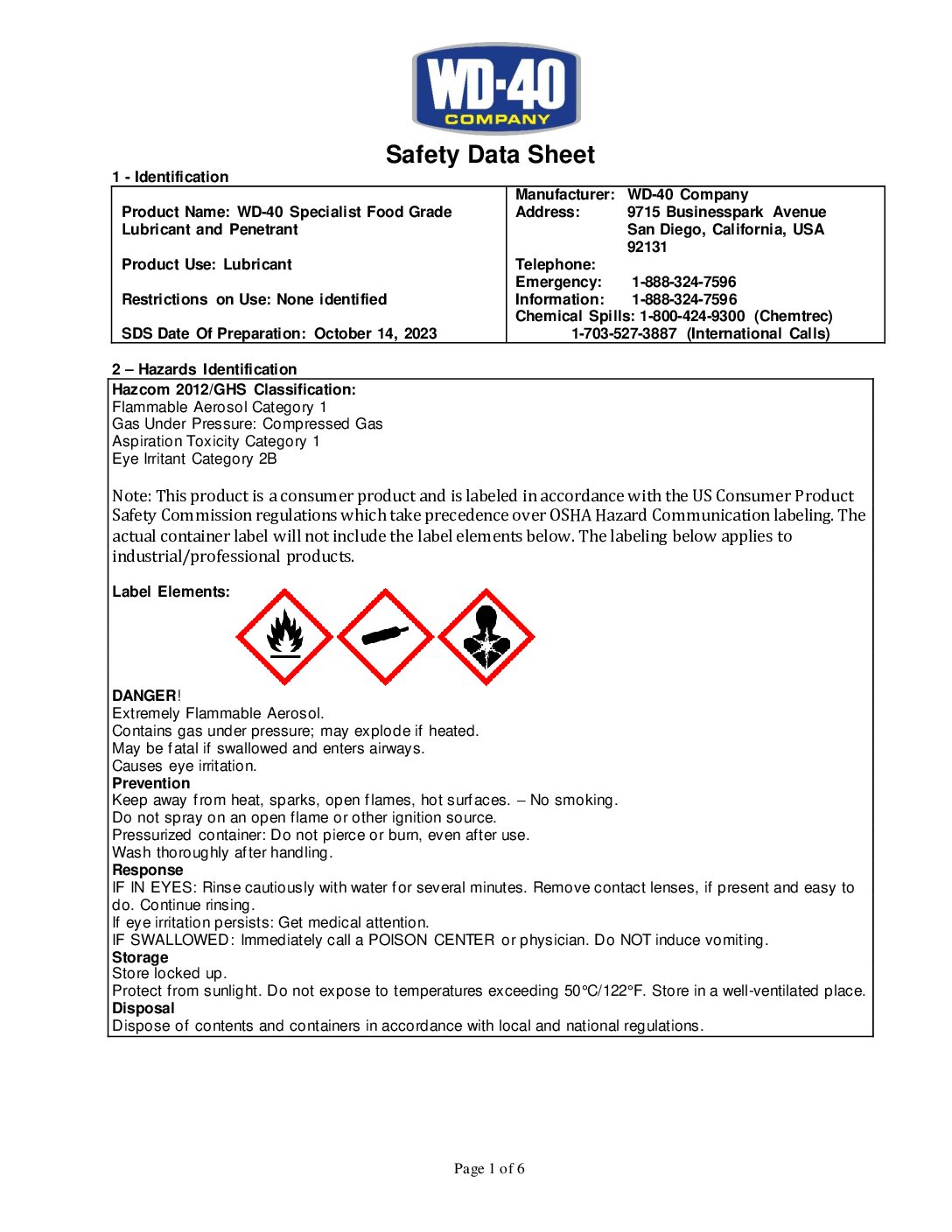
WD-40 – Specialist Food Grade Lubricant Penetrant – SDS (US GHS)
WD-40 – Product Guide 2022

WD-40 – Multi-Use Product – 2000 Uses
