
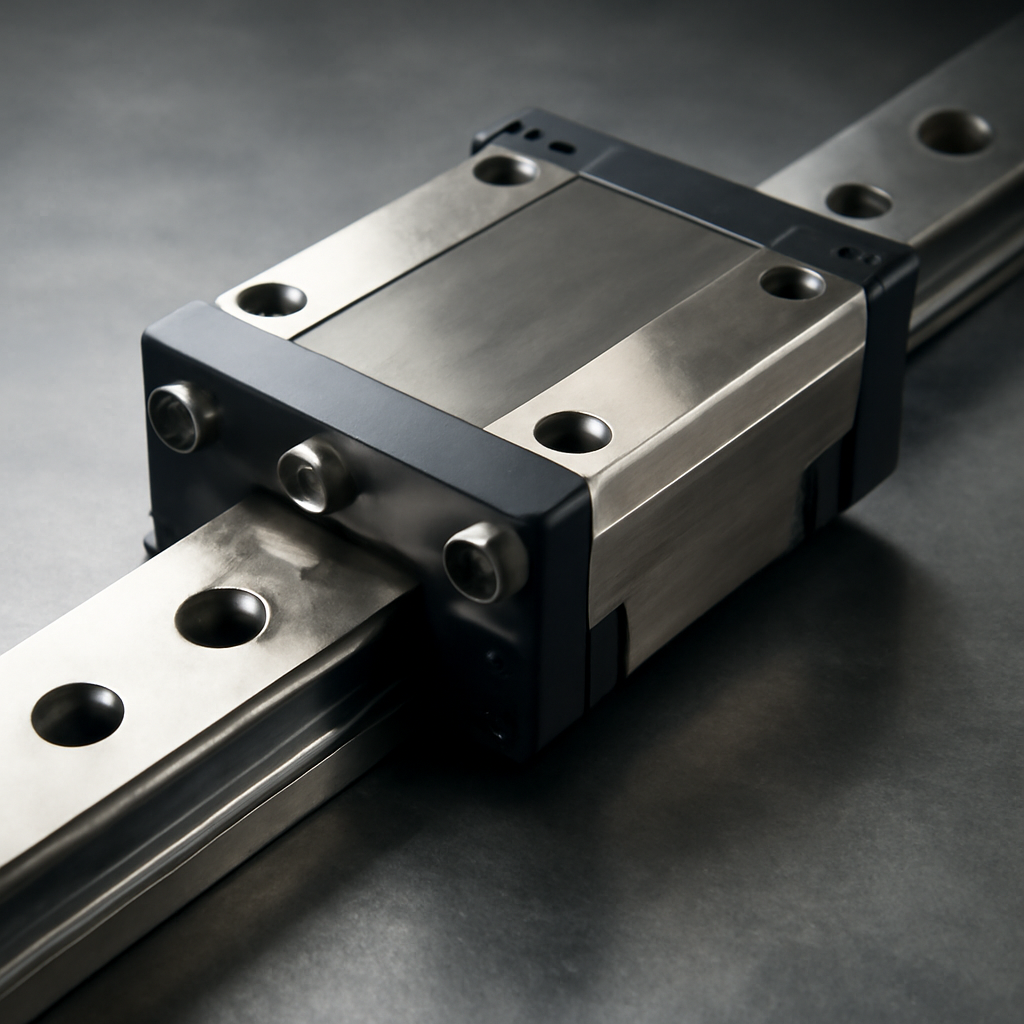
SCHNEEBERGER, founded in Roggwil (Switzerland) in 1923, is one of a small group of suppliers that European machine-tool builders specify by name. The company designs and manufactures monorail guideways, recirculating bearings, integrated measuring systems and complete linear assemblies — and its name on a machine carries the same weight that SKF or FAG carry on rolling bearings. In 2026, with the linear motion systems market projected to grow from $12.84B to $22.07B by 2033 (7.04% CAGR), SCHNEEBERGER continues to occupy the premium end of a structurally growing market.
1. The product families that matter
- MONORAIL series — heavy-duty profiled rail guideways with recirculating ball or roller carriages. The flagship for precision machine tools, available in MR, BM, BZ and AMS variants.
- MINIRAIL and MINISCALE PLUS — miniature profiled rail guideways for medical, electronics, semiconductor handling equipment. Sizes from 7 to 15 mm rail width.
- NK and NDK roller bearings — caged needle roller guideways for highest precision and lowest friction. The choice when sub-micron repeatability matters.
- AMS integrated measuring system — optical encoders integrated directly into the guideway. A distinctive Schneeberger differentiator that simplifies machine builder BOMs.
- SLIDE assemblies — pre-engineered carriages combining bearings, housings, and seals for drop-in integration.
- Custom-engineered configurations — for specialised metrology, optical instruments, and laboratory precision positioning.
2. Where the SCHNEEBERGER premium comes from
2.1 Manufacturing precision
Schneeberger profiles are hardened, ground, and finish-machined to tolerances tighter than the published standards. For high-precision metrology and semiconductor handling, this matters at the micron level — and is where Schneeberger has earned its specifications-by-name reputation.
2.2 Material engineering
Through-hardened bearing steel raceways with carefully controlled microstructure, optimised for high contact pressures and very long calculated service life. Schneeberger publishes calculated L10 lives that are routinely above the industry benchmark for the same envelope.
2.3 Integrated measurement
The AMS family combines linear guideway and incremental scale in a single integrated assembly. Sub-micron position feedback without an additional encoder rail — the kind of integration that simplifies a machine builder’s bill of materials and reduces assembly error budget.
2.4 Batch-to-batch consistency
For OEMs producing the same machine over years, batch consistency is as valuable as headline precision. Schneeberger’s manufacturing controls deliver consistent characteristics that allow machine builders to lock down tolerances and stop tweaking.
3. Where SCHNEEBERGER is the natural choice
- Five-axis machining centres at the high end of precision (jig boring, grinding, EDM).
- Semiconductor wafer-handling and inspection equipment — the segment investing heavily in 2025-2026 and a fast-growth destination.
- Laboratory metrology and ultra-precision positioning.
- Medical robotics and surgical equipment requiring sub-micron repeatability under sterile conditions.
- Optical and photonics manufacturing.
4. Where commodity alternatives are fine
For general-purpose industrial automation — pick-and-place, packaging, conveyor sub-systems — a commodity profile rail from Hiwin, Samick, or a Chinese supplier is perfectly adequate. The Schneeberger premium would not pay back in those applications. Match the supplier to the precision requirement.
5. Selection guidance
- Match the carriage type to the load profile: ball recirculating for general high-precision; roller (NK/NDK) for the highest stiffness and load capacity.
- For axes that need integrated position feedback, default to the AMS variant — the price premium is recouped by the simpler assembly.
- Specify the preload class carefully: heavier preload increases stiffness but reduces calculated life. Schneeberger’s preload tables guide this choice.
- Pair Schneeberger guideways with high-quality ball screws or linear motors of equal precision — a precision guideway behind a coarse drive is wasted money.
- For sub-micron repeatability, specify the higher precision class and verify the spec by measurement on the assembled machine.
6. Lead-time reality and stocking strategy
Schneeberger commits to short lead times on standard catalogue parts but custom-engineered assemblies routinely run 12+ weeks. Plan accordingly on new machine designs. For miniature rail in semiconductor applications, stocking depth at distribution still pays off — these segments have seen intermittent allocations through 2023-2025.
7. The 2026 context: where linear motion is heading
Three forces are reshaping the linear motion market and where Schneeberger competes:
- Linear motor growth: 8.75% CAGR through 2033, driven by semiconductor and high-throughput automation. Schneeberger competes here with iron-core and ironless linear motor solutions.
- Asia Pacific dominance: 42.8% of the global market is in Asia Pacific (~$5.7B in 2025). Schneeberger’s European premium positioning faces growing pressure from Taiwanese (Hiwin) and Korean (Samick) competition.
- Industrial robotics expansion: 11.7% CAGR through 2031 for industrial robots, opening new demand for integrated guide+drive solutions.
8. Cross-reference notes
Schneeberger profile rails are dimensionally compatible with most European and Asian competitors on standard sizes — a Schneeberger MR12 carriage will fit a Hiwin HG12 rail, with caveats on preload and accuracy class. Verify before any cross-substitution, especially on precision-class assemblies.
Conclusion
Where precision and consistency matter and the application can absorb a premium, SCHNEEBERGER remains a default specification in 2026 — backed by 100+ years of Swiss linear motion engineering and a portfolio that is actively evolving toward integrated, measurement-equipped solutions. For commodity industrial automation, lower-cost alternatives are sound choices; for the high end, Schneeberger continues to set the benchmark.
The Schneeberger custom engineering capability
For applications where the standard catalogue does not match the specific requirement, Schneeberger offers custom engineering services. Specialised metrology equipment, optical instruments, semiconductor handling tools, and ultra-precision positioning systems all benefit from this capability. The custom-engineered configurations leverage standard Schneeberger components — raceways, balls or rollers, cages, seals — in non-standard envelopes or with non-standard precision specifications.
Custom engineering lead times typically run 12-18 weeks. For machine builders planning new equipment designs, engaging Schneeberger application engineering early in the design process is the difference between a smooth integration and a redesign-driven delay. The engineering relationship pays dividends across multiple subsequent projects.
The Swiss manufacturing heritage
Schneeberger’s 100+ year manufacturing heritage in Switzerland is itself a competitive asset. The precision engineering ecosystem in the Roggwil and Bern region supplies skilled craftsmen, specialised machinery suppliers, and quality systems that together produce the consistency Schneeberger is known for. For customers, this heritage translates into batch-to-batch consistency that some competing brands cannot match — particularly important on machines produced in series over years.
The competitive landscape vs Asian alternatives
Hiwin, Samick, and Chinese suppliers compete with Schneeberger on price across the linear motion portfolio. For general-precision industrial automation, the Asian alternatives are competitive choices. For high-precision applications — semiconductor capital equipment, machine tool spindles, metrology instruments — Schneeberger retains a defensible premium position that the Asian alternatives have not yet matched. The premium is paid back in equipment performance and consistency over years of operation.
The Schneeberger Mineralguss damping technology
Schneeberger offers an unusual differentiator: Mineralguss (polymer concrete) bases and structural elements that provide vibration damping characteristics no metallic structure can match. For precision applications where micro-vibration affects measurement repeatability, the Mineralguss combination with Schneeberger linear guideways delivers measurable performance improvement. The technology is particularly valuable in metrology, optical alignment, and semiconductor inspection equipment.
The integration with control systems
Modern machine tool builders integrating Schneeberger AMS guideways into multi-axis systems benefit from tight coupling between the integrated measurement and the machine control system. The AMS encoder output is compatible with major CNC platforms (Siemens, Fanuc, Heidenhain) and modern servo drive systems. The integration eliminates the assembly tolerance stack-up between a separate encoder and the linear guideway — measurable contribution to positioning accuracy.
Field service and Schneeberger global support
For installed Schneeberger equipment requiring service, the support network spans Europe, North America, and Asia. Technical support, application engineering consultation, and field service capability are all available through authorised distribution. For high-value equipment with multi-year operational lifecycles, this support network is itself a strategic asset that reduces operational risk over the asset’s service life.
The 2026 European market environment
The European bearing market in 2026 reflects the broader industrial recovery trajectory combined with specific bearing-industry consolidation dynamics. EU industrial production indicators have improved through the first half; raw material cost pressure continues; trade defence measures (CBAM, steel safeguards, anti-dumping investigations) add regulatory complexity to import economics; and the supplier landscape continues to consolidate around fewer larger entities.
For European distributors and OEMs, the practical implications converge on three priorities: building substitution agility across suppliers to navigate the consolidation, locking pricing on framework agreements while leverage exists, and investing in condition monitoring capability that delivers documented ROI within 6-18 months. The cumulative operational impact of these investments across years compounds meaningfully.
Strategic supplier relationships in the consolidation period
Beyond transactional procurement, the strategic supplier relationship delivers value during industry consolidation. Engineering consultation on new equipment designs, training programmes for maintenance teams, condition monitoring platform integration, smart bearing roadmap visibility, and access to emerging product information all flow from mature supplier relationships. Customers who build these relationships with one or two preferred manufacturers — while maintaining qualified alternatives for supply resilience — position themselves favourably for the post-consolidation industry structure.
Looking ahead through 2030
Through the rest of the decade, the bearing industry continues structural evolution. EV adoption acceleration, wind energy expansion, humanoid robotics commercialisation, smart bearing technology maturation, and continued M&A all contribute to the industry transformation. For European industrial customers, the procurement strategy needs to evolve in parallel: smart bearing qualification, condition monitoring platform selection, supplier substitution capability, and master data discipline all become competitive differentiators.
The 2026-2030 window is one of the most consequential in modern bearing industry history. Customers who actively engage with the developments — repositioning supplier strategy, qualifying new technology, locking framework agreements — capture the value of the transition. Defensive postures yield to engaged operators systematically; the strategic question for procurement leadership is not whether to act but how aggressively and how soon.
Related guides on Eurobearing
- Applications of SCHNEEBERGER Systems in Industry
- How SCHNEEBERGER Systems Enhance Precision
- Linear Motion Market to Hit $22 Billion by 2033
- SFERAX Linear Bearings: When Precision Beats Cost
- SAMICK Linear Bearings
Need help with bearing selection or maintenance? Our technical team supports you with cross-references, selection and lead-times.