
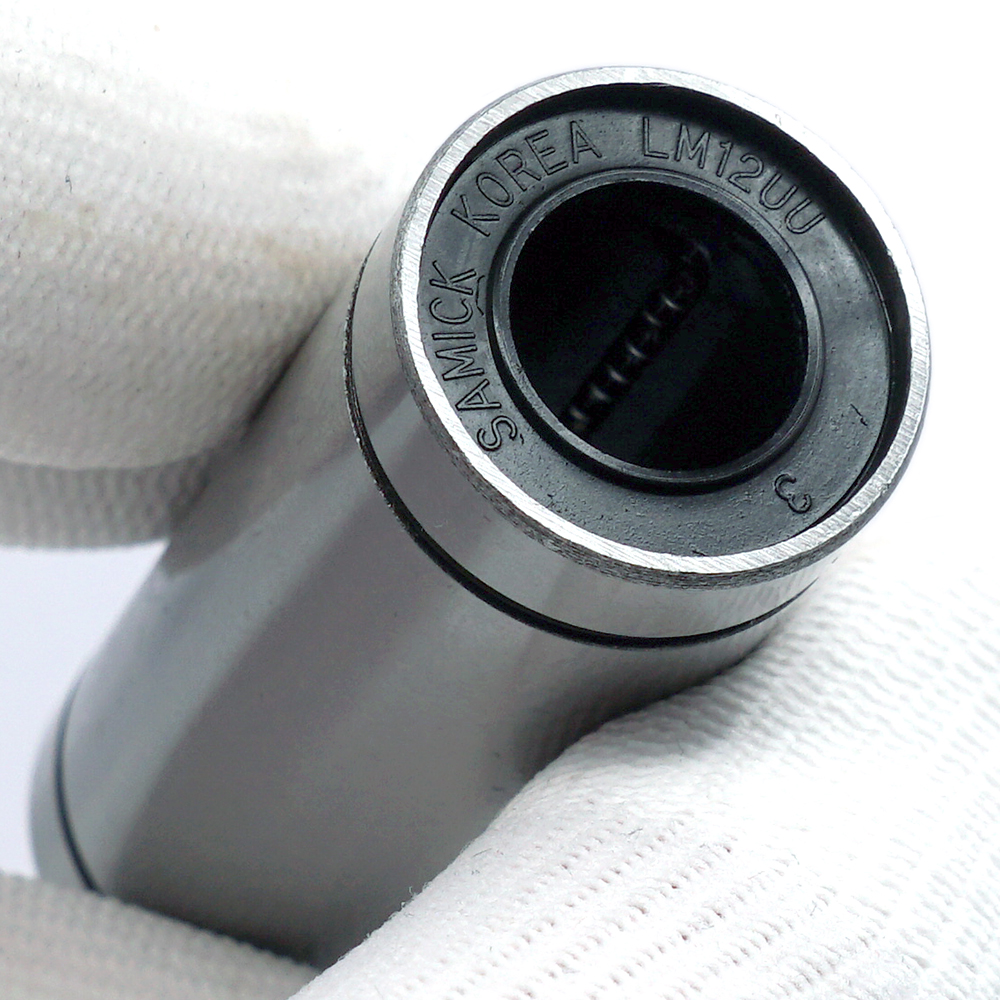
In the world of industrial automation and precision mechanics, linear bearings play a crucial role in ensuring smooth, precise, and reliable movements. SAMICK, a leader in the sector, offers a range of innovative linear bearings designed to enhance system efficiency and longevity.
In this article, we will explore the advantages, features, and applications of SAMICK linear bearings, highlighting why they are a strategic choice for those seeking precision and reliability.
What Are Linear Bearings?
Linear bearings are mechanical components that enable smooth and precise linear motion while minimizing friction. Used across numerous industries, they provide high performance and durability, improving productivity and reducing maintenance costs.
Why Choose SAMICK Linear Bearings?
SAMICK linear bearings stand out for their high-quality construction, reliability, and technological innovation. Their main advantages include:
✅ Smooth and precise motion – Advanced design ensures perfect glide with minimal friction.
✅ High-quality materials – Manufactured with wear-resistant steel and special treatments for increased durability.
✅ High load resistance – Designed to withstand intense mechanical stress without losing efficiency.
✅ Low maintenance – Due to high-quality materials and precision construction, these bearings reduce long-term operational costs.
✅ Versatile applications – Available in various configurations to suit different industrial needs.
Types of SAMICK Linear Bearings
SAMICK offers a comprehensive range of linear bearings, designed to adapt to different environments and applications:
1. Ball Linear Bearings
These bearings use a recirculating ball system, ensuring smooth, quiet, and precise motion. Ideal for:
🔹 CNC machines
🔹 Industrial automation
🔹 3D printers
2. Self-Lubricating Linear Bearings
With special coatings and self-lubricating materials, these bearings eliminate the need for frequent lubrication, reducing maintenance time and improving efficiency. Perfect for:
🔹 Pharmaceutical industry
🔹 Automated handling systems
🔹 Packaging machinery
3. Compact Linear Bearings
Designed for applications with limited space, they maintain high performance in terms of precision and smoothness. Used in:
🔹 Robotics
🔹 Measuring instruments
🔹 Electronics industry
4. Linear Guides with Integrated Bearings
These combine the stability of linear guides with the smoothness of ball bearings, improving movement precision and reducing wear. Ideal for:
🔹 Automated production lines
🔹 Medical applications
🔹 Assembly plants
Industrial Applications of SAMICK Linear Bearings
Thanks to their precision and reliability, SAMICK linear bearings are used in various industrial sectors, including:
🔹 Industrial automation – Used in production lines and robotic systems.
🔹 CNC machines and 3D printing – Essential for ensuring precise and repeatable movements.
🔹 Medical and pharmaceutical industry – Applications requiring absolute precision and minimal maintenance.
🔹 Packaging machinery – Ensuring smooth motion in automated packaging systems.
🔹 Aerospace sector – Used in high-precision, high-resistance applications.
How to Choose the Right Linear Bearing?
To select the best SAMICK linear bearing for your needs, consider:
🔹 Type of load – Axial, radial, or combined.
🔹 Required precision – Some applications demand extremely tight tolerances.
🔹 Environmental conditions – Temperature, humidity, and exposure to contaminants affect material and lubrication choices.
🔹 Maintenance frequency – Opting for self-lubricating or low-maintenance solutions can significantly reduce operational costs.
Conclusion
SAMICK linear bearings are a reliable and innovative solution for numerous industrial applications. Thanks to their precision, durability, and versatility, they ensure excellent performance and reduce maintenance costs over time.
🔧 Looking to improve the precision and efficiency of your systems?
📲 Visit our website to explore the full range of SAMICK linear bearings and find the perfect solution for your needs!
Related Reading
- CRAFT Ball Bearings: A Cost-Effective Standard
- SKF Y-Bearings (Insert Bearings): Selection Guide
- THK Linear Bearings: Premium Choice or Overkill?
- Bosch Rexroth Linear Motion Systems Overview 2026
- Loctite Threadlockers: Industrial Use Guide 2026
Need help with bearing selection?
Our Euro Bearing technical team helps engineers and maintenance managers choose the right bearing, seal or linear component for each application — from automotive transmissions to agricultural machinery and industrial robotics. Tell us your operating conditions (load, speed, temperature, environment) and we will recommend the optimal solution from our catalogue of premium European bearings.
Contact our technical office → or browse the full product range.
What a Linear Bearing Has to Do
A rotary bearing has one job: constrain a shaft while letting it turn. A linear bearing has a harder one. It must carry load in every direction except the one it is meant to move in, resist the moment loads that appear the instant the payload sits off-centre, and do all of this while sliding along a rail or a shaft with as little friction as possible — and, crucially, with consistent friction, because a linear axis that binds intermittently will never hold its position. Precision, stiffness and smoothness are not independent requirements here; they are the same requirement expressed three ways.
SAMICK is one of the established Korean manufacturers in this space, with a range that spans recirculating ball bushings, profile rail guides, ball screws and support units. Its position in the market is best described as high-quality, broadly interchangeable with the dimensional standards the industry uses, and priced well below the premium European brands — which is exactly why it appears so often in machine builds where the axis must be accurate but the budget must be defended.
The Main Product Families
Linear ball bushings (LM types). A cylindrical bushing with recirculating ball tracks that runs on a hardened round shaft. Simple, compact, inexpensive, and forgiving of small misalignments — especially in the self-aligning variants. They handle radial load well and moment load poorly, so they are usually used in pairs or fours. Dimensionally they follow the widely used LM / LME standards, which makes cross-referencing straightforward.
Profile rail guides (linear motion guides). A rectangular hardened rail with a recirculating ball or roller block. This is the workhorse of modern machine tools, gantries, robotics and automation, and its advantage over a round shaft is decisive: because the raceways are on the rail flanks, the block resists radial, reverse-radial and lateral loads almost equally, and it takes substantial moment loads. Preload classes and accuracy grades let the designer trade stiffness against friction and cost.
Ball screws. The rotary-to-linear converter that gives a machine axis its resolution and its stiffness. Rolled screws are economical and entirely adequate for most positioning duties; ground screws deliver the lead accuracy that precision machining demands.
Support units and accessories. Bearing support blocks, shaft supports and end machining — unglamorous, but they are what determines whether the assembled axis actually achieves the accuracy of its components.
Specifying a Linear Axis Correctly
- Define the load properly. Not just the payload mass, but where its centre of gravity sits relative to the carriage. Off-centre payloads generate pitch, yaw and roll moments that will dominate the sizing calculation and are the single most common thing designers get wrong.
- Include the dynamics. Acceleration and deceleration forces frequently exceed the static load. A 20 kg payload accelerating at 1 g is a 40 kg dynamic load, before you count the moment arm.
- Choose the accuracy grade you actually need. Higher grades cost disproportionately more; specifying precision you cannot measure is wasted money.
- Choose the preload deliberately. Higher preload gives higher stiffness and better repeatability, at the price of higher friction and shorter life. Light preload suits fast, lightly loaded axes; heavy preload suits cutting machines.
- Mount to a proper surface. A profile rail is only as straight as the machined surface it is bolted to. Rail mounting flatness and parallelism specifications exist for a reason — ignore them and the block will bind, wear unevenly and fail early.
Lubrication, Sealing and Service Life
Linear bearings fail for the same two reasons rotary bearings do: contamination and lubrication faults. The recirculating ball tracks are an efficient mechanism for dragging any abrasive particle on the rail straight into the load zone, which is why wipers, scrapers and — in dirty environments — bellows are not optional extras. Grease is the usual lubricant, delivered through the block’s nipple or from an automatic lubricator; the base-oil viscosity logic is the same one described in our guide to grease lubrication for bearings, and the interval depends on stroke length, speed and cleanliness. Short-stroke oscillation is a particular hazard: the balls never make a full revolution, the grease is never redistributed, and the raceway develops false brinelling. Where strokes are short, program a periodic full-stroke “exercise” cycle.
The failure signatures will be familiar to anyone who has read our article on identifying bearing damage: dull indentations from contamination, burnished tracks from inadequate film, and asymmetric wear from a rail that was not mounted flat — the linear equivalent of misalignment. A simple monitoring routine — check for rising drive current, listen for roughness, watch for grease discoloration — belongs in the same preventive inspection programme as your rotary bearings.
Where SAMICK Makes Sense
SAMICK is a strong choice where the design calls for standard dimensions, solid quality and competitive pricing: packaging machinery, general automation, woodworking and stone machinery, laboratory and medical equipment, 3D printers and CNC retrofits, and the many machine builds where a premium European brand would be over-specified. Because the dimensional standards are shared across the industry, SAMICK components can usually be cross-referenced directly against equivalents from other manufacturers — and cross-referencing is exactly the kind of work our technical team does every day.
Need help with bearing selection? Our team supports you with cross-references and lead-times. Contact our specialists →