
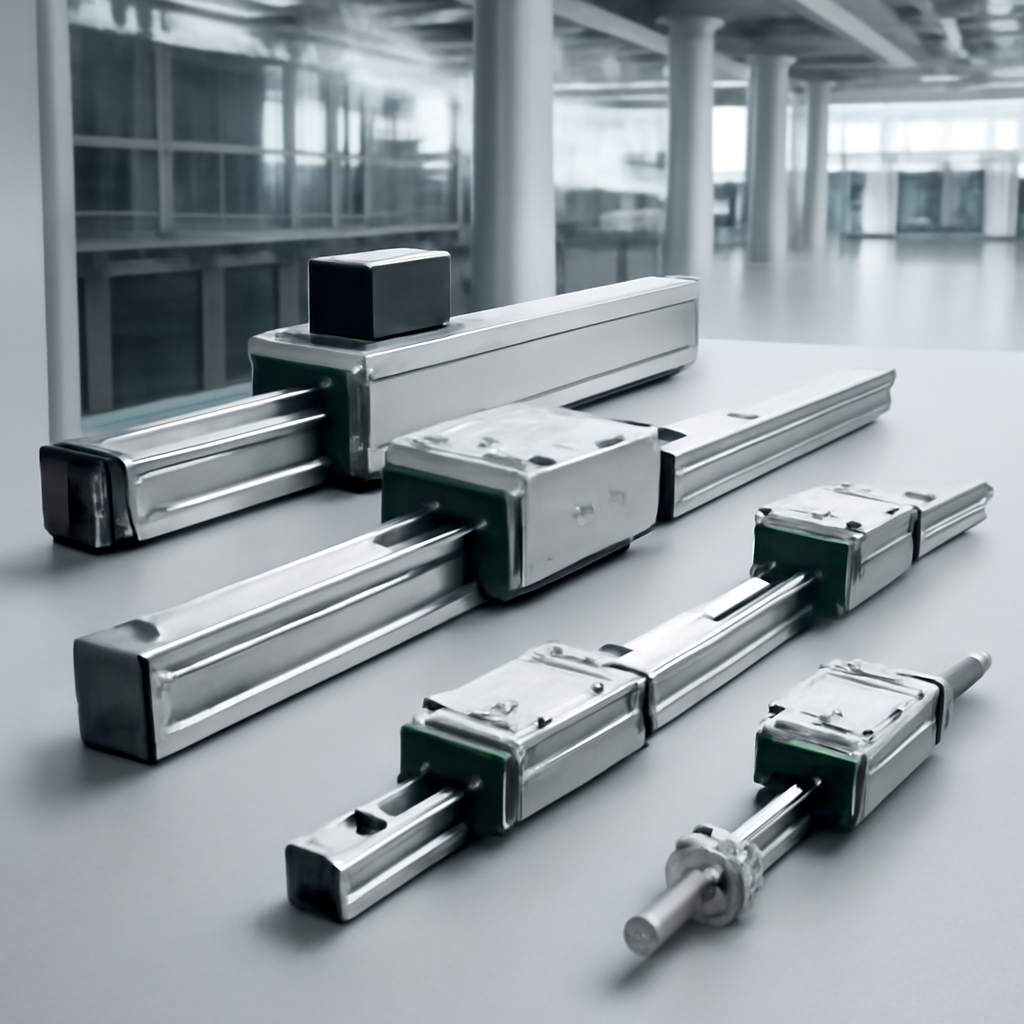
Bosch Rexroth, part of the Bosch Group, supplies one of the most complete linear motion portfolios in the industry. Profiled rails, ball screws, linear bushings, integrated linear modules, multi-axis gantries — the company covers the full range from miniature precision components to heavy industrial systems. This is the practical overview for 2026.
1. The Rexroth linear motion portfolio
1.1 Ball rail systems (profiled rail guideways)
Standard profiled rail guideways across sizes 15 to 65 mm. Direct competitors to Hiwin HG, Schneeberger MR, THK SHS. Strengths: tight integration with Rexroth ball screws and motors, excellent application engineering.
1.2 Cam roller guides
Open-style guides with cam-rolled outer surfaces. Used in applications where dust contamination would clog a recirculating system.
1.3 Ball screws
Precision ground and rolled-thread ball screws. C5/C7 ground classes are the workhorses; C3 for high-precision applications. Direct competitor to THK and Hiwin.
1.4 Linear motors
Iron-core and ironless linear motors for high-throughput automation, semiconductor and electronics manufacturing. Growing market segment (8.75% CAGR through 2033).
1.5 Compact modules and integrated linear assemblies
Pre-engineered units combining guide, drive, motor, and feedback. Drop-in axes for machine builders. Standard products: MKR, EMC, CKK series.
1.6 Multi-axis gantry and Cartesian systems
Pre-engineered XYZ gantries for assembly, pick-and-place, dispensing. Rexroth competes with IAI, Festo, IGUS in this segment.
2. Where Bosch Rexroth wins
- Machine builder OEM accounts: deep engineering support, integrated multi-axis solutions, single-supplier accountability.
- Heavy industrial automation: roller-bearing guideways with high load and stiffness.
- Hydraulics integration: Bosch Rexroth’s hydraulics heritage means seamless integration with hydraulic actuators where applicable.
- Mid-to-high precision automation: machine tools, printing, packaging.
3. Where commodity alternatives are fine
For light-duty general automation — pick-and-place at moderate cycles, packaging, low-load conveyors — a Hiwin or Samick equivalent is fine and meaningfully cheaper. The Rexroth premium pays back on integrated systems and on heavy/precision applications.
4. Decoding Rexroth designations
Example: R165 169 0420 = R-series runner block, runner block model 169, runner block accuracy class 04, runner block preload class 20. Manufacturer documentation is comprehensive and necessary for first-time spec.
5. Cross-reference notes
Rexroth profile rails are dimensionally compatible with Hiwin HG and THK SHS on standard sizes. Carriage interchange is possible with caveats on preload and accuracy.
6. The 2026 product roadmap
- Smart linear modules with integrated condition monitoring sensors.
- Expanded linear motor portfolio for semiconductor and battery cell manufacturing.
- Multi-axis assemblies with integrated controllers for cobot-style machine builds.
- Tighter Rexroth-IoT platform integration for predictive maintenance.
7. Selection guidance
- For new machine builds with multiple axes, evaluate Rexroth’s integrated module portfolio against component-based alternatives.
- For machine tool axes: ball rail with appropriate preload class, ground ball screw, servo motor — standard Rexroth combination.
- For semiconductor and electronics: linear motor solutions where the throughput justifies the premium.
- For commodity automation: a Hiwin or Samick equivalent may be the better economic choice.
Conclusion
Bosch Rexroth offers a complete linear motion portfolio backed by deep engineering support and integrated multi-axis solutions. For OEM machine builders the integrated approach is a differentiator; for component-only buyers the commodity alternatives often compete on price. Match the supplier to the project structure.
Industry consolidation effects in 2026
The bearing industry consolidation period is reshaping the European supplier landscape. The NSK and NTN Memorandum of Understanding (signed 12 May 2026, target closing October 2027) creates a combined entity that will challenge SKF and Schaeffler for the global #1 position. SKF’s separation of its Automotive business under a new three-segment structure (Bearing Solutions, Specialized Industrial Solutions, Automotive) sharpens segment focus. Schaeffler’s Yinchuan capacity expansion doubles standard catalogue capacity, normalising lead times that have been intermittently long since 2022. SKF’s G-Tech Instruments acquisition (March 2026) deepens condition monitoring capability.
For European industrial customers, these dynamics translate into specific operational implications. Multi-supplier qualification becomes more important across critical SKUs. Framework agreement negotiations should incorporate the consolidation context with substitution provisions and SKU continuity guarantees. Pricing leverage exists during the competitive window before NSK + NTN integration closes; framework agreements signed during 2026 lock favourable terms through the transition period.
Smart bearing platforms and procurement implications
The smart bearing transition is reshaping the broader supplier relationship. Every major manufacturer (SKF Insight, Schaeffler OPTIME, NSK SAT, NTN smart bearing platforms) has built or acquired platform capability. The integrated offering combines instrumented bearings, cloud analytics, AI-based anomaly detection, prescriptive workflow integration, and integrated services. For procurement leadership, the smart bearing decision involves more than the bearing — it involves the broader reliability ecosystem.
For European industrial customers, qualifying smart bearings on critical applications during 2026 positions the organisation for the post-2028 industry structure where smart bearings become standard rather than premium. The decision criteria expand beyond bearing specification and pricing to include platform capability, integration with existing CMMS and ERP, data ownership terms, and roadmap visibility.
Condition monitoring economic case
The deployment economics for IoT-based condition monitoring in 2026 are particularly favourable. Sensor hardware costs (under $50 per node) have collapsed 85% since 2019. Cloud platforms have matured into turnkey SaaS offerings. AI analytics adds capability that human analysts alone cannot match. Documented payback periods converge on 6-18 months for typical European mid-size industrial plant deployments.
For a typical mid-size plant with 50-100 critical assets, deployment cost runs €15,000-30,000 first-year capex plus €10,000-20,000 annual recurring. Documented savings: 30-50% reduction in unplanned downtime, typically valued at €100,000-500,000 annually. The capital justification is straightforward; the organisational change to operate alongside the technology is the actual implementation challenge.
The strategic procurement posture
For European industrial procurement leadership in 2026, the strategic posture distils to active engagement rather than passive reaction. Build supplier substitution agility across critical SKUs. Lock framework pricing where leverage exists during the competitive window. Invest in condition monitoring capability that delivers documented ROI. Qualify smart bearings on critical applications. Build master data discipline that supports informed substitution decisions during supply disruptions.
The cumulative effect of these procurement disciplines compounds across years. Organisations that build the capability now position themselves to outperform through the industry transition; those that delay will be implementing in 2028 against competitors who already have the foundation in place. The strategic window for proactive positioning is open through 2026 with diminishing returns thereafter.
Strategic procurement actions for H2 2026
For European industrial procurement teams in 2026, the practical action list during H2 2026 distils to several converging priorities. First, multi-supplier qualification on critical SKUs supports substitution agility through the consolidation period. The combined NSK + NTN entity will reshape supply dynamics post-2027; building qualified alternatives now provides operational protection regardless of how the integration unfolds. Second, framework agreement renegotiation captures pricing leverage that exists during the competitive window before consolidation closes. Multi-year locks on standard catalogue ranges deliver predictable cost discipline.
Third, condition monitoring deployment delivers documented ROI within 6-18 months for typical European mid-size industrial plants. The technology has matured; the economic case is clear; the implementation pathway is well-understood. Fourth, smart bearing qualification on critical applications positions the organisation for the post-2028 industry structure where smart bearings become standard. Fifth, master data discipline (clean bearing reference data, accurate cross-references, documented engineering equivalence) supports informed substitution decisions during the consolidation period.
The 2026 supplier ecosystem dynamics
The European bearing supplier ecosystem in 2026 is undergoing one of the most active restructuring periods in three decades. SKF’s restructuring around three reporting segments (Bearing Solutions, Specialized Industrial Solutions, Automotive) sharpens strategic focus. Schaeffler’s Yinchuan capacity expansion doubles standard catalogue capacity. NSK and NTN are integrating under a joint holding company target closing October 2027. JTEKT (Koyo) faces strategic positioning pressure from the broader consolidation. TIMKEN continues independent strategic direction in heavy industrial.
For European industrial customers operating in this environment, the supplier landscape that emerges in 2027-2028 will be materially different from 2025. Procurement strategy needs to evolve in parallel: multi-supplier qualification with engineering equivalence, framework provisions that anticipate consolidation effects, smart bearing platform commitments aligned with long-term reliability strategy, and condition monitoring infrastructure that supports data-driven supplier engagement. The investments made during 2026 set the procurement foundation for the coming decade.
The operational reality for European industrial customers
For European industrial customers operating in 2026, the bearing supply environment requires active management rather than passive procurement. Multi-supplier qualification, framework agreement renegotiation, condition monitoring deployment, smart bearing platform qualification, and master data discipline are all converging priorities. The strategic window for proactive positioning is open through 2026 with diminishing returns thereafter.
The cumulative effect of disciplined execution across these priorities compounds across years. Organisations that build the capability now position themselves for the post-2028 industry structure where smart bearings, condition monitoring, and integrated reliability services become standard rather than premium. The companies that wait will face higher capability gaps in 2028 against competitors who already have the foundation in place.
The 2026 strategic outlook
For European industrial customers, the 2026 bearing industry strategic outlook combines structural growth opportunity (market projection from $151.8B to $301B by 2033) with active consolidation dynamics (NSK + NTN integration, SKF Automotive spin-off, Schaeffler expansion). The practical posture is active engagement with these developments: multi-supplier qualification, framework agreement renegotiation, condition monitoring investment, and smart bearing qualification on critical applications. The cumulative effect of these disciplines compounds across the rest of the decade.
The 2026 strategic outlook
For European industrial customers, the 2026 bearing industry strategic outlook combines structural growth opportunity (market projection from $151.8B to $301B by 2033) with active consolidation dynamics (NSK + NTN integration, SKF Automotive spin-off, Schaeffler expansion). The practical posture is active engagement with these developments: multi-supplier qualification, framework agreement renegotiation, condition monitoring investment, and smart bearing qualification on critical applications. The cumulative effect of these disciplines compounds across the rest of the decade.
Related guides
- Linear Motion Market 2033
- HIWIN Linear Guides 2026
- SAMICK Linear Bearings
- SCHNEEBERGER Linear Motion
Need help with bearing selection? Our team supports you with cross-references and lead-times.