
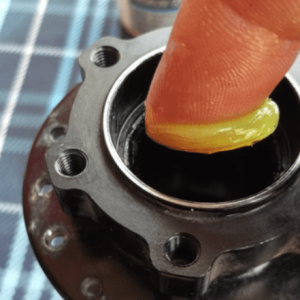
As we have frequently mentioned on our blog, lubrication is essential for ensuring the correct use of bearings. Since this process is a priority for maintaining optimal performance, it is important to clarify some key concepts that are often underestimated.
Let’s start by exploring grease lubrication systems.
How Much Grease Do Bearings Need?
The first point to keep in mind—and, if necessary, discuss with your trusted consultant—is the amount of grease required for proper bearing lubrication. Contrary to common belief, excessive amounts of grease are not necessary for effective lubrication. In many cases, frequent re-greasing is not required.
As expected, the frequency of re-greasing and the amount of grease needed depend on factors such as:
✔ The type of bearing
✔ Its size
✔ Rotational speed
✔ Operating conditions that may affect its efficiency
That said, you don’t need to perform complicated calculations to determine your lubrication needs. Simply refer to the manufacturer’s user manual, and if needed, consult a trusted specialist to estimate re-greasing intervals and usage quantities. These estimates take into account the bearing’s temperature, operating conditions, and expected lifespan.
Which Grease Should Be Used?
Another important factor to consider is the type of grease used in the bearing. For example, high-quality lithium-based synthetic oil greases often provide longer lubrication intervals compared to standard bearing greases. Choosing the right lubricant can help reduce maintenance efforts and extend bearing life.
How Important Is It to Protect Bearings from External Elements?
One crucial aspect that affects lubrication effectiveness and its longevity is the level of isolation from external contaminants.
Grease lubrication efficiency can significantly decrease due to:
- Emulsification (mixing with water)
- Deterioration caused by the penetration of dust, moisture, or foreign substances
If the bearing is not properly sealed, planned lubrication intervals may need to be shortened to prevent performance degradation.
Size Matters!
Another major factor influencing lubrication frequency is the size of the bearing:
- Larger bearings or those operating at high speeds typically require more frequent lubrication.
- To facilitate lubrication, these bearings are often equipped with dedicated grease insertion holes, eliminating the need for disassembly every time re-lubrication is required.
Find the Right Bearing for Your Needs
For any bearing-related needs, Cuscinetti & Componenti has the replacement parts you’re looking for. Contact our pre- and post-sales technical support for further information!
Related Reading
- Bearing Lubrication Intervals: A Practical Calculation Method
- How to Choose the Right Grease for Marine Bearings
- Sealing Rings and Oil Seals: Materials Used in 2026
- Grease vs Oil Lubrication for Bearings: A Decision Framework
- Sealing Solutions: Oil Seals vs Gaskets Compared
Need help with bearing selection?
Our Euro Bearing technical team helps engineers and maintenance managers choose the right bearing, seal or linear component for each application — from automotive transmissions to agricultural machinery and industrial robotics. Tell us your operating conditions (load, speed, temperature, environment) and we will recommend the optimal solution from our catalogue of premium European bearings.
Contact our technical office → or browse the full product range.
What Grease Actually Is
Grease is not simply “thick oil”. It is a three-part system: a base oil (typically 80–95 % by weight), a thickener (5–20 %) that holds the oil in a soap-fibre or clay matrix, and an additive package (antioxidants, anti-wear, extreme-pressure, corrosion inhibitors). The thickener behaves like a sponge: under the shear of the rolling contact it releases base oil into the contact zone, and when the shear stops it holds the remaining oil in place. That is the whole trick — and it is why grease lubricates roughly nine out of ten industrial bearings. It stays where you put it, it helps seal the bearing against dirt and moisture, and it needs no circuit, pump or reservoir.
Critically, it is the base oil viscosity, not the grease consistency, that forms the lubricating film. A stiff NLGI 3 grease with a thin base oil will lubricate a fast bearing better than a soft NLGI 1 grease with a heavy base oil. Confusing consistency with viscosity is the most common grease-selection error in industry.
Reading the Specification: NLGI, Base Oil, Thickener
NLGI consistency. Grades run from 000 (nearly fluid) to 6 (block hard). For rolling bearings, NLGI 2 is the default; NLGI 3 is chosen for vertical shafts or where the grease must resist being thrown out; NLGI 1 for centralised lubrication systems and low temperatures.
Base oil viscosity. Select it exactly as you would for an oil-lubricated bearing: calculate the required viscosity from bearing size and speed, then compare it with the actual viscosity at the operating temperature. The kappa ratio logic is set out in our companion article on how oil lubrication works for bearings, and it applies unchanged to the base oil in a grease.
Thickener type determines the personality of the grease. Lithium and lithium complex are the general-purpose workhorses, with lithium complex offering a higher dropping point and better high-temperature performance. Calcium sulphonate excels at water resistance and corrosion protection — the choice for wet or washdown environments. Polyurea is the standard for sealed-for-life electric motor bearings, thanks to excellent oxidation stability and long life. Clay (bentonite) has no dropping point and suits very high temperatures where relubrication is frequent. Aluminium complex is common in food-grade applications.
Compatibility: The Silent Killer
Mixing incompatible thickeners can destroy a grease outright. The classic failure is lithium mixed with polyurea, or calcium sulphonate mixed with lithium: the blended grease softens dramatically, runs out of the bearing, and the bearing fails from starvation — even though the housing looked full when you last checked it. When you change grease type, purge the bearing completely, or better still, dismount, clean and repack. Never assume two greases of the same NLGI grade will mix.
How Much Grease, and How Often
Both under-greasing and over-greasing cause failure, and they produce the same symptom — a hot bearing — which is why diagnosis must precede intervention. The working rules:
- Initial fill: pack the bearing cavity 100 %, but fill the free space in the housing only 30–50 % at medium speeds. At high speeds fill less; at very low speeds and in vertical arrangements, fill more.
- Relubrication quantity: a widely used approximation is G = 0.005 × D × B grams, where D is the outer diameter and B the width, both in millimetres.
- Relubrication interval: derive it from speed, load and temperature using the manufacturer’s chart, then halve it for every 15 °C above 70 °C. Grease life is dominated by temperature.
- Relubricate while running, where safety allows, so that fresh grease reaches the rolling elements and the old grease can purge.
The most damaging habit in industry is the grease gun applied “because it’s Friday”. Over-greasing causes churning, raises the temperature, and — in electric motors — pushes grease past the inner bearing cap into the windings. If the bearing you are servicing is already running hot, read our guide to bearing overheating before you add anything.
What Grease Failure Looks Like
Grease fails in recognisable ways. Oxidation darkens it and hardens it into a varnish that no longer releases oil. Bleeding — excessive separation of base oil — leaves a dry, crusty thickener behind. Mechanical shearing softens it until it runs out of the bearing. Water contamination turns it pale and emulsified. Solid contamination shows up as grit when you rub the purged grease between two fingers, and as dull indentations on the raceway when the bearing is finally opened. Each of these is visible in the grease you purge at the next service, which makes purged-grease inspection one of the cheapest diagnostics available — see our article on preventive inspections for how to build it into a routine, and bearing damage identification for reading the raceway itself. The seal is what keeps water and dirt out in the first place: our overview of oil seal materials explains how to specify it.
When Grease Is the Wrong Answer
Grease reaches its limits at high speed (where churning generates unmanageable heat), at sustained high temperature (where it oxidises too fast to be practical), where the bearing must be cooled by the lubricant, and where the bearing shares a sump with gears. In all four cases, oil circulation, jet or oil-air lubrication is the correct engineering answer.
Key Takeaways
- Grease = base oil + thickener + additives; the base oil viscosity forms the film, not the NLGI grade.
- Match the thickener to the environment: lithium complex general-purpose, calcium sulphonate for water, polyurea for motors.
- Never mix incompatible thickeners — purge or repack when changing grease.
- Fill the housing 30–50 %, not 100 %. Over-greasing is a leading cause of overheating.
- Halve the relubrication interval for every 15 °C above 70 °C.
Frequently Asked Questions
Can I mix two greases? Only if the thickeners are compatible. Lithium and polyurea, or lithium and calcium sulphonate, are classic incompatible pairs: the mixture softens, runs out of the bearing and starves it. When in doubt, purge or repack.
How much grease does a bearing need? Fill the bearing cavity completely and the surrounding housing space only 30–50 % at medium speeds. For relubrication, G = 0.005 × OD × width (mm) gives a workable quantity in grams.
Does a higher NLGI number mean better lubrication? No. NLGI describes consistency, not film-forming ability. The base oil viscosity at operating temperature is what determines whether the bearing is protected.
How does temperature affect grease life? Dramatically. Grease service life roughly halves for every 15 °C above 70 °C, which is why a bearing running 30 °C hot needs relubricating up to four times more often.
Need help with bearing selection? Our team supports you with cross-references and lead-times. Contact our specialists →