
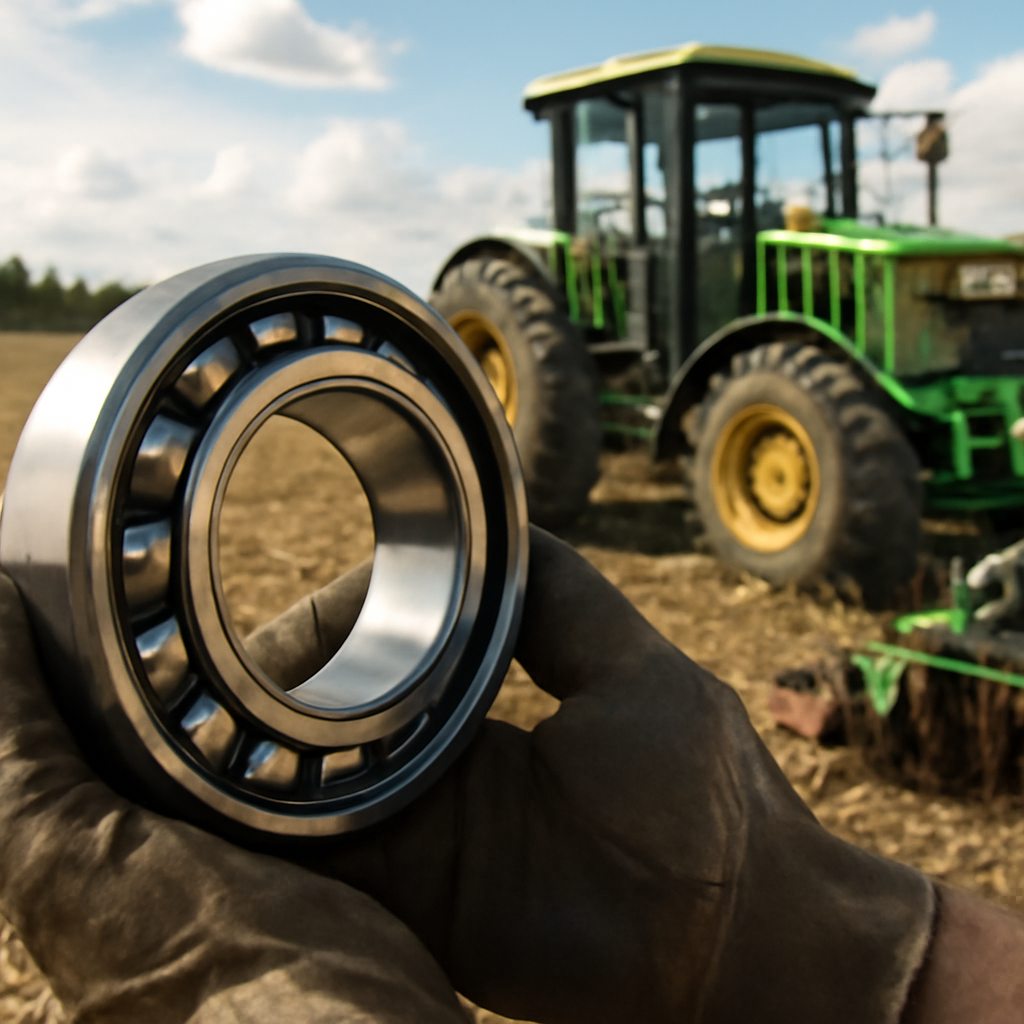
Agriculture punishes bearings. Heavy shock loads from rough fields, prolonged exposure to mud, fertiliser, washing water and silage acids, long storage periods between seasons, and a maintenance environment that ranges from immaculate to non-existent — all of it adds up to a duty profile far tougher than most industrial applications. NTN’s agricultural bearing range is engineered specifically around these realities.
The signature features of NTN agricultural bearings
- Triple-lip seals: standard radial agricultural inserts use three contact lips designed to keep mud and water out under spray.
- Wide inner ring designs: longer hub for better support on shafts, with set-screw or eccentric collar locking.
- Heavy-duty cage designs: pressed steel or polyamide cages chosen for shock-load survival.
- High-fill grease: factory-filled with a high quantity of high-viscosity grease, sealing additionally by displacement.
The main NTN agricultural product families
Agri-Hub units
Pre-engineered hub assemblies for disc harrows, rotary tillers, and seeding equipment. The hub housing, bearing, seals, and grease are integrated as a sealed-for-life unit. The trade-off is that the unit is replaced rather than serviced — but field downtime is minimised.
UC and UCP insert bearings
The workhorse of seasonal equipment: ball-bearing inserts in cast iron, stainless steel, or thermoplastic housings, mounted on shafts up to roughly 60-80 mm. NTN’s agricultural variants feature reinforced seals and high-fill grease.
Disc bearings
Tapered roller bearings specifically configured for plough discs and harrow gangs — high axial-load capacity, very heavy seals, designed for replacement-friendly removal at the end of the season.
Maintenance routine for seasonal equipment
- End of season: wash the machine but never direct high-pressure water at the bearing seals. Re-grease all serviceable bearings while the equipment is still warm.
- Winter storage: ideally indoors and on supports that prevent shock loads from settling. Rotate shafts by hand once a month to redistribute grease and prevent false brinelling.
- Pre-season startup: visual inspection, pressure-grease all serviceable bearings, run the equipment at reduced speed for the first 30 minutes.
- Mid-season: re-grease at the manufacturer’s interval — most agricultural bearings benefit from re-greasing every 50-100 working hours.
When to replace rather than re-grease
Signs that a bearing has reached the end of its useful life: rough or notchy rotation by hand, visible rust or pitting on the rolling elements, persistent water in the grease drained during service, or audible noise that does not improve after re-lubrication.
The NTN Agri-Hub solution in depth
NTN’s Agri-Hub units consolidate bearing, seals, and hub assembly into single sealed-for-life units designed for the harshest agricultural applications. The unit design eliminates field maintenance — when service is required, the entire unit is replaced rather than serviced. The trade-off: higher initial cost vs lower total ownership cost across the equipment lifecycle for high-duty applications.
The Agri-Hub portfolio covers disc harrow hubs, rotary tiller drives, and seeder/planter row units. For European agricultural OEMs and equipment dealers, the units simplify both new equipment specification and aftermarket service. The reduced field maintenance burden directly addresses the operational reality of modern agriculture: tight harvest windows where equipment downtime is operationally expensive.
NTN agricultural product positioning vs competitors
NTN competes with SKF, FAG/INA, Timken, and specialty agricultural bearing suppliers across the agricultural range. NTN’s competitive positioning: strong on tapered roller bearings (truck wheel hub heritage transfers cleanly), strong on heavy-duty insert bearings with triple-lip seals, and competitive on standard catalogue ranges through global aftermarket distribution.
For European agricultural equipment manufacturers and dealers, the bearing choice often follows OEM specification — and NTN appears as a default on many OEM bills of material. For aftermarket replacement, customers typically have multi-brand options with NTN as one of the established choices.
The NSK + NTN merger context for agricultural customers
The May 2026 MoU between NSK and NTN does not change operational reality for agricultural customers in 2026. Both brands continue to operate independently, both will be supplied through existing aftermarket channels, and both brand identities will likely be preserved in the post-merger entity. Agricultural customers should continue to specify NTN where it is the established choice, with confidence that supply continuity is not at risk during the integration period.
Looking ahead: smart agricultural bearings
The next generation of agricultural bearings adds integrated sensors for condition monitoring. The use case for agricultural equipment is particularly compelling — equipment that operates for limited weekly hours during peak season, with high cost per hour of unplanned downtime, benefits from predictive maintenance more than continuous-duty industrial equipment. The 2026-2027 product roadmap from NTN and competitors includes smart agricultural bearing variants entering the market.
The 2026 supplier landscape and procurement strategy
The European industrial bearing supplier landscape continues to consolidate through 2026 with the NSK + NTN integration, SKF Automotive spin-off, and Schaeffler capacity expansion all reshaping the competitive dynamics. For procurement teams, the practical implications are: multi-supplier qualification becomes more important, framework agreement provisions need explicit substitution clauses, and supplier relationships shift toward longer-term partnerships rather than transactional cost optimisation.
The substitution agility — the ability to switch between supplier sources without operational disruption — is the most valuable procurement capability through the consolidation period. Building the cross-reference database, qualifying multiple sources on critical SKUs, and documenting engineering equivalence delivers protection against supplier strategic missteps and competitive pricing leverage during normal operation.
Total cost of ownership across the equipment lifecycle
Beyond purchase price, total cost of ownership across the equipment lifecycle frequently shifts procurement decisions toward higher-specification bearings. The cumulative cost components: acquisition, installation, lubrication and maintenance, downtime cost during failures, replacement, and end-of-life disposal. For applications with significant downtime cost or extended service intervals between maintenance windows, premium specifications routinely pay back across the lifecycle.
For European industrial customers operating under tight maintenance budgets, the TCO analysis sometimes reveals that the “cheaper” bearing produces higher total cost. The discipline of working through the lifecycle math — rather than defaulting to acquisition price comparisons — is one of the highest-leverage procurement capability investments available.
Smart bearing integration roadmap
The next generation of industrial bearings integrates sensors for predictive maintenance: temperature, vibration, sometimes current monitoring built into the bearing itself. Major manufacturers (SKF, Schaeffler, NSK, NTN) are all developing smart bearing platforms with progressive commercial rollout through 2027. For specifying engineers and procurement teams, the question is when to begin qualifying smart bearings on new equipment and how to integrate with existing condition monitoring infrastructure.
The smart bearing economics favour critical assets where the integrated sensor delivers more value than the price premium represents. For routine industrial bearing positions, standard products remain the right choice. The strategic decision is on critical assets where the smart bearing investment positions the customer for the post-2028 industry where smart bearings will be standard rather than premium.
The 2026 application engineering ecosystem
Modern bearing application engineering goes beyond catalogue selection. The major manufacturers provide structured application engineering services: bearing selection consultation, calculated bearing life analysis, lubrication system design, failure mode analysis, and integrated condition monitoring programmes. For OEM equipment designers and major industrial customers, engaging these services during equipment design pays back through extended service life and reduced operational risk.
The European authorised distribution network typically provides the first layer of application engineering — sufficient for standard catalogue selection and common application questions. Manufacturer engineering centres provide deeper consultation for complex applications, specialty environments, or new equipment design. The escalation path from distribution to manufacturer is well-established and worth using for non-routine applications.
Quality assurance and traceability
For critical applications, bearing manufacturer quality assurance and product traceability matter as much as the bearing specification. Modern bearing manufacturers maintain detailed batch records, material certification documentation, and dimensional inspection records. For aerospace, medical, and food applications subject to regulatory traceability requirements, this documentation is itself a strategic asset that supports customer compliance.
For routine industrial applications, traceability is less critical but still valuable. When unusual failures occur, batch traceability supports root-cause analysis. When supplier substitution is required, traceability documentation supports engineering equivalence verification.
The strategic supplier relationship
Beyond transactional bearing supply, the strategic supplier relationship delivers value across multi-year horizons. Engineering consultation on new equipment designs, training programmes for maintenance teams, condition monitoring platform integration, and access to roadmap information for procurement planning all flow from strategic supplier relationships. For European industrial customers, building this relationship with one or two preferred manufacturers — while maintaining qualified alternatives for supply resilience — is a sound procurement strategy.
Looking ahead to 2027-2030
The next 3-5 years will see continued bearing industry evolution: smart bearing technology becoming standard rather than premium, condition monitoring platforms maturing across all major manufacturers, supplier consolidation effects flowing through to procurement choices, and end-user expectations evolving toward integrated reliability solutions rather than component supply. For European industrial customers, positioning the procurement strategy for this evolution — qualifying smart bearing platforms, building condition monitoring capability, and maintaining supplier substitution agility — is the strategic foundation for the coming decade.
Related guides on Eurobearing
- Applications of NTN Bearings in the Agricultural Sector
- NTN: How to Choose the Right Bearings
- Complete Checklist for Periodic Bearing Maintenance
Need help choosing the right bearing for your application? Our technical team can support you with selection, cross-references, and lead-time information.