
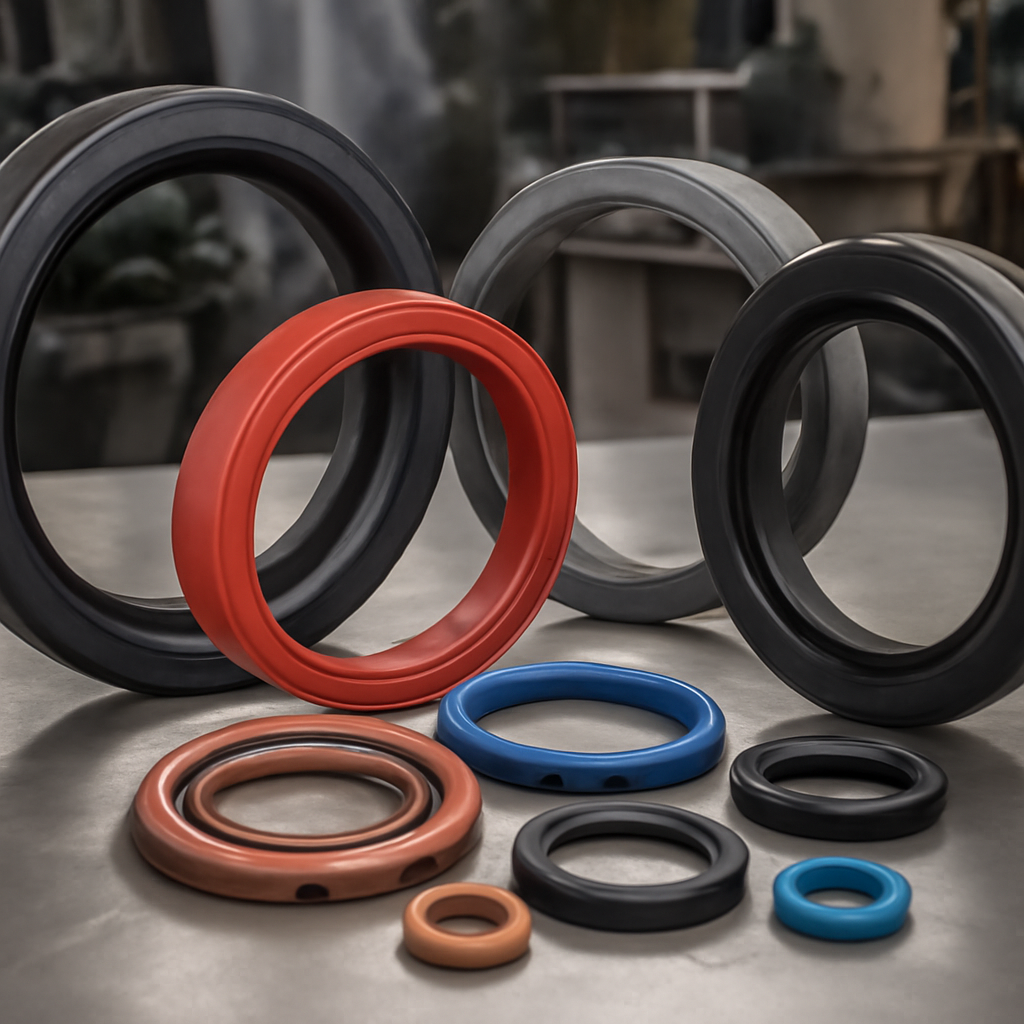
DICHTOMATIK, founded in Germany in 1969 and now part of the Freudenberg Group, is one of the most established names in industrial sealing. Its range covers radial shaft seals, O-rings, hydraulic and pneumatic seals, and specialty configurations across virtually every elastomer family.
The DICHTOMATIK product range
- Radial shaft seals: single-lip, double-lip, with or without dust lip; metric and imperial sizes; NBR, FKM, silicone, PTFE-based.
- O-rings: very broad cross-section and diameter ranges, with engineered material grades.
- Hydraulic seals: piston seals, rod seals, wipers, guide rings for hydraulic cylinders.
- Pneumatic seals: lower-pressure, lower-friction variants for pneumatic actuators.
- Specialty seals: PTFE-based for chemical, food-grade for hygienic, conductive elastomers for ESD-sensitive applications.
Why distributors specify DICHTOMATIK
1. Material consistency
The elastomer compounds are formulated for repeatable performance batch after batch. For industrial buyers managing thousands of SKUs, batch consistency translates directly into predictable maintenance scheduling.
2. Catalogue breadth
Standard catalogue items cover the vast majority of industrial sizes. Engineering-class seals are available on shorter lead times than truly custom designs.
3. Cross-reference availability
DICHTOMATIK provides clear cross-reference tables to the historical specifications of the major German and international suppliers — Simrit, Corteco, NOK, SKF.
Common selection mistakes
- Wrong elastomer for the fluid: NBR specified for synthetic transmission oil, leading to seal swelling. Always check fluid compatibility tables.
- Wrong shaft finish: a roughness of Ra 0.2-0.8 µm is the typical sweet spot for radial shaft seals. Too smooth causes stick-slip; too rough chews up the lip.
- Wrong installation tool: pressing a seal in with a screwdriver damages the case and the spring. Use a proper installation sleeve.
Cross-reference notes
DICHTOMATIK part numbers are based on the bore × outer diameter × thickness convention. Most standard sizes cross-reference cleanly to Freudenberg-Simrit, Corteco, NOK and SKF equivalents. For engineering-class seals, verify dimensions and elastomer grade carefully.
DICHTOMATIK industrial market segments
DICHTOMATIK seals appear across virtually every European industrial sector:
- Hydraulic and pneumatic equipment: piston seals, rod seals, wipers across all standard cylinder configurations.
- Industrial gearboxes and transmissions: shaft seals matched to oil chemistry and operating temperature.
- Pumps and compressors: shaft seals plus static seals at flange interfaces.
- Marine applications: specialty seals for salt-water exposure.
- Aerospace and defence: certified seals for specific applications.
- Food and beverage: FDA-compliant elastomer seals for hygienic equipment.
- Automotive aftermarket: replacement seals for engine, transmission, and chassis applications.
- HVAC and refrigeration: seals for compressors and refrigerant circuits.
The Freudenberg ownership and engineering depth
DICHTOMATIK’s status as part of Freudenberg Group provides engineering depth that smaller seal manufacturers cannot match. Freudenberg’s broader sealing portfolio includes Simrit, Freudenberg Sealing Technologies, and specialty businesses serving aerospace, medical, and automotive applications. The shared engineering resources accelerate product development and quality improvement across the DICHTOMATIK range.
For European industrial customers, the Freudenberg ownership means access to engineering consultation on complex sealing applications, certified materials documentation for regulated industries, and product roadmap visibility for long-term planning. The strategic supplier relationship extends beyond transactional seal supply.
Custom seal engineering and lead times
For applications outside the standard catalogue, DICHTOMATIK accepts custom engineering requests. Specialty elastomer formulations, non-standard dimensions, integrated assemblies, and certified materials for regulated industries are all available through custom engineering. Lead times for custom-engineered seals typically run 6-12 weeks; the engineering investment is worthwhile for applications where standard catalogue products do not adequately address the duty profile.
Material compatibility tables and selection
Seal selection ultimately depends on material compatibility with the application fluid, temperature, and pressure. DICHTOMATIK publishes comprehensive compatibility tables covering:
- Mineral oils across viscosity grades.
- Synthetic lubricants (PAO, PAG, ester-based).
- Hydraulic fluids (mineral, fire-resistant, biodegradable).
- Process fluids (acids, alkalis, solvents).
- Food-contact substances (per FDA and EU regulations).
- Aggressive chemicals (per industry-specific applications).
Verifying compatibility against the published tables before specification prevents the most common seal failure mode: elastomer degradation from incompatible fluid contact.
The OEM and aftermarket distribution structure
DICHTOMATIK serves both OEM equipment manufacturers (direct supply for new equipment builds) and aftermarket distribution (replacement seals through authorised distributors). The pricing and engineering support differ between channels — OEM customers receive bulk pricing and integrated engineering services; aftermarket customers receive broad standard catalogue availability and individual technical support through distribution.
For European industrial maintenance teams, building the relationship with a local authorised DICHTOMATIK distributor is the practical entry point. The distributor provides technical support for selection, stocking for routine needs, and access to Freudenberg engineering for complex applications.
Looking ahead: smart seals and integration
The next generation of industrial seals integrates condition monitoring sensors — wear sensors, leak detection, temperature monitoring built into the seal assembly. The technology is in early commercial deployment on selected critical applications. For European industrial customers operating predictive maintenance programmes, smart seal technology integrates naturally with broader Industry 4.0 platforms.
Through 2027-2030, expect smart seal adoption to follow a similar trajectory to smart bearing adoption: premium positioning on critical applications first, with progressive expansion to broader industrial use as the technology matures and cost reduces.
The 2026 application engineering ecosystem
Modern bearing application engineering goes beyond catalogue selection. The major manufacturers provide structured application engineering services: bearing selection consultation, calculated bearing life analysis, lubrication system design, failure mode analysis, and integrated condition monitoring programmes. For OEM equipment designers and major industrial customers, engaging these services during equipment design pays back through extended service life and reduced operational risk.
The European authorised distribution network typically provides the first layer of application engineering — sufficient for standard catalogue selection and common application questions. Manufacturer engineering centres provide deeper consultation for complex applications, specialty environments, or new equipment design. The escalation path from distribution to manufacturer is well-established and worth using for non-routine applications.
Quality assurance and traceability
For critical applications, bearing manufacturer quality assurance and product traceability matter as much as the bearing specification. Modern bearing manufacturers maintain detailed batch records, material certification documentation, and dimensional inspection records. For aerospace, medical, and food applications subject to regulatory traceability requirements, this documentation is itself a strategic asset that supports customer compliance.
For routine industrial applications, traceability is less critical but still valuable. When unusual failures occur, batch traceability supports root-cause analysis. When supplier substitution is required, traceability documentation supports engineering equivalence verification.
The strategic supplier relationship
Beyond transactional bearing supply, the strategic supplier relationship delivers value across multi-year horizons. Engineering consultation on new equipment designs, training programmes for maintenance teams, condition monitoring platform integration, and access to roadmap information for procurement planning all flow from strategic supplier relationships. For European industrial customers, building this relationship with one or two preferred manufacturers — while maintaining qualified alternatives for supply resilience — is a sound procurement strategy.
Looking ahead to 2027-2030
The next 3-5 years will see continued bearing industry evolution: smart bearing technology becoming standard rather than premium, condition monitoring platforms maturing across all major manufacturers, supplier consolidation effects flowing through to procurement choices, and end-user expectations evolving toward integrated reliability solutions rather than component supply. For European industrial customers, positioning the procurement strategy for this evolution — qualifying smart bearing platforms, building condition monitoring capability, and maintaining supplier substitution agility — is the strategic foundation for the coming decade.
Practical procurement guidance for 2026
For European industrial procurement teams operating in 2026, the practical guidance distils to a few key principles. First, build multi-supplier qualification across critical SKUs — supplier substitution agility is the most valuable procurement capability through the consolidation period. Second, lock pricing on framework agreements where leverage exists — bearing list prices continue upward trajectory through H2 2026 on most ranges. Third, invest in condition monitoring capability — the technology is mature and the ROI is documented. Fourth, build cross-reference databases that support informed substitution decisions during supply disruptions.
The cumulative effect of these procurement disciplines compounds across years. Organisations that build the capability now position themselves to outperform through the industry transition; those that delay will be implementing in 2028 against competitors who already have the foundation in place. The strategic window is open through 2026; the practical actions are well-defined.
The H2 2026 market context
Looking ahead to H2 2026, the European bearing market enters the period with several specific dynamics worth tracking. Industrial production indicators point toward moderate recovery; raw material costs remain elevated but stable; supply chain rebalancing continues as Schaeffler Yinchuan capacity reaches steady-state output. The NSK + NTN antitrust filings expected in Q3 2026 will be the most-watched ongoing story; SKF Automotive spin-off mechanics provide additional industry restructuring context.
For distributors and end-users operating in this environment, the practical posture is active engagement with supplier strategic developments combined with disciplined operational execution. Framework agreement negotiations during H2 2026 should incorporate the consolidation context; inventory positioning should reflect the lead-time normalisation; condition monitoring deployments should accelerate while implementation capacity is available. The window for proactive positioning ahead of the 2027 industry structure is narrow but real.
Related guides
- DICHTOMATIK Seal Guide for Industrial Applications
- Sealing Rings and Oil Seals: Materials Used
- Sealing Solutions: Oil Seals vs Gaskets
Need help choosing the right bearing? Our technical team can support you with selection, cross-references and lead-times.