
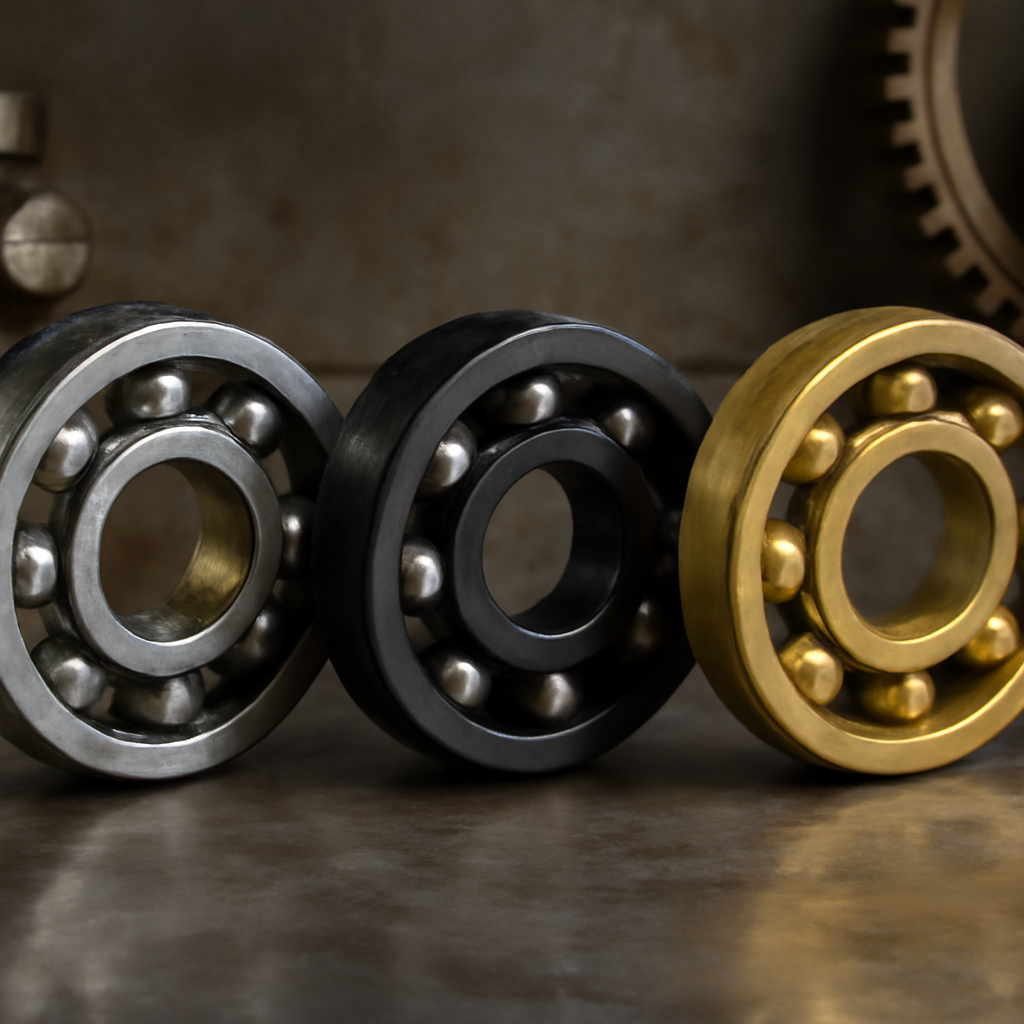
The cage of a bearing is not what carries the load — the rolling elements do that. The cage simply keeps them evenly spaced. Yet the cage choice determines maximum speed, shock-load tolerance, temperature limit and noise level. Three materials dominate the market.
Pressed steel cages
Stamped from steel strip, riveted or welded. The default in most general-purpose bearings.
- Pros: cheap, robust, broad temperature range (-50 to +250 °C), excellent for moderate speeds.
- Cons: heavier than alternatives, noisier at high speeds, can corrode.
- Use it for: standard industrial drives, agricultural machinery, general-purpose pumps and fans.
Polyamide (PA66) cages — typically the “TVH” designation
Glass-fibre-reinforced polyamide. Increasingly the standard in modern bearings.
- Pros: lighter, lower friction, quieter at high speeds, self-lubricating properties, good shock absorption.
- Cons: temperature limit around 120 °C continuous (150 °C peak), degrades in some specific lubricant additives over time.
- Use it for: high-speed electric motors, machine tool spindles, modern industrial gearboxes.
Solid brass cages
Machined or cast brass, heavier and more expensive.
- Pros: excellent shock-load survival, high temperature tolerance (above 200 °C), good lubricity, very stable dimensionally.
- Cons: more expensive, heavier, slightly more friction than polyamide.
- Use it for: heavy industrial duty (steel mills, mining), high-temperature applications, large bearings (above 100 mm bore).
Decision matrix
- Standard duty, moderate speed → pressed steel.
- High-speed motor, gearbox, machine tool spindle → polyamide.
- Heavy industry, shock loads, high temperature → brass.
- Above 100 mm bore, regardless of duty → brass is the default.
Suffix lookup
Steel cage: usually no specific suffix or J (SKF). Polyamide: TVH (FAG/INA), TN9 (SKF). Brass: M (FAG/INA/SKF), MB (heavier brass). Cross-reference catalogue tables before specifying.
Cage selection for specific industrial applications
The cage decision matrix expands when specific industrial applications are considered:
- Heavy industrial steel mill bearings: brass cage standard. The shock-load tolerance and high-temperature capability are non-optional.
- High-speed motor bearings (above 3000 rpm): polyamide cage preferred. Lower friction, quieter operation, adequate temperature capability.
- Agricultural insert bearings: pressed steel cage typical. Cost-effective, adequate for the duty profile.
- Wind turbine main bearings: brass cage standard. Long fatigue life, heavy load capability, decades of operational experience.
- Aerospace bearings: silver-plated steel or polyimide cages for specific applications. Specification driven by certification requirements.
- Food and beverage processing: stainless steel or polymer cages. Corrosion resistance is the priority.
- Machine tool spindles: specialised cage designs (often phenolic or carbon-reinforced polymer). Precision and low vibration are critical.
Cage failure modes and prevention
Cage failures are a significant cause of bearing damage when they occur. Common failure modes:
- Cage fracture from shock loading: occurs when impact loads exceed the cage material capability. Prevention: select brass cages for shock-loaded applications.
- Cage wear from inadequate lubrication: the cage pockets wear progressively, eventually allowing rolling element misalignment. Prevention: maintain proper lubrication.
- Cage degradation from temperature: polyamide cages soften above 120 °C continuous, eventually failing. Prevention: do not specify polyamide above its temperature limit.
- Cage corrosion: brass cages can corrode in specific chemical environments. Prevention: verify chemical compatibility before specification.
- Cage cracking from cyclic stress: occurs at very high speed in some applications. Prevention: select brass for sustained high-speed heavy-duty applications.
The 2026 cage material innovations
Bearing manufacturers continue to invest in cage material innovation:
- Carbon fibre reinforced polymer cages: lighter than brass, stronger than standard polyamide, with improved high-temperature performance. Emerging on premium machine tool spindle bearings.
- Self-lubricating polymer composites: reduce friction and re-lubrication requirements on selected applications.
- Smart cages with integrated sensors: enable bearing condition monitoring from within the bearing itself. Emerging on premium industrial applications.
- Hybrid metallic-polymer cages: combine the strengths of metal (durability, temperature) and polymer (weight, friction).
Cost vs benefit analysis across cage materials
The cost differential between cage materials is meaningful:
- Pressed steel cage: baseline cost.
- Polyamide cage: typically 10-25% premium over pressed steel.
- Brass cage: typically 30-60% premium over pressed steel.
- Specialty cages (silver-plated, polyimide, carbon-reinforced): 100%+ premium.
For most applications, the cage cost is a small fraction of the total bearing cost, and specifying the correct cage is more important than minimising cage cost. The wrong cage choice produces predictable bearing failures that vastly exceed any cage cost savings.
Cross-reference of cage designations across manufacturers
Cage designations follow manufacturer-specific conventions but functionally cross-reference cleanly:
- Polyamide: FAG/INA TVH, TVP — SKF TN9 — NSK TR — NTN T2.
- Brass: FAG/INA M, MB — SKF M — NSK MB — NTN M.
- Pressed steel: usually unmarked or J — SKF J — NSK F — NTN F.
- Solid brass machined: heavier brass variants for very large bearings.
The role of cage in modern bearing innovation
Cage design is one of the more active areas of bearing innovation in 2026. The combination of new materials (polymer composites, smart-sensor integration), new manufacturing techniques (additive manufacturing for prototyping, advanced moulding for production), and new application requirements (humanoid robotics, EV motors at very high speed) is driving continuous evolution in cage design. The cage of a 2030 bearing will look meaningfully different from the cage of a 2020 bearing.
The 5-year structural outlook
Looking through 2030, the structural drivers of bearing market evolution remain robust. EV adoption acceleration, wind energy capacity expansion, industrial robotics growth, linear motion market expansion, and smart bearing technology maturation all combine to drive sustained demand growth above the broader industrial GDP rate. The bearing market projection (from $151.8B in 2026 to $301B by 2033) reflects these structural drivers operating in parallel.
For distributors and OEMs operating in this environment, the strategic question is not whether the market grows but how to position to capture share of the growth. Investment in smart bearing capability, condition monitoring platforms, EV-specific product knowledge, and integrated reliability services positions the participant for the post-2028 industry structure.
Risk factors and scenario planning
Beyond the base case, scenario planning identifies the risk factors that could change the trajectory. Downside scenarios include: global recession affecting industrial production, supply chain disruption from geopolitical events, trade barrier escalation reshaping competitive economics, or technology adoption slower than forecasted. Upside scenarios include: accelerated EV adoption, faster humanoid robotics commercialisation, sustained wind capacity expansion above current forecasts.
For sound strategic planning, the appropriate posture is preparation for multiple scenarios with strategies that perform reasonably across scenarios rather than optimisation for any single scenario. Build supplier substitution agility, condition monitoring capability, and master data discipline — these pay back regardless of which scenario unfolds.
Regional dynamics and supply chain implications
The bearing market dynamics vary by region. Asia Pacific dominates volume; Europe leads premium positioning; North America benefits from tariff protection but faces smaller scale. The competitive interplay across regions affects pricing, technology adoption, and supplier strategic positioning. For European distributors and OEMs, navigating the regional dynamics — particularly the impact of US tariff regime and EU regulatory complexity — is increasingly part of strategic planning.
The investment thesis for industrial reliability
For European industrial customers, the broader investment thesis for reliability capability — smart bearings, condition monitoring, predictive maintenance — is decisive. The economic case is documented; the technology is mature; the implementation pathway is well-understood. The strategic question is the pace and depth of investment, not whether to invest.
The cumulative effect across years of investment is meaningful: 30-50% reduction in unplanned downtime, 15-25% reduction in maintenance labour, extended equipment life, and operational benefits across virtually every dimension. The reliability investment is the single highest-leverage operational improvement available to most industrial plants in 2026.
Practical procurement guidance for 2026
For European industrial procurement teams operating in 2026, the practical guidance distils to a few key principles. First, build multi-supplier qualification across critical SKUs — supplier substitution agility is the most valuable procurement capability through the consolidation period. Second, lock pricing on framework agreements where leverage exists — bearing list prices continue upward trajectory through H2 2026 on most ranges. Third, invest in condition monitoring capability — the technology is mature and the ROI is documented. Fourth, build cross-reference databases that support informed substitution decisions during supply disruptions.
The cumulative effect of these procurement disciplines compounds across years. Organisations that build the capability now position themselves to outperform through the industry transition; those that delay will be implementing in 2028 against competitors who already have the foundation in place. The strategic window is open through 2026; the practical actions are well-defined.
The H2 2026 market context
Looking ahead to H2 2026, the European bearing market enters the period with several specific dynamics worth tracking. Industrial production indicators point toward moderate recovery; raw material costs remain elevated but stable; supply chain rebalancing continues as Schaeffler Yinchuan capacity reaches steady-state output. The NSK + NTN antitrust filings expected in Q3 2026 will be the most-watched ongoing story; SKF Automotive spin-off mechanics provide additional industry restructuring context.
For distributors and end-users operating in this environment, the practical posture is active engagement with supplier strategic developments combined with disciplined operational execution. Framework agreement negotiations during H2 2026 should incorporate the consolidation context; inventory positioning should reflect the lead-time normalisation; condition monitoring deployments should accelerate while implementation capacity is available. The window for proactive positioning ahead of the 2027 industry structure is narrow but real.
Related guides
- How to Read FAG Bearing Designations
- Bearing Installation: 7 Mistakes
- How to Choose the Right Bearing
Need help choosing the right bearing? Our technical team can support you with selection, cross-references and lead-times.