
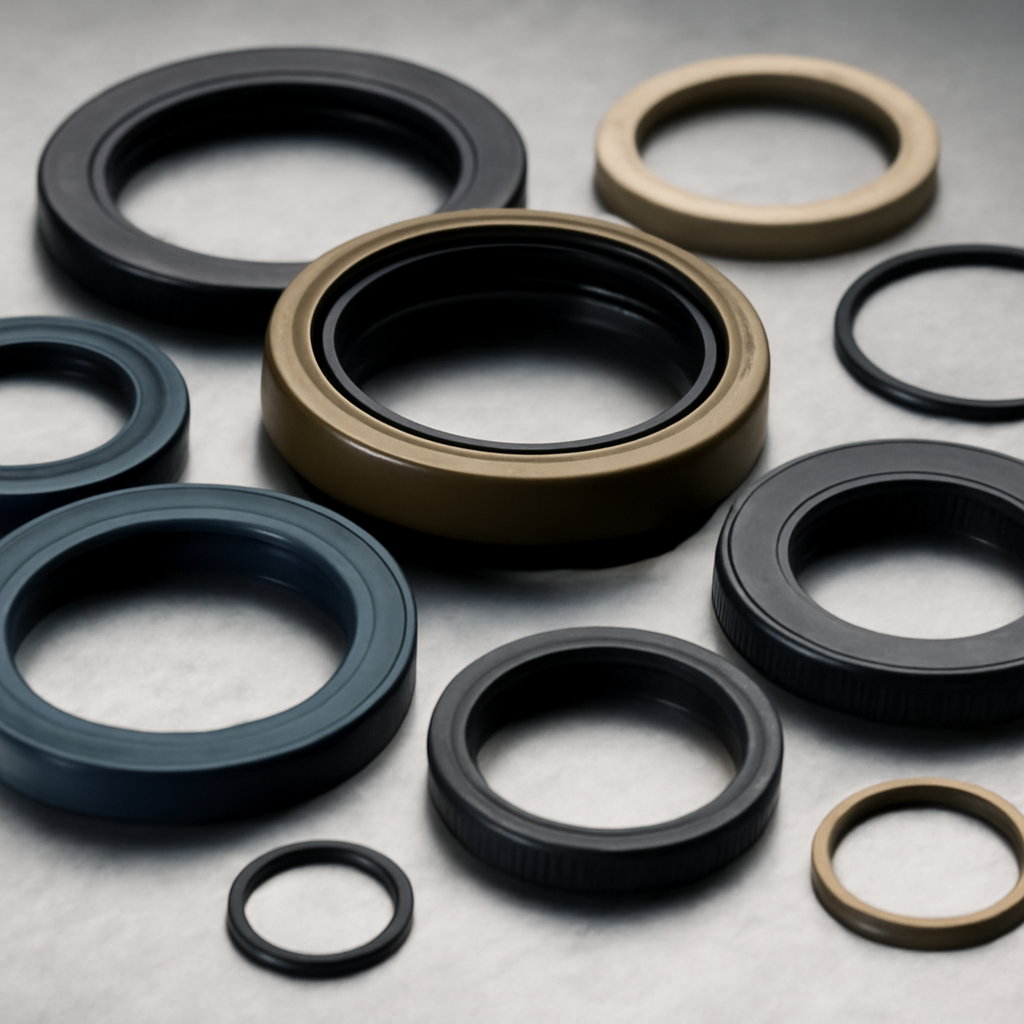
The visible part of an oil seal is the metal case. The performance — temperature range, chemical resistance, service life — is in the elastomer that forms the sealing lip. Choose the wrong elastomer and the seal degrades within months, regardless of how good the bearing behind it is. This is the practical guide to oil seal materials in 2026: the four dominant elastomer families, where each one shines, where it fails, and how to specify with confidence.
1. Why the material matters more than the dimension
Standard oil seal dimensions (DIN 3760, ISO 6194) are commodity items — every major supplier produces them. The technical decision lives in the elastomer specification. Get the dimensions right and use the wrong material, and the seal will leak within months. Get the material right with even imperfect dimensions, and you will usually get usable service life.
2. NBR — the default
Nitrile butadiene rubber (NBR, also Buna-N) is the most widely used seal elastomer. It covers most general-purpose industrial applications.
- Temperature range: -30 to +100 °C continuously, -40 to +120 °C peak.
- Fluid compatibility: excellent with mineral oils, hydraulic fluids, mineral-oil-based greases, water-glycol mixtures.
- Where it fails: aromatic solvents, ketones, esters, brake fluids. Sustained operation above 100 °C accelerates degradation.
- Use it for: standard motor, gearbox, pump and fan applications. The default unless something pushes you to specify otherwise.
- Hardness range: typically 70-90 Shore A; 75-80 is the sweet spot for industrial dynamic seals.
3. FKM (Viton) — for heat and aggressive fluids
Fluorocarbon elastomer is the workhorse upgrade from NBR when temperatures or fluid chemistry demand it.
- Temperature range: -20 to +200 °C continuously, brief excursions to +230 °C.
- Fluid compatibility: excellent with mineral oils, synthetic lubricants, fuels, aggressive chemicals.
- Where it fails: amines, ammonia, hot water (sustained), brake fluids, ketones.
- Use it for: hot gearboxes, automotive transmissions, engine oil seals, applications using synthetic lubricants where NBR swells.
- Cost: 3-5× the cost of NBR. The premium is paid back in service life and prevented downtime in the right application.
4. PTFE — the specialty
Polytetrafluoroethylene seals are used where chemical compatibility is extreme or where friction must be very low.
- Temperature range: -200 to +260 °C.
- Fluid compatibility: virtually universal — resists almost all chemicals.
- Where it fails: PTFE lips have lower elasticity than rubber, so the seal design must compensate (spring-energised lips, complex lip geometries).
- Use it for: chemical processing, high-speed applications where rubber friction is unacceptable, dry running, food and pharmaceutical applications.
- Cost: significantly higher than NBR or FKM; specialised assembly tools sometimes required.
5. Silicone (VMQ) — for low temperatures and food
Silicone elastomers cover the cold end of the temperature spectrum and the food/medical end of the application spectrum.
- Temperature range: -60 to +180 °C, with excellent low-temperature flexibility.
- Fluid compatibility: poor with mineral oils (the elastomer swells), so application limited to dry or special-fluid environments.
- Where it shines: food and pharmaceutical applications (FDA-compliant grades), low-temperature service, dry running.
- Where it fails: any oil or grease lubricated dynamic application.
6. Additional materials worth knowing
- HNBR (Hydrogenated NBR): improved temperature and ozone resistance over standard NBR. Good for automotive and high-temperature mineral oil service.
- EPDM: excellent water/steam compatibility, poor oil compatibility. Used in HVAC and brake fluid applications.
- Polyurethane (PU): high abrasion resistance, used heavily in hydraulic piston/rod seals.
- ACM: improved temperature and oil resistance vs NBR, used in automotive transmissions.
7. The selection checklist
- Identify the operating temperature range — both continuous and peak.
- Identify the fluid in contact with the seal lip.
- Check compatibility against the elastomer datasheet — most suppliers publish chemical resistance tables.
- For dynamic seals, verify the surface speed against the maximum allowable for the elastomer (NBR ~14 m/s, FKM ~25 m/s, PTFE varies).
- Match the shaft surface finish to the elastomer’s requirements (Ra 0.2-0.8 µm for NBR/FKM, finer for PTFE).
- Consider stocking duplicates — seal failure is rarely planned, and an installed spare is worth more than a procurement saga.
8. Common selection mistakes
- Specifying NBR for synthetic engine oil applications — the seal swells and fails.
- Wrong shaft finish: too smooth causes stick-slip; too rough chews up the lip.
- Reusing seals after disassembly — the lip has taken a set, the new run loads it differently.
- Installing a seal with the wrong direction (the lip faces the lubricant, not the environment).
- Using oil on the seal lip during installation when the manufacturer specifies dry installation (or vice versa).
9. Cross-reference notes
DICHTOMATIK, Freudenberg-Simrit, Corteco, SKF and NOK dominate the European market. Standard sizes cross-reference cleanly; verify the elastomer code in the part number when substituting. The colour of the seal lip is sometimes (but not always) a reliable indicator of the elastomer — never assume; check the datasheet.
Conclusion
The right oil seal is a matter of material first, dimension second. NBR is the workhorse and the default; FKM is the upgrade for heat or aggressive chemistry; PTFE is the specialty for extreme conditions; silicone is for cold and food. Get the elastomer right and the seal will outlast the bearing it protects. Get it wrong and you will be back replacing it in months. The decision deserves more thought than most procurement teams give it.
The H2 2026 market context
Looking ahead to H2 2026, the European bearing market enters the period with several specific dynamics worth tracking. Industrial production indicators point toward moderate recovery; raw material costs remain elevated but stable; supply chain rebalancing continues as Schaeffler Yinchuan capacity reaches steady-state output. The NSK + NTN antitrust filings expected in Q3 2026 will be the most-watched ongoing story; SKF Automotive spin-off mechanics provide additional industry restructuring context.
For distributors and end-users operating in this environment, the practical posture is active engagement with supplier strategic developments combined with disciplined operational execution. Framework agreement negotiations during H2 2026 should incorporate the consolidation context; inventory positioning should reflect the lead-time normalisation; condition monitoring deployments should accelerate while implementation capacity is available. The window for proactive positioning ahead of the 2027 industry structure is narrow but real.
The application engineering depth
Beyond catalogue selection, application engineering for this product category benefits from manufacturer engineering consultation. Specialised duty profiles, non-standard environments, and integrated multi-component solutions all benefit from manufacturer engineering involvement during the design phase. The investment pays back through extended service life and reduced operational risk across the equipment lifecycle.
The 2026 European market context
The European bearing market in 2026 enters a period of structural change. Industry consolidation (NSK + NTN, SKF Automotive spin-off), capacity expansions (Schaeffler Yinchuan), regulatory evolution (REACH, CBAM, trade defence), and end-market shifts (EV, wind, robotics) all reshape the operational environment. For procurement teams, the strategic posture is active engagement rather than passive reaction.
Supplier relationships and substitution capability
Beyond product specification, the supplier relationship and substitution capability matter as much as the bearing choice. Multi-supplier qualification, cross-reference database maintenance, and engineering equivalence documentation deliver procurement leverage and supply resilience. For European industrial customers, this capability investment is one of the highest-ROI strategic decisions available in 2026.
The 2026 reliability investment thesis
For European industrial customers in 2026, the broader reliability investment thesis is decisive. The combination of affordable IoT sensors (under $50 per node, an 85% cost reduction since 2019), mature AI analytics platforms, documented ROI cases (6-18 month payback in mid-size plants), and supplier ecosystem support makes condition monitoring deployment economically realistic for virtually any plant with critical rotating equipment. The cumulative effect across years of deployment is meaningful: 30-50% reduction in unplanned downtime, 15-25% reduction in maintenance labour, and extended equipment service life.
For procurement leadership specifically, the reliability investment changes the supplier relationship dynamic. Bearing supply becomes part of an integrated reliability conversation rather than a transactional component supply. Engineering services, condition monitoring platforms, training programmes, and roadmap visibility all flow from strategic supplier relationships. The companies building these relationships now position themselves for the post-2028 industry structure where smart bearings and integrated reliability solutions become standard rather than premium.
What the next 18 months will tell us
The next 18 months will clarify several major industry questions. NSK + NTN antitrust filings progress through Q3-Q4 2026 will reveal the regulatory burden and possible remedies. SKF Automotive spin-off mechanics will be confirmed, with implications for both the SKF industrial businesses and the new standalone automotive entity. Schaeffler Yinchuan capacity ramp will reach steady-state output, affecting standard catalogue lead times and pricing dynamics. EU industrial demand recovery will be tested through H2 2026 and into 2027.
For organisations operating in this environment, active engagement with these developments — through industry events, supplier conversations, and trade press monitoring — supports informed strategic decisions. The bearing industry in 2026-2027 is not on autopilot; the strategic decisions made during this period set competitive positioning for years to come.
Related guides on Eurobearing
- Viton Oil Seal: A Top-Quality Component
- Sealing Solutions: Oil Seals vs Gaskets Compared
- DICHTOMATIK Seals for Industrial Applications
- DICHTOMATIK Seal Guide
- Bearing Storage Best Practices
Need help with bearing selection or maintenance? Our technical team supports you with cross-references, selection and lead-times.