
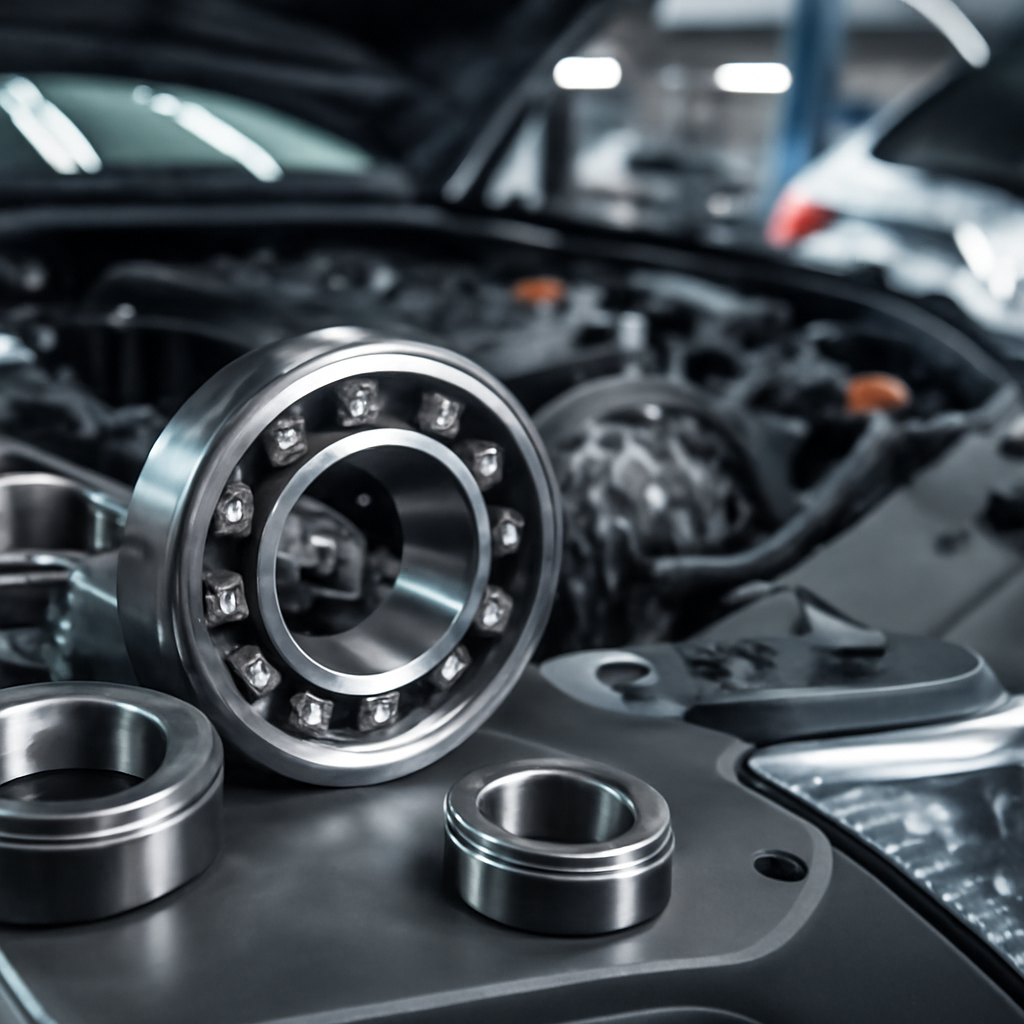
A modern passenger car contains 30 to 60 individual ball bearings distributed across the powertrain, transmission, wheels, steering, brakes, and auxiliary systems. Most are invisible to the driver and to the technician unless they fail. This is the practical map of ball bearings in a car — where they sit, what they do, and how the shift from internal combustion to electric vehicles is reshaping the specification.
1. Wheel hub bearings
The most heavily loaded bearings in the vehicle. Modern cars use Gen 1, Gen 2, or Gen 3 hub units:
- Gen 1: simple double-row angular contact unit, pressed into the steering knuckle.
- Gen 2: pre-assembled with mounting flange.
- Gen 3: includes ABS sensor target ring, single integrated assembly.
For EVs, the wheel hub bearing is increasingly specified with insulation against stray currents from the inverter-driven motor.
2. Engine bearings (ICE only)
- Crankshaft main bearings: typically plain (journal) bearings, not rolling. Some niche applications use rolling.
- Connecting rod bearings: plain bearings.
- Camshaft bearings: deep groove ball bearings in some designs; plain in others.
- Timing belt/chain tensioners: small deep groove ball bearings with integrated seals.
- Water pump: integrated bearing-and-seal cartridge.
EV impact
EVs eliminate engine, water pump (in many designs), and timing components. The bearing content per vehicle drops, but the remaining bearings are higher specification.
3. Transmission bearings
ICE transmissions (manual and automatic) carry dozens of bearings: input shaft, output shaft, layshaft, planetary gear stages. EV reducers — typically single-speed or two-speed — use fewer bearings but at higher speeds (up to 18,000-20,000 rpm) and higher torque density.
4. Differential bearings
Tapered roller bearings on the differential carrier and pinion. Specification is similar for ICE and EV applications.
5. Electric motor bearings (EV-specific)
The most thermally and electrically stressed bearings in an EV:
- Drive end: deep groove or angular contact ball bearing at very high speed.
- Non-drive end: deep groove ball bearing.
- Insulation requirement: at least one of the two positions must break the electrical path from rotor to housing — either via hybrid (ceramic ball) construction or via insulated outer ring coating.
Failure mode if insulation is omitted: EDM fluting — washboard-pattern raceway erosion that destroys the bearing within months.
6. Steering bearings
- Upper and lower steering column bearings: usually angular contact ball bearings.
- Electric power steering (now universal): brushless DC motor with its own bearing pack.
- Steering rack bearings: deep groove or needle.
7. Brake system bearings
Electronic brake-actuator pumps contain small deep groove bearings. Brake-by-wire systems (early production) introduce additional electric-motor bearing applications.
8. Auxiliary systems
- Alternator (ICE): two deep groove ball bearings.
- Starter motor (ICE): bearings on the armature.
- Air conditioning compressor: clutch bearing + pulley bearing (ICE); high-speed compressor bearings (EV with electric AC compressor).
- Cooling fans: deep groove ball bearings.
- Window regulators, sunroof motors, seat adjusters: small bearings with high cumulative count.
9. The aftermarket implications
For independent garages and parts distributors, the EV transition is reshaping the parts mix:
- Wheel hub units remain the largest aftermarket bearing category and are growing.
- Engine-side bearings shrink as the ICE fleet ages out.
- Electric motor bearings emerge as a growing but specialised category requiring insulation specification.
- Cross-reference databases need to flag insulated variants explicitly.
10. Cross-reference and supplier notes
SKF, FAG (Schaeffler), NTN, NSK, Koyo (JTEKT), Timken supply the OEM market. After-market is a wider field including FAG/INA, SKF, NTN, NSK plus regional specialists. For Gen 3 wheel hub units, prefer OEM-spec parts: lower-spec equivalents have measurably shorter life.
Conclusion
Ball bearings sit invisibly across the modern car, and the EV transition is changing where they are and what they need to be. For the aftermarket, the practical implication is simple: catalogue the insulated variants, train the technicians on the EDM failure mode, and prepare for a wheel hub unit market that keeps growing while engine-side bearings shrink.
The integrated technology layers in modern bearing applications
Modern bearing applications operate within an integrated technology ecosystem: bearing hardware, condition monitoring sensors, cloud analytics platforms, CMMS work order integration, and ERP procurement integration. For end-users adopting this integrated approach, the technology stack delivers value beyond any single component. The bearing supplier ecosystem in 2026 increasingly provides integrated solutions rather than discrete components.
The market signal for sustained growth
Multiple independent market signals point to sustained bearing industry growth through the end of the decade. The market size forecast (from $151.8B in 2026 to $301B by 2033, a 9.8% CAGR) reflects structural drivers operating in parallel: EV adoption acceleration, wind energy capacity expansion, industrial robotics growth, linear motion market expansion, and smart bearing technology maturation. For procurement teams, the implications are: bearing list prices likely continue upward trajectory, supplier strategic moves continue to reshape the landscape, and reliability technology investment continues to deliver documented ROI.
The strategic procurement priorities
For European industrial procurement leadership in 2026, the strategic priorities distil to: supplier substitution agility, framework pricing locks where leverage exists, condition monitoring capability investment, smart bearing qualification on critical applications, and master data discipline that supports informed substitution decisions. These five priorities compound across years of execution and position the procurement organisation for the post-consolidation industry structure.
Looking ahead to 2027-2030
The next 3-5 years will see continued bearing industry evolution: NSK + NTN integration completing and reshaping competitive dynamics, SKF Automotive spin-off mechanics clarified, Schaeffler humanoid robotics commercialisation, condition monitoring platform maturation across major manufacturers, and end-user expectations evolving toward integrated reliability solutions. For European industrial customers, positioning the procurement strategy for this evolution now — rather than reacting in 2028 — is the strategic foundation for competitive operational performance through the coming decade.
The smart bearing transition impact
Beyond standard procurement considerations, the smart bearing transition reshapes the broader supplier relationship. Smart bearings come with platform commitments (which analytics platform supports the sensors), software licensing implications (cloud platform subscriptions), and integration requirements (CMMS, ERP connections). For procurement teams, the smart bearing decision involves more than the bearing — it involves the broader reliability ecosystem.
The companies positioning early on smart bearing platforms capture multi-year operational advantage. The technology is mature enough for deployment on critical applications today; the economics are clear; the strategic question is platform selection and deployment pace rather than whether to deploy. For European industrial customers, engaging with the major manufacturer smart bearing roadmaps during 2026 positions the organisation for the 2027-2028 industry structure.
The 2026 reliability investment thesis
For European industrial customers in 2026, the broader reliability investment thesis is decisive. The combination of affordable IoT sensors (under $50 per node, an 85% cost reduction since 2019), mature AI analytics platforms, documented ROI cases (6-18 month payback in mid-size plants), and supplier ecosystem support makes condition monitoring deployment economically realistic for virtually any plant with critical rotating equipment. The cumulative effect across years of deployment is meaningful: 30-50% reduction in unplanned downtime, 15-25% reduction in maintenance labour, and extended equipment service life.
For procurement leadership specifically, the reliability investment changes the supplier relationship dynamic. Bearing supply becomes part of an integrated reliability conversation rather than a transactional component supply. Engineering services, condition monitoring platforms, training programmes, and roadmap visibility all flow from strategic supplier relationships. The companies building these relationships now position themselves for the post-2028 industry structure where smart bearings and integrated reliability solutions become standard rather than premium.
What the next 18 months will tell us
The next 18 months will clarify several major industry questions. NSK + NTN antitrust filings progress through Q3-Q4 2026 will reveal the regulatory burden and possible remedies. SKF Automotive spin-off mechanics will be confirmed, with implications for both the SKF industrial businesses and the new standalone automotive entity. Schaeffler Yinchuan capacity ramp will reach steady-state output, affecting standard catalogue lead times and pricing dynamics. EU industrial demand recovery will be tested through H2 2026 and into 2027.
For organisations operating in this environment, active engagement with these developments — through industry events, supplier conversations, and trade press monitoring — supports informed strategic decisions. The bearing industry in 2026-2027 is not on autopilot; the strategic decisions made during this period set competitive positioning for years to come.
The reliability ecosystem in 2026
For European industrial customers, the bearing supply relationship in 2026 increasingly extends beyond transactional component supply into a broader reliability ecosystem. Engineering consultation, condition monitoring platform integration, training programmes, and access to product roadmap information all flow from strategic supplier relationships. Building these relationships with preferred manufacturers — while maintaining qualified alternatives for supply resilience — is the foundation for navigating the industry consolidation period through 2027-2028.
Looking ahead through 2030
The bearing industry continues structural evolution through the rest of the decade, driven by EV adoption acceleration, wind energy expansion, industrial robotics growth, humanoid robotics commercialisation, and smart bearing technology maturation. The market projection from $151.8B in 2026 to $301B by 2033 reflects these structural drivers operating in parallel. For European industrial customers, positioning the procurement strategy for this evolution now, rather than reacting in 2028, is the strategic foundation for competitive operational performance through the coming decade.
Related guides
- Ball Bearings for Cars (legacy)
- EV Wheel Hub Bearings
- How to Choose the Right Bearing
- EV Transmissions
- FAG Ball Bearings 2026
Need help with bearing selection? Our team supports you with cross-references and lead-times.