
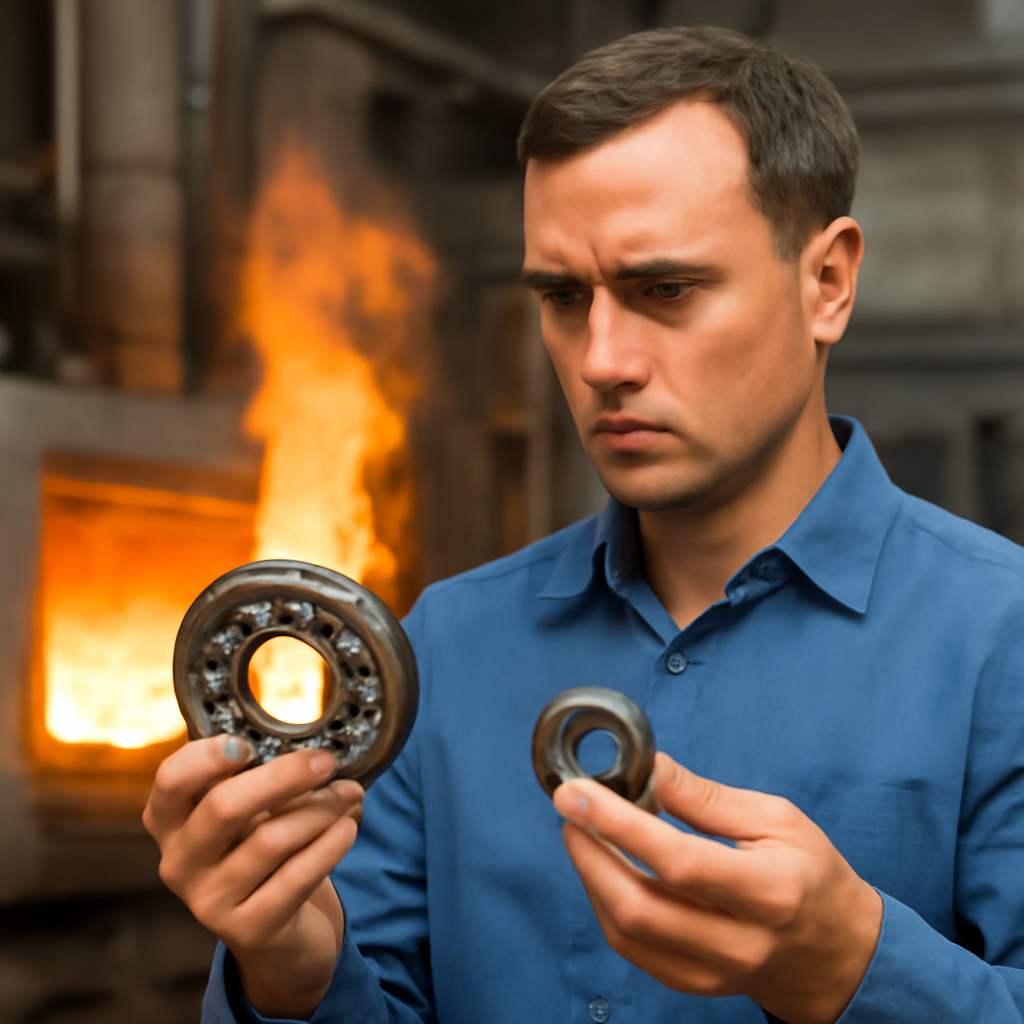
Standard bearings are engineered for a thermal envelope that breaks down above roughly 120 °C. Many industrial applications — furnaces, kilns, hot rolling mills, cement plants, steam turbines, baking ovens — run continuously well above that limit. Specifying the wrong bearing for this duty is one of the most expensive maintenance mistakes; specifying the right one produces years of trouble-free service. This guide walks through every dimension of the choice.
1. What “high temperature” means for a bearing
Above 120 °C, three things start to break down in a standard bearing:
- Lubricant degradation accelerates exponentially. NLGI 2 lithium grease that lasts 10,000 hours at 80 °C may last 500 hours at 150 °C.
- Internal clearance shrinks as the inner ring expands more than the outer. Risk of seizure if the bearing was specified with normal clearance.
- Steel hardness declines above 200 °C if the bearing was through-hardened with a standard heat treatment.
2. Bearing steel selection
- Up to 120 °C continuous: standard 100Cr6 (52100) bearing steel works fine.
- 120-200 °C: standard bearing steel with stabilisation heat treatment (S0 designation = stabilised to 150 °C, S1 to 200 °C, etc.).
- Above 250 °C: case-carburised steels or specialty alloys (M50, M50NiL) used in aerospace and turbine applications.
3. Clearance class
Above 100 °C, specify C3 clearance as a minimum. Above 150 °C continuous, consider C4. The expanded inner ring needs the extra space to avoid radial preload that overheats the bearing further.
4. Cage material
- Pressed steel: fine to 250 °C continuous.
- Polyamide (TVH): limit ~120 °C continuous, 150 °C peak. Do not specify for high-temperature service.
- Solid brass (M): excellent to 250 °C+, the default for heavy industrial high-temperature applications.
5. Lubrication strategy
Grease selection for high temperature
- 120-150 °C: synthetic-base greases (polyalphaolefin, ester) with lithium-complex or polyurea thickeners. SKF LGHT, Mobil Polyrex EM, equivalents.
- 150-200 °C: high-temperature specialty greases with fluorinated thickeners or solid lubricant additives.
- Above 200 °C: oil circulation rather than grease.
Re-lubrication interval
Halves for every 15-20 °C rise above the grease’s reference temperature. Use the manufacturer’s calculator and verify in service.
6. Sealing strategy
Standard NBR seals fail above 100 °C. For 100-200 °C, use FKM (Viton) seals. Above 200 °C, non-contact labyrinth seals replace lip seals — accepting some contamination ingress in exchange for thermal stability.
7. Mounting considerations
Differential expansion between shaft and housing must be designed in. Use a fixed bearing at one shaft end and a floating bearing at the other to accommodate thermal growth. The floating bearing is typically a cylindrical roller (NU type) that allows axial displacement freely.
8. When to use specialty bearings
- Hybrid ceramic ball bearings for very high speeds at elevated temperatures (machine tool spindles).
- Through-hardened M50 steel bearings for aerospace turbines.
- Graphite-cage bearings for solid-lubricant high-temperature service.
- Sealed grease-filled bearings with high-temperature grease for “fit and forget” service up to 180 °C.
9. Selection checklist
- Identify the maximum continuous operating temperature and the peak temperature.
- Confirm bearing steel and stabilisation: standard up to 120 °C, S1 up to 200 °C.
- Specify C3 or C4 clearance.
- Solid brass cage above 150 °C.
- Match grease to the temperature envelope and verify re-lubrication interval.
- Choose FKM seals up to 200 °C; labyrinth above.
- Design the mounting for thermal expansion (fixed + floating arrangement).
Conclusion
High-temperature bearing selection is a system problem, not a part choice. Get all six dimensions right — steel, clearance, cage, grease, seals, mounting — and you get years of trouble-free operation in conditions that would destroy a standard catalogue selection in weeks.
The integrated technology layers in modern bearing applications
Modern bearing applications operate within an integrated technology ecosystem: bearing hardware, condition monitoring sensors, cloud analytics platforms, CMMS work order integration, and ERP procurement integration. For end-users adopting this integrated approach, the technology stack delivers value beyond any single component. The bearing supplier ecosystem in 2026 increasingly provides integrated solutions rather than discrete components.
The market signal for sustained growth
Multiple independent market signals point to sustained bearing industry growth through the end of the decade. The market size forecast (from $151.8B in 2026 to $301B by 2033, a 9.8% CAGR) reflects structural drivers operating in parallel: EV adoption acceleration, wind energy capacity expansion, industrial robotics growth, linear motion market expansion, and smart bearing technology maturation. For procurement teams, the implications are: bearing list prices likely continue upward trajectory, supplier strategic moves continue to reshape the landscape, and reliability technology investment continues to deliver documented ROI.
The strategic procurement priorities
For European industrial procurement leadership in 2026, the strategic priorities distil to: supplier substitution agility, framework pricing locks where leverage exists, condition monitoring capability investment, smart bearing qualification on critical applications, and master data discipline that supports informed substitution decisions. These five priorities compound across years of execution and position the procurement organisation for the post-consolidation industry structure.
Looking ahead to 2027-2030
The next 3-5 years will see continued bearing industry evolution: NSK + NTN integration completing and reshaping competitive dynamics, SKF Automotive spin-off mechanics clarified, Schaeffler humanoid robotics commercialisation, condition monitoring platform maturation across major manufacturers, and end-user expectations evolving toward integrated reliability solutions. For European industrial customers, positioning the procurement strategy for this evolution now — rather than reacting in 2028 — is the strategic foundation for competitive operational performance through the coming decade.
The smart bearing transition impact
Beyond standard procurement considerations, the smart bearing transition reshapes the broader supplier relationship. Smart bearings come with platform commitments (which analytics platform supports the sensors), software licensing implications (cloud platform subscriptions), and integration requirements (CMMS, ERP connections). For procurement teams, the smart bearing decision involves more than the bearing — it involves the broader reliability ecosystem.
The companies positioning early on smart bearing platforms capture multi-year operational advantage. The technology is mature enough for deployment on critical applications today; the economics are clear; the strategic question is platform selection and deployment pace rather than whether to deploy. For European industrial customers, engaging with the major manufacturer smart bearing roadmaps during 2026 positions the organisation for the 2027-2028 industry structure.
The 2026 reliability investment thesis
For European industrial customers in 2026, the broader reliability investment thesis is decisive. The combination of affordable IoT sensors (under $50 per node, an 85% cost reduction since 2019), mature AI analytics platforms, documented ROI cases (6-18 month payback in mid-size plants), and supplier ecosystem support makes condition monitoring deployment economically realistic for virtually any plant with critical rotating equipment. The cumulative effect across years of deployment is meaningful: 30-50% reduction in unplanned downtime, 15-25% reduction in maintenance labour, and extended equipment service life.
For procurement leadership specifically, the reliability investment changes the supplier relationship dynamic. Bearing supply becomes part of an integrated reliability conversation rather than a transactional component supply. Engineering services, condition monitoring platforms, training programmes, and roadmap visibility all flow from strategic supplier relationships. The companies building these relationships now position themselves for the post-2028 industry structure where smart bearings and integrated reliability solutions become standard rather than premium.
What the next 18 months will tell us
The next 18 months will clarify several major industry questions. NSK + NTN antitrust filings progress through Q3-Q4 2026 will reveal the regulatory burden and possible remedies. SKF Automotive spin-off mechanics will be confirmed, with implications for both the SKF industrial businesses and the new standalone automotive entity. Schaeffler Yinchuan capacity ramp will reach steady-state output, affecting standard catalogue lead times and pricing dynamics. EU industrial demand recovery will be tested through H2 2026 and into 2027.
For organisations operating in this environment, active engagement with these developments — through industry events, supplier conversations, and trade press monitoring — supports informed strategic decisions. The bearing industry in 2026-2027 is not on autopilot; the strategic decisions made during this period set competitive positioning for years to come.
The reliability ecosystem in 2026
For European industrial customers, the bearing supply relationship in 2026 increasingly extends beyond transactional component supply into a broader reliability ecosystem. Engineering consultation, condition monitoring platform integration, training programmes, and access to product roadmap information all flow from strategic supplier relationships. Building these relationships with preferred manufacturers — while maintaining qualified alternatives for supply resilience — is the foundation for navigating the industry consolidation period through 2027-2028.
Looking ahead through 2030
The bearing industry continues structural evolution through the rest of the decade, driven by EV adoption acceleration, wind energy expansion, industrial robotics growth, humanoid robotics commercialisation, and smart bearing technology maturation. The market projection from $151.8B in 2026 to $301B by 2033 reflects these structural drivers operating in parallel. For European industrial customers, positioning the procurement strategy for this evolution now, rather than reacting in 2028, is the strategic foundation for competitive operational performance through the coming decade.
Related guides
- High-Temperature Bearings
- Grease vs Oil Lubrication
- Guide to Choosing Lubricants
- How to Address Bearing Overheating
- Bearing Cages: Steel vs Polyamide vs Brass
Need help with bearing selection? Our team supports you with cross-references and lead-times.