
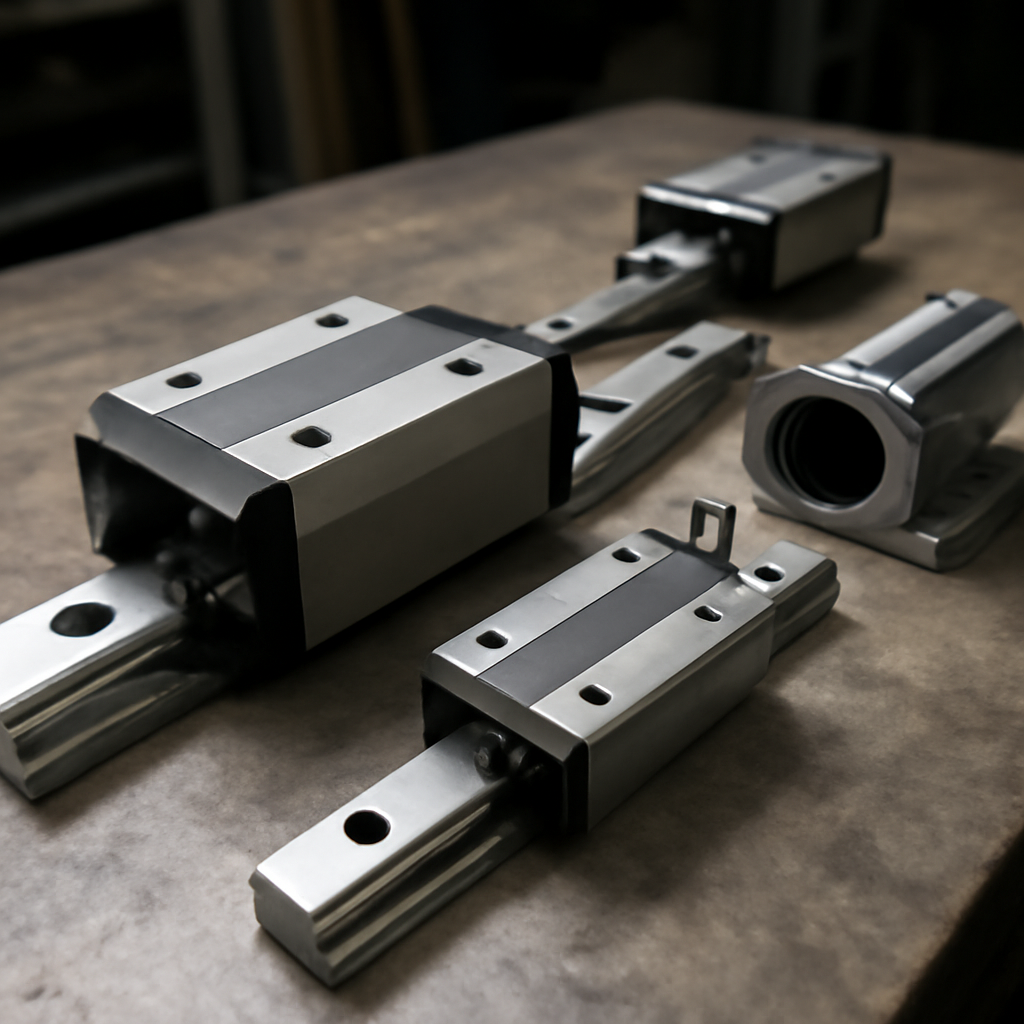
THK Co. Ltd, headquartered in Tokyo, is the company that invented the Linear Motion (LM) Guide in 1971 and remains the largest dedicated linear motion supplier globally. The THK name appears on machine tools, semiconductor equipment, robotics platforms, medical robots — and routinely commands a price premium over competing brands. The practical question for design engineers and procurement teams is straightforward: when is that premium justified, and when is it overkill?
1. The THK portfolio
- SR series: standard profile rail guideway, the global industry reference for general high-precision applications.
- SHS series: medium-load LM guides, balanced load and precision.
- HSR series: heavy-load LM guides for machine tools.
- RSR series: miniature LM guides for medical, electronics, semiconductor handling.
- SRG series: caged ball technology — uniform load distribution, lower noise, longer life.
- LM ball screws, linear motors, ball splines, cross-roller rings: complementary linear motion components.
2. Where the THK premium is justified
2.1 Semiconductor equipment
The semiconductor industry is the natural home of THK products. Sub-micron repeatability, very long calculated service life, batch-to-batch consistency, and global engineering support are non-negotiable. Premium is paid back in equipment uptime.
2.2 High-end machine tools
Five-axis machining centres, jig boring machines, ultra-precision grinders. The machine builder specifies THK because the end customer expects it; the customer expects it because the historical performance data supports the specification.
2.3 Medical and surgical robotics
Where bearing life data is part of regulatory approval, and component substitution requires re-certification. THK’s documentation and consistency support this regulatory burden.
2.4 Optical instrumentation and metrology
Where sub-micron motion smoothness is needed.
3. Where THK is overkill
For general-purpose industrial automation — packaging machinery, pick-and-place at moderate cycle rates, light-duty conveyors, prototyping — THK is meaningfully more expensive than alternatives that perform adequately. Hiwin HG, Schneeberger MR, Samick SR, or Korean and Chinese equivalents work fine.
4. The honest cost-benefit comparison
- Acquisition cost: THK typically 20-50% higher than Hiwin, 30-60% higher than Samick or Chinese suppliers, comparable to Schneeberger.
- Calculated bearing life: typically equivalent on equivalent envelope and load. Premium does not come from longer life in isolation.
- Repeatability and precision: THK consistently matches its published spec; some lower-cost alternatives vary batch-to-batch.
- Engineering support: THK’s documentation and application engineering are industry-leading. Material when designing a complex multi-axis system.
- Resale and warranty: THK’s commitment to long-term product support is a material consideration for capital equipment with 15+ year service life.
5. The caged-ball technology question
THK’s SRG series uses a ball cage (Caged Ball technology) that distributes load uniformly, runs quieter, and extends maintenance intervals. Patent-protected — competitors offer functionally similar technologies under different trade names. For applications where the SRG benefits matter (quiet operation, long maintenance intervals), the THK product is the natural reference; for applications where they do not, the simpler standard product is fine.
6. Cross-reference compatibility
THK SR profile rails are dimensionally compatible with Hiwin HG, Schneeberger MR, and Samick SR on standard sizes. Carriage interchange is possible with caveats on preload and accuracy.
7. Selection decision framework
- Is the application sub-micron precision? → THK or Schneeberger.
- Is regulatory or qualification documentation a factor? → THK.
- Is the application semiconductor or medical robotics? → THK.
- Is the application general industrial automation? → Hiwin or comparable.
- Is it commodity packaging or light-duty pick-and-place? → Samick or Chinese.
- Is it heavy industrial automation (foundry, metal forming)? → Schneeberger heavy-duty or THK HSR.
Conclusion
THK is the premium reference in global linear motion. The premium is justified for high-precision, regulatory-sensitive, and long-life applications; it is overkill for general industrial automation. Match the brand to the actual precision requirement and the budget will follow naturally.
Industry consolidation and supplier landscape
The European bearing industry consolidation period reshapes the supplier landscape. NSK + NTN integration MoU (12 May 2026, target closing October 2027), SKF Automotive spin-off, Schaeffler Yinchuan capacity expansion, and SKF G-Tech Instruments acquisition all combine to create a materially different supplier ecosystem by 2027-2028. For European industrial procurement teams, the practical implications are: multi-supplier qualification becomes more important across critical SKUs, framework agreement provisions need explicit substitution clauses, and supplier relationships evolve toward longer-term strategic partnerships rather than transactional cost optimisation.
The smart bearing transition
The bearing industry’s transition from component supply to integrated reliability platform delivery represents the defining strategic shift of the decade. Every major manufacturer has built or acquired smart bearing platform capability. The integrated offering combines instrumented bearings, cloud analytics, AI-based anomaly detection, prescriptive workflow integration, and integrated services. For procurement leadership, the smart bearing decision involves more than the bearing — it involves the broader reliability ecosystem including platform commitments, integration architecture, data ownership terms, and ongoing software roadmap.
For European industrial customers, qualifying smart bearings on critical applications during 2026 positions the organisation for the post-2028 industry structure. The technology is mature; the economic case is documented; the strategic question is platform selection and deployment pace rather than whether to deploy.
Raw material costs and pricing trajectory
Bearing pricing dynamics in 2026 reflect converging cost drivers. US steel tariffs at 50% (in force since June 2025) reshape global trade flows. Bearing-grade alloy premiums continue widening as demand for cleaner steel chemistry grows faster than supply. EU regulatory developments (CBAM, REACH SVHC updates, steel safeguards) add complexity to import economics. The cumulative effect through 2026 has been modest but consistent upward pressure on bearing list prices.
For procurement teams, the practical posture is active engagement. Lock pricing on top-50 SKUs in framework agreements. Build steel-cost adjustment mechanisms into multi-year contracts. Verify customs classifications carefully. Document supplier origin certifications for preferential trade agreement benefits. Build inventory depth on critical references where the carrying cost is lower than the expected price step in subsequent quarters.
Condition monitoring economic case
IoT-based condition monitoring deployment economics in 2026 are particularly favourable for European mid-size industrial plants. Sensor hardware costs (under $50 per node) have collapsed 85% since 2019. Cloud platforms have matured into turnkey SaaS offerings. AI analytics adds capability that human analysts alone cannot match. Documented payback periods converge on 6-18 months for typical deployments. For a typical mid-size plant with 50-100 critical assets, deployment cost runs €15,000-30,000 first-year capex plus €10,000-20,000 annual recurring; documented savings of 30-50% reduction in unplanned downtime translate to €100,000-500,000 annually in operational benefit.
The strategic horizon through 2030
Looking through 2030, the structural drivers of bearing market evolution remain robust. EV adoption acceleration, wind energy capacity expansion, industrial robotics growth, humanoid robotics commercialisation, smart bearing technology maturation, and continued M&A all combine to drive sustained demand growth. The bearing market projection from $151.8B in 2026 to $301B by 2033 reflects these structural drivers operating in parallel. For European industrial customers, positioning the procurement strategy for this evolution now — rather than reacting in 2028 — is the strategic foundation for competitive operational performance through the coming decade.
The H2 2026 procurement priorities
The H2 2026 European bearing procurement environment calls for focused action across several converging priorities. Industry consolidation effects flow through the supplier ecosystem as NSK + NTN antitrust filings progress and SKF Automotive spin-off mechanics are confirmed. Schaeffler Yinchuan capacity expansion normalises standard catalogue lead times. Raw material costs remain elevated under tariff and regulatory pressure. EU industrial demand recovery continues at moderate pace.
For procurement leadership, the actionable priorities distil to: lock framework pricing on top-50 SKUs where leverage exists; renegotiate multi-year agreements with substitution provisions and SKU continuity guarantees; build inventory depth on critical references where carrying cost favours stock vs expected price step; qualify smart bearings on critical applications; deploy condition monitoring on the 20-100 most critical assets; build cross-reference databases that support substitution agility. The cumulative impact of these actions across the H2 2026 window positions the procurement organisation favourably for 2027-2028.
Looking ahead through 2027-2030
The bearing industry through 2027-2030 continues structural evolution driven by EV adoption, wind energy expansion, industrial robotics growth, humanoid robotics commercialisation, smart bearing maturation, and ongoing supplier consolidation. The market projection from $151.8B in 2026 to $301B by 2033 reflects these drivers operating in parallel. For European industrial customers, the strategic procurement question is not whether the market grows but how to position to capture value through the transition. The investments and disciplines built during 2026 compound across the rest of the decade.
The 2026 strategic outlook
For European industrial customers, the 2026 bearing industry strategic outlook combines structural growth opportunity (market projection from $151.8B to $301B by 2033) with active consolidation dynamics (NSK + NTN integration, SKF Automotive spin-off, Schaeffler expansion). The practical posture is active engagement with these developments: multi-supplier qualification, framework agreement renegotiation, condition monitoring investment, and smart bearing qualification on critical applications. The cumulative effect of these disciplines compounds across the rest of the decade.
The 2026 strategic outlook
For European industrial customers, the 2026 bearing industry strategic outlook combines structural growth opportunity (market projection from $151.8B to $301B by 2033) with active consolidation dynamics (NSK + NTN integration, SKF Automotive spin-off, Schaeffler expansion). The practical posture is active engagement with these developments: multi-supplier qualification, framework agreement renegotiation, condition monitoring investment, and smart bearing qualification on critical applications. The cumulative effect of these disciplines compounds across the rest of the decade.
Related guides
- HIWIN Linear Guides 2026
- SCHNEEBERGER Linear Motion
- SAMICK Linear Bearings
- SFERAX When Precision Beats Cost
- Linear Motion Market 2033
Need help with bearing selection? Our team supports you with cross-references and lead-times.