
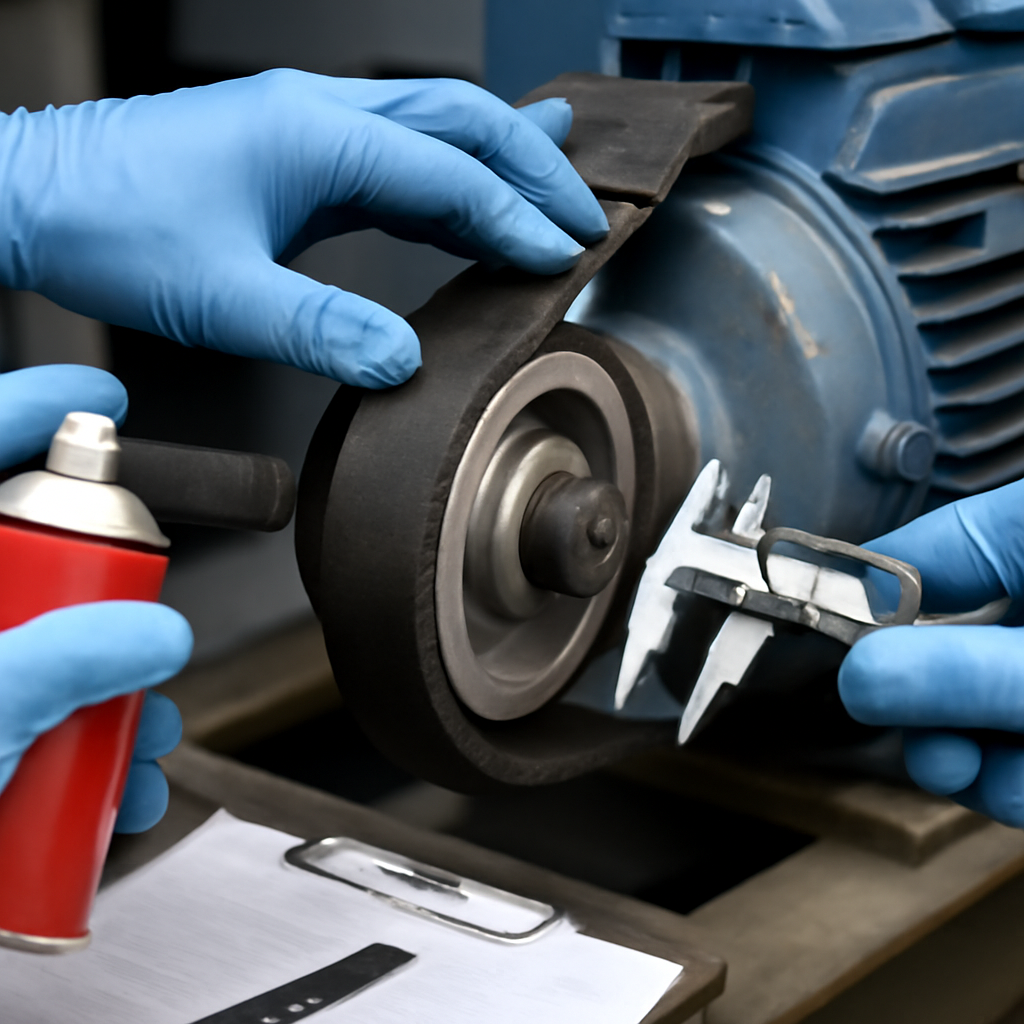
Power transmission belts are deceptively simple components that pay back disproportionately when they are correctly selected, tensioned, aligned and maintained. The same belt, under different operating conditions, can last six months or six years. This guide walks through the practical strategies for extending belt service life — strategies that work in 2026 just as they did in 2006, with some new tools and materials added.
1. Get the selection right
The largest single lever. Selection covers:
- Profile: classical (SPZ, SPA, SPB, SPC) for general industrial; narrow (XPZ, XPA, XPB) for higher power density; timing for synchronous applications.
- Cross-section: sized to design power (motor nameplate × service factor).
- Length: calculated from centre distance and pulley diameters.
- Construction: standard cord, high-modulus cord for low stretch, aramid cord for high temperature.
An undersized belt is loaded above its design and lives short; an oversized belt runs cool but wastes premium cost.
2. Tension correctly at install — and after 24 hours
Use a belt tension gauge, not your thumb. Under-tension causes slip and overheating; over-tension shortens belt life and stresses bearings on both pulleys. Critical: re-tension after 24 hours of running. New belts seat into the pulley grooves and lose tension during the first hours of operation.
3. Align the pulleys precisely
Belt life drops 25% for each 1° of angular misalignment between pulleys. Use a straight edge or laser tool to verify parallel alignment of the pulleys before tensioning. Loose pulleys on shafts are a common cause of recurring misalignment.
4. Replace in matched sets on multi-belt drives
If one belt fails on a multi-belt drive, replacing only that belt loads it disproportionately while the others continue to share what they used to. The result: rapid second failure. Replace all belts in the set; match by part number including any letter suffix that indicates stretch class.
5. Keep the environment under control
- Excessive heat shortens belt life dramatically. Provide ventilation if the belt drive runs above 50 °C ambient.
- Oil and grease degrade rubber. Keep lubricants away from belts.
- Ozone (from electric motors, welders) degrades belt cord and elastomer. Address local ozone sources.
- Sunlight (UV) on outdoor installations shortens belt life. Cover or relocate if practical.
6. Use the right pulley
Pulleys wear, even though they look indestructible. A worn pulley with rounded groove edges accelerates belt wear. Inspect pulleys at every belt change; replace if groove cross-section shows visible wear.
7. Choose the right belt construction for the duty
- Standard rubber V-belts: general industrial drives.
- High-power EPDM belts: better heat and ozone resistance, longer life.
- Oil-resistant compounds: where oil contamination cannot be eliminated.
- Aramid-cord belts: very high tensile strength, low stretch, premium applications.
- Toothed (synchronous) belts: where positive timing is required.
8. The OPTIBELT range
For European industrial applications, the OPTIBELT range is a default specification: OMEGA HP, KRAFTBAND, TRUCK POWER for commercial vehicles, RBK for automotive aftermarket. The OPTIBELT engineering documentation includes selection calculators that simplify the specification work.
9. Monitor for trouble signs
- Squealing on startup: under-tensioned or worn belt.
- Vibration: misalignment, unbalanced pulleys, or belt damage.
- Glazed belt surfaces: over-tensioned, overheating, or slip.
- Cracking on the outer surface: heat, ozone, or aging.
10. Inspection schedule
- Daily walk-around: visual check for noise, vibration, debris.
- Monthly inspection: tension check on critical drives.
- Annual: full inspection including pulley condition.
Conclusion
Power transmission belts reward disciplined attention with dramatically extended service life. Selection, tension, alignment, environment, and inspection — these five levers compound. A belt that should last 12 months can last 36 with the right attention, and the cost-benefit math is overwhelmingly in favour of doing it right.
Industry consolidation and supplier landscape
The European bearing industry consolidation period reshapes the supplier landscape. NSK + NTN integration MoU (12 May 2026, target closing October 2027), SKF Automotive spin-off, Schaeffler Yinchuan capacity expansion, and SKF G-Tech Instruments acquisition all combine to create a materially different supplier ecosystem by 2027-2028. For European industrial procurement teams, the practical implications are: multi-supplier qualification becomes more important across critical SKUs, framework agreement provisions need explicit substitution clauses, and supplier relationships evolve toward longer-term strategic partnerships rather than transactional cost optimisation.
The smart bearing transition
The bearing industry’s transition from component supply to integrated reliability platform delivery represents the defining strategic shift of the decade. Every major manufacturer has built or acquired smart bearing platform capability. The integrated offering combines instrumented bearings, cloud analytics, AI-based anomaly detection, prescriptive workflow integration, and integrated services. For procurement leadership, the smart bearing decision involves more than the bearing — it involves the broader reliability ecosystem including platform commitments, integration architecture, data ownership terms, and ongoing software roadmap.
For European industrial customers, qualifying smart bearings on critical applications during 2026 positions the organisation for the post-2028 industry structure. The technology is mature; the economic case is documented; the strategic question is platform selection and deployment pace rather than whether to deploy.
Raw material costs and pricing trajectory
Bearing pricing dynamics in 2026 reflect converging cost drivers. US steel tariffs at 50% (in force since June 2025) reshape global trade flows. Bearing-grade alloy premiums continue widening as demand for cleaner steel chemistry grows faster than supply. EU regulatory developments (CBAM, REACH SVHC updates, steel safeguards) add complexity to import economics. The cumulative effect through 2026 has been modest but consistent upward pressure on bearing list prices.
For procurement teams, the practical posture is active engagement. Lock pricing on top-50 SKUs in framework agreements. Build steel-cost adjustment mechanisms into multi-year contracts. Verify customs classifications carefully. Document supplier origin certifications for preferential trade agreement benefits. Build inventory depth on critical references where the carrying cost is lower than the expected price step in subsequent quarters.
Condition monitoring economic case
IoT-based condition monitoring deployment economics in 2026 are particularly favourable for European mid-size industrial plants. Sensor hardware costs (under $50 per node) have collapsed 85% since 2019. Cloud platforms have matured into turnkey SaaS offerings. AI analytics adds capability that human analysts alone cannot match. Documented payback periods converge on 6-18 months for typical deployments. For a typical mid-size plant with 50-100 critical assets, deployment cost runs €15,000-30,000 first-year capex plus €10,000-20,000 annual recurring; documented savings of 30-50% reduction in unplanned downtime translate to €100,000-500,000 annually in operational benefit.
The strategic horizon through 2030
Looking through 2030, the structural drivers of bearing market evolution remain robust. EV adoption acceleration, wind energy capacity expansion, industrial robotics growth, humanoid robotics commercialisation, smart bearing technology maturation, and continued M&A all combine to drive sustained demand growth. The bearing market projection from $151.8B in 2026 to $301B by 2033 reflects these structural drivers operating in parallel. For European industrial customers, positioning the procurement strategy for this evolution now — rather than reacting in 2028 — is the strategic foundation for competitive operational performance through the coming decade.
The H2 2026 procurement priorities
The H2 2026 European bearing procurement environment calls for focused action across several converging priorities. Industry consolidation effects flow through the supplier ecosystem as NSK + NTN antitrust filings progress and SKF Automotive spin-off mechanics are confirmed. Schaeffler Yinchuan capacity expansion normalises standard catalogue lead times. Raw material costs remain elevated under tariff and regulatory pressure. EU industrial demand recovery continues at moderate pace.
For procurement leadership, the actionable priorities distil to: lock framework pricing on top-50 SKUs where leverage exists; renegotiate multi-year agreements with substitution provisions and SKU continuity guarantees; build inventory depth on critical references where carrying cost favours stock vs expected price step; qualify smart bearings on critical applications; deploy condition monitoring on the 20-100 most critical assets; build cross-reference databases that support substitution agility. The cumulative impact of these actions across the H2 2026 window positions the procurement organisation favourably for 2027-2028.
Looking ahead through 2027-2030
The bearing industry through 2027-2030 continues structural evolution driven by EV adoption, wind energy expansion, industrial robotics growth, humanoid robotics commercialisation, smart bearing maturation, and ongoing supplier consolidation. The market projection from $151.8B in 2026 to $301B by 2033 reflects these drivers operating in parallel. For European industrial customers, the strategic procurement question is not whether the market grows but how to position to capture value through the transition. The investments and disciplines built during 2026 compound across the rest of the decade.
The 2026 strategic outlook
For European industrial customers, the 2026 bearing industry strategic outlook combines structural growth opportunity (market projection from $151.8B to $301B by 2033) with active consolidation dynamics (NSK + NTN integration, SKF Automotive spin-off, Schaeffler expansion). The practical posture is active engagement with these developments: multi-supplier qualification, framework agreement renegotiation, condition monitoring investment, and smart bearing qualification on critical applications. The cumulative effect of these disciplines compounds across the rest of the decade.
The 2026 strategic outlook
For European industrial customers, the 2026 bearing industry strategic outlook combines structural growth opportunity (market projection from $151.8B to $301B by 2033) with active consolidation dynamics (NSK + NTN integration, SKF Automotive spin-off, Schaeffler expansion). The practical posture is active engagement with these developments: multi-supplier qualification, framework agreement renegotiation, condition monitoring investment, and smart bearing qualification on critical applications. The cumulative effect of these disciplines compounds across the rest of the decade.
Related guides
- Secrets to Proper Belt Drive Alignment
- Guide to OPTIBELT Drive Belts
- OPTIBELT V-Belts Selection Guide
- Applications of OPTIBELT
- OPTIBELT Belts Reliability
Need help with bearing selection? Our team supports you with cross-references and lead-times.