
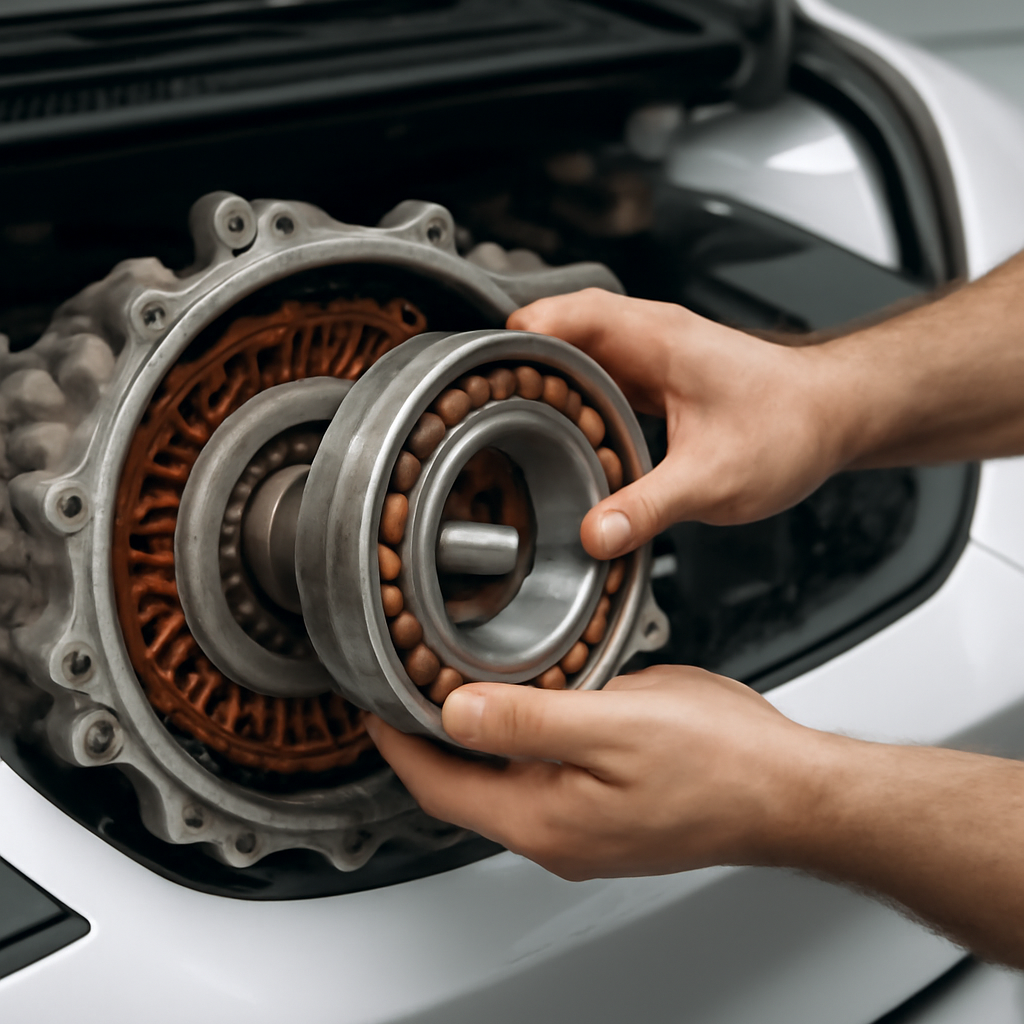
The electric vehicle traction motor is one of the most demanding bearing applications in modern industry: 18,000-20,000 rpm continuous speed, inverter-driven electrical activity that can erode raceways, fluctuating thermal load, and a service life expectation measured in hundreds of thousands of kilometres. Standard automotive bearing designs do not survive in this environment. The bearing industry has responded with a new generation of EV-specific products. This guide walks through what is different and who supplies the new generation.
1. The two differentiating problems
1.1 Stray current and EDM raceway erosion
Inverter switching at high frequency produces voltage differences between the rotor shaft and the bearing housing. When that voltage exceeds the dielectric strength of the lubricant film, microscopic arcs cross the bearing — Electrical Discharge Machining. Over time the arc pattern forms the characteristic fluting pattern on the raceway, accompanied by rising vibration and ultimately seizure. Standard 100Cr6 steel cannot survive this; the bearing must be electrically isolated.
1.2 High-speed continuous operation
20,000 rpm in continuous duty exceeds the comfortable operating range of standard automotive bearings. The lubrication regime must be optimised for very high speeds; the cage materials must tolerate the centrifugal loads; the internal geometry must minimise friction.
2. The three engineering responses
2.1 Hybrid bearings (ceramic rolling elements)
Replace the steel balls with silicon nitride (Si3N4) ceramic. Ceramic is non-conductive — the current cannot flow from inner to outer ring. Lower density also reduces centrifugal load on the cage at high speed. This is the most common solution on the drive end of EV traction motors.
2.2 Insulated bearings (coated outer ring)
An aluminium oxide coating applied by plasma spray on the outer ring’s outer diameter. Provides electrical insulation of >1000 V. SKF INSOCOAT, Schaeffler INSOCOAT-equivalent products. Used on positions where the bearing diameter favours coating over ceramic.
2.3 Conductive grease in layered defence designs
Where insulation is not feasible on every position, conductive grease provides a controlled, non-arcing path for any current that does flow. Used as a complementary layer, not a primary defence.
3. The supplier landscape
3.1 SKF
Long history in industrial inverter-driven motors transferred directly to EV. SKF INSOCOAT and hybrid bearings are widely qualified across European EV programmes.
3.2 Schaeffler
Aggressive EV positioning, integrating bearings into a broader motion components offering. INSOCOAT-equivalent technology, hybrid bearings, and integrated module supply.
3.3 NSK
Strong Japanese EV OEM relationships. Specialty hybrid bearing range optimised for EV traction.
3.4 NTN
EV wheel hub assemblies (Gen 3 hub units with insulation), motor bearings.
3.5 JTEKT (Koyo)
Long Toyota relationship transferring into EV programmes. EV-specific product range.
3.6 Specialty Chinese suppliers
Growing presence on the Chinese EV market with quality moving up rapidly.
4. Where these bearings sit in the vehicle
- EV traction motor drive end: hybrid (ceramic) ball bearing.
- EV traction motor non-drive end: insulated steel deep groove bearing.
- Reducer input/output bearings: high-speed steel bearings, often standard but with optimised lubrication.
- Wheel hubs: Gen 3 units with insulation, particularly on positions adjacent to in-wheel motors or e-axle architectures.
5. The aftermarket implications
- Specification matching is critical — fitting a standard wheel hub to an EV will fail within months.
- Cross-reference databases need to clearly flag insulated and hybrid variants.
- OEM-spec parts are not optional in this category.
- Independent garages need to identify EV-specific parts at the start of the repair conversation.
6. The cost premium
EV-specific bearings typically carry a 30-80% price premium over equivalent ICE-era references. Hybrid (ceramic ball) bearings are the more expensive option; insulated bearings sit lower in the range. Justified by the prevented failure mode.
7. Looking ahead
- EV traction motor bearings are the fastest-growing sub-segment of the global bearing market.
- Continued capacity expansion by the major Western and Japanese suppliers.
- Smart EV bearings with integrated sensors emerging on premium platforms.
- Cost reduction through volume scaling expected through 2027.
Conclusion
EV traction motor bearings are a structurally new product category, not just an existing bearing with minor modifications. The hybrid ceramic and insulated designs solve real failure modes that standard bearings cannot survive. For OEMs and aftermarket buyers, sourcing from a qualified supplier with proven EV experience is non-negotiable; for distributors, building EV-specific product categories into the catalogue is the strategic positioning move for the next five years.
Industry consolidation and supplier landscape
The European bearing industry consolidation period reshapes the supplier landscape. NSK + NTN integration MoU (12 May 2026, target closing October 2027), SKF Automotive spin-off, Schaeffler Yinchuan capacity expansion, and SKF G-Tech Instruments acquisition all combine to create a materially different supplier ecosystem by 2027-2028. For European industrial procurement teams, the practical implications are: multi-supplier qualification becomes more important across critical SKUs, framework agreement provisions need explicit substitution clauses, and supplier relationships evolve toward longer-term strategic partnerships rather than transactional cost optimisation.
The smart bearing transition
The bearing industry’s transition from component supply to integrated reliability platform delivery represents the defining strategic shift of the decade. Every major manufacturer has built or acquired smart bearing platform capability. The integrated offering combines instrumented bearings, cloud analytics, AI-based anomaly detection, prescriptive workflow integration, and integrated services. For procurement leadership, the smart bearing decision involves more than the bearing — it involves the broader reliability ecosystem including platform commitments, integration architecture, data ownership terms, and ongoing software roadmap.
For European industrial customers, qualifying smart bearings on critical applications during 2026 positions the organisation for the post-2028 industry structure. The technology is mature; the economic case is documented; the strategic question is platform selection and deployment pace rather than whether to deploy.
Raw material costs and pricing trajectory
Bearing pricing dynamics in 2026 reflect converging cost drivers. US steel tariffs at 50% (in force since June 2025) reshape global trade flows. Bearing-grade alloy premiums continue widening as demand for cleaner steel chemistry grows faster than supply. EU regulatory developments (CBAM, REACH SVHC updates, steel safeguards) add complexity to import economics. The cumulative effect through 2026 has been modest but consistent upward pressure on bearing list prices.
For procurement teams, the practical posture is active engagement. Lock pricing on top-50 SKUs in framework agreements. Build steel-cost adjustment mechanisms into multi-year contracts. Verify customs classifications carefully. Document supplier origin certifications for preferential trade agreement benefits. Build inventory depth on critical references where the carrying cost is lower than the expected price step in subsequent quarters.
Condition monitoring economic case
IoT-based condition monitoring deployment economics in 2026 are particularly favourable for European mid-size industrial plants. Sensor hardware costs (under $50 per node) have collapsed 85% since 2019. Cloud platforms have matured into turnkey SaaS offerings. AI analytics adds capability that human analysts alone cannot match. Documented payback periods converge on 6-18 months for typical deployments. For a typical mid-size plant with 50-100 critical assets, deployment cost runs €15,000-30,000 first-year capex plus €10,000-20,000 annual recurring; documented savings of 30-50% reduction in unplanned downtime translate to €100,000-500,000 annually in operational benefit.
The strategic horizon through 2030
Looking through 2030, the structural drivers of bearing market evolution remain robust. EV adoption acceleration, wind energy capacity expansion, industrial robotics growth, humanoid robotics commercialisation, smart bearing technology maturation, and continued M&A all combine to drive sustained demand growth. The bearing market projection from $151.8B in 2026 to $301B by 2033 reflects these structural drivers operating in parallel. For European industrial customers, positioning the procurement strategy for this evolution now — rather than reacting in 2028 — is the strategic foundation for competitive operational performance through the coming decade.
The H2 2026 procurement priorities
The H2 2026 European bearing procurement environment calls for focused action across several converging priorities. Industry consolidation effects flow through the supplier ecosystem as NSK + NTN antitrust filings progress and SKF Automotive spin-off mechanics are confirmed. Schaeffler Yinchuan capacity expansion normalises standard catalogue lead times. Raw material costs remain elevated under tariff and regulatory pressure. EU industrial demand recovery continues at moderate pace.
For procurement leadership, the actionable priorities distil to: lock framework pricing on top-50 SKUs where leverage exists; renegotiate multi-year agreements with substitution provisions and SKU continuity guarantees; build inventory depth on critical references where carrying cost favours stock vs expected price step; qualify smart bearings on critical applications; deploy condition monitoring on the 20-100 most critical assets; build cross-reference databases that support substitution agility. The cumulative impact of these actions across the H2 2026 window positions the procurement organisation favourably for 2027-2028.
Looking ahead through 2027-2030
The bearing industry through 2027-2030 continues structural evolution driven by EV adoption, wind energy expansion, industrial robotics growth, humanoid robotics commercialisation, smart bearing maturation, and ongoing supplier consolidation. The market projection from $151.8B in 2026 to $301B by 2033 reflects these drivers operating in parallel. For European industrial customers, the strategic procurement question is not whether the market grows but how to position to capture value through the transition. The investments and disciplines built during 2026 compound across the rest of the decade.
Related guides
- EV Wheel Hub Bearings
- Ball Bearings for Cars 2026
- EV Transmissions
- Bearing Market Outlook
- NSK + NTN Merger
Need help with bearing selection? Our team supports you with cross-references and lead-times.