
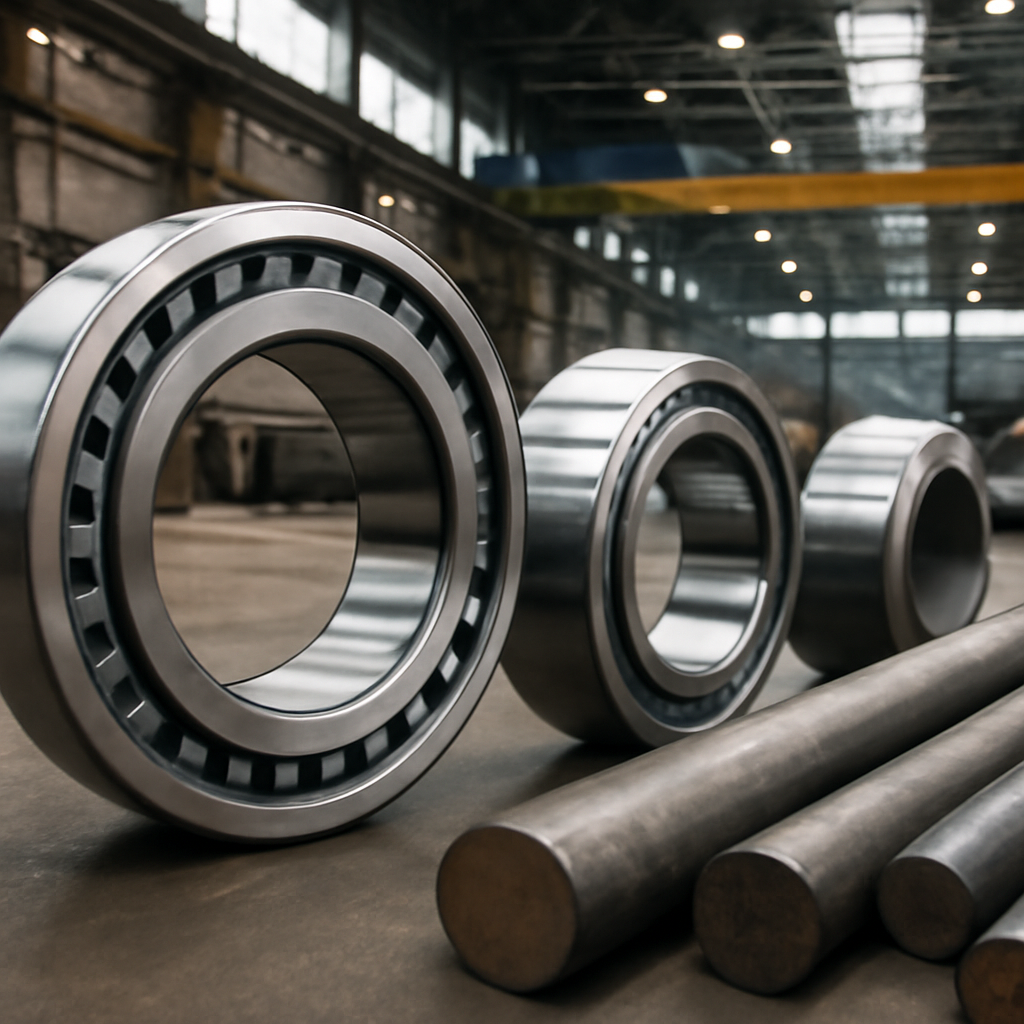
The price premium that bearing-grade steel alloy commands over commodity hot-rolled coil has been widening progressively since 2023. The trajectory is not cyclical — it reflects structural changes in steel demand, manufacturing economics, and downstream bearing industry requirements. This deep-dive analysis examines why the alloy premium will continue widening through the rest of the decade, what the implications are for bearing pricing and procurement strategy, and which mitigation strategies actually work.
1. What is bearing-grade alloy steel?
Bearing-grade steel is fundamentally 52100 (100Cr6, AISI 52100) — a high-carbon chromium steel with specific composition controls. The grade itself has not changed materially in decades. What has changed dramatically is the cleanliness specification required for modern high-performance bearings:
- Inclusion content limits: maximum non-metallic inclusion size and frequency.
- Hydrogen content control: parts-per-million level hydrogen limits to prevent embrittlement.
- Macro and micro segregation control: uniform chemical composition through the cross-section.
- Aerospace cleanliness (AMS 6440, AMS 6447): specifications drawn from aerospace standards now applied to high-end industrial.
The cleanliness specifications add significant manufacturing cost over commodity hot-rolled coil, which is what drives the alloy premium.
2. The 2026 alloy premium baseline
As of mid-2026:
- US hot-rolled coil: approximately $1,109/ton.
- Bearing-grade 52100 commodity cleanliness: $1,400-1,800/ton.
- Bearing-grade 52100 aerospace cleanliness: $2,500-4,000/ton.
- Specialty steels (M50, M50NiL): $8,000-15,000/ton.
The premium widens at each cleanliness step. The trajectory through 2030 is for the premium to continue widening.
3. Force 1: Demand for cleaner steel is growing faster than supply
Bearing-grade steel demand growth comes from multiple sources:
- EV bearings requiring higher fatigue life specifications.
- Wind energy main shaft and gearbox bearings requiring extended L10 lives.
- High-end industrial bearings adopting premium fatigue life ranges (Explorer, X-life, SPEXX).
- Aerospace bearing demand from commercial aviation recovery.
- Smart bearings with sensor-equipped variants requiring premium specifications.
Manufacturing capacity for clean bearing-grade steel grows more slowly than demand — the manufacturing investments are capital-intensive and require specialised expertise.
4. Force 2: Vacuum degassing and remelting capacity is constrained
Clean bearing-grade steel requires vacuum degassing during ladle metallurgy and often vacuum arc remelting (VAR) for the highest-cleanliness grades. These processes are capital-intensive and operationally complex. Global capacity grows slowly. Demand pressure on the constrained capacity flows directly into the alloy premium.
5. Force 3: Continuous casting vs ingot route economics
Commodity steel uses continuous casting; high-cleanliness bearing steel uses ingot route with subsequent forging. The ingot route is more expensive per ton. Premium bearing applications increasingly demand the ingot route for fatigue life reasons, shifting more bearing-grade steel away from cost-effective continuous casting.
6. Force 4: Aerospace-grade specifications spreading to industrial
Specifications developed for aerospace (AMS 6440, AMS 6447, double vacuum melt) are progressively adopted for high-end industrial bearings. Each new industrial application that adopts aerospace cleanliness expands demand on the constrained vacuum melt capacity.
7. Force 5: Regional manufacturing concentration
Clean bearing-grade steel manufacturing is concentrated in specific producers: SKF (vertically integrated), Schaeffler (partially integrated), specialty steel producers (Ovako, Saarstahl Ascometal, NIPPON STEEL, Daido Steel, Sanyo Special Steel). Regional concentration creates supply-demand imbalances and pricing leverage.
8. Implications for bearing pricing
Bearing-grade steel cost typically represents 25-35% of bearing manufacturing cost. The alloy premium widening flows into bearing list prices on a 6-18 month lag. Through 2026-2030, expect bearing list prices on premium ranges (X-life, Explorer, SPEXX) to rise faster than commodity ranges (standard 6200/6300 catalogue) by 1-2% annually compounded.
9. Implications for procurement strategy
9.1 Lock multi-year framework agreements
Pricing pressure favours longer-term framework commitments while pricing windows persist.
9.2 Steel-cost adjustment mechanisms
Build steel-cost indexation into framework agreements rather than fixed pricing.
9.3 Premium specification discipline
Apply premium specifications selectively where operational value justifies the premium pricing. Avoid blanket premium specification across the bearing fleet.
9.4 Inventory positioning
Build inventory depth on premium specifications before price increases land. The carrying cost is usually less than the price step.
9.5 Multi-supplier qualification on premium ranges
Competitive dynamics across premium ranges (SKF Explorer vs FAG X-life vs TIMKEN SPEXX vs NSK premium) provide procurement leverage.
10. The mitigation strategies that work
- Strategic supplier relationships with major manufacturers offering steel cost transparency.
- Integrated reliability services that justify premium bearing pricing through operational benefit.
- Smart bearing platforms that drive ROI on premium specifications.
- Premium range standardisation on critical applications where TCO supports the premium.
- Multi-supplier framework agreements during competitive windows.
11. The mitigation strategies that do NOT work
- Switching to lower-cleanliness budget alternatives on premium applications — operational costs erase any pricing benefit.
- Single-supplier consolidation seeking volume pricing — sacrifices substitution agility for marginal pricing benefit.
- Deferring premium specification to standard catalogue — operational costs from reduced bearing life erase pricing benefit.
- Hedging steel commodity prices — bearing steel premium is not correlated with commodity steel hedging instruments.
12. The 2030 outlook
Looking through 2030, the bearing-grade alloy premium structure continues widening:
- Bearing-grade commodity cleanliness premium over hot-rolled coil: from 30-60% in 2026 to 40-80% in 2030.
- Aerospace cleanliness premium: from 130-260% to 180-350%.
- Specialty steel premium (M50, etc.): from 500-1000% to 600-1200%.
The trajectory is not cyclical and not reversible without major manufacturing capacity investment that is not currently funded.
13. The strategic implication for the bearing industry
The alloy premium structure shapes the bearing industry competitive landscape:
- Vertically-integrated manufacturers (SKF, Schaeffler) gain pricing power from steel manufacturing capability.
- Premium-range positioning becomes more important as standard catalogue pricing power compresses.
- Smart bearings and integrated reliability services support premium pricing structures.
- Procurement relationships with manufacturer engineering depth become more valuable.
14. The procurement leadership response
For European industrial procurement leadership, the structural alloy premium widening calls for strategic procurement evolution:
- Multi-year framework agreements with steel cost adjustment mechanisms.
- Premium specification discipline matched to operational value.
- Multi-supplier qualification on premium ranges.
- Strategic supplier relationships with manufacturer engineering depth.
- Integrated reliability conversations rather than transactional cost optimisation.
Conclusion
Bearing-grade steel alloy premiums will continue widening through 2030 driven by structural demand-supply dynamics that are not cyclical or reversible without major capacity investment. The implications flow through bearing pricing, supplier competitive positioning, and procurement strategy. European procurement leadership engaging actively with these dynamics through multi-year framework agreements, premium specification discipline, and strategic supplier relationships captures competitive advantage; defensive postures yield to engaged operators systematically through the transition.
Related guides on Eurobearing
- Why Bearing Prices Are Still Rising
- Why H2 2026 Reshapes Pricing Structure
- Steel Prices June 2026
- US Steel Tariffs at 50%
- Bearing Tariffs Update
Need help with bearing selection? Our team supports you with cross-references and lead-times.