
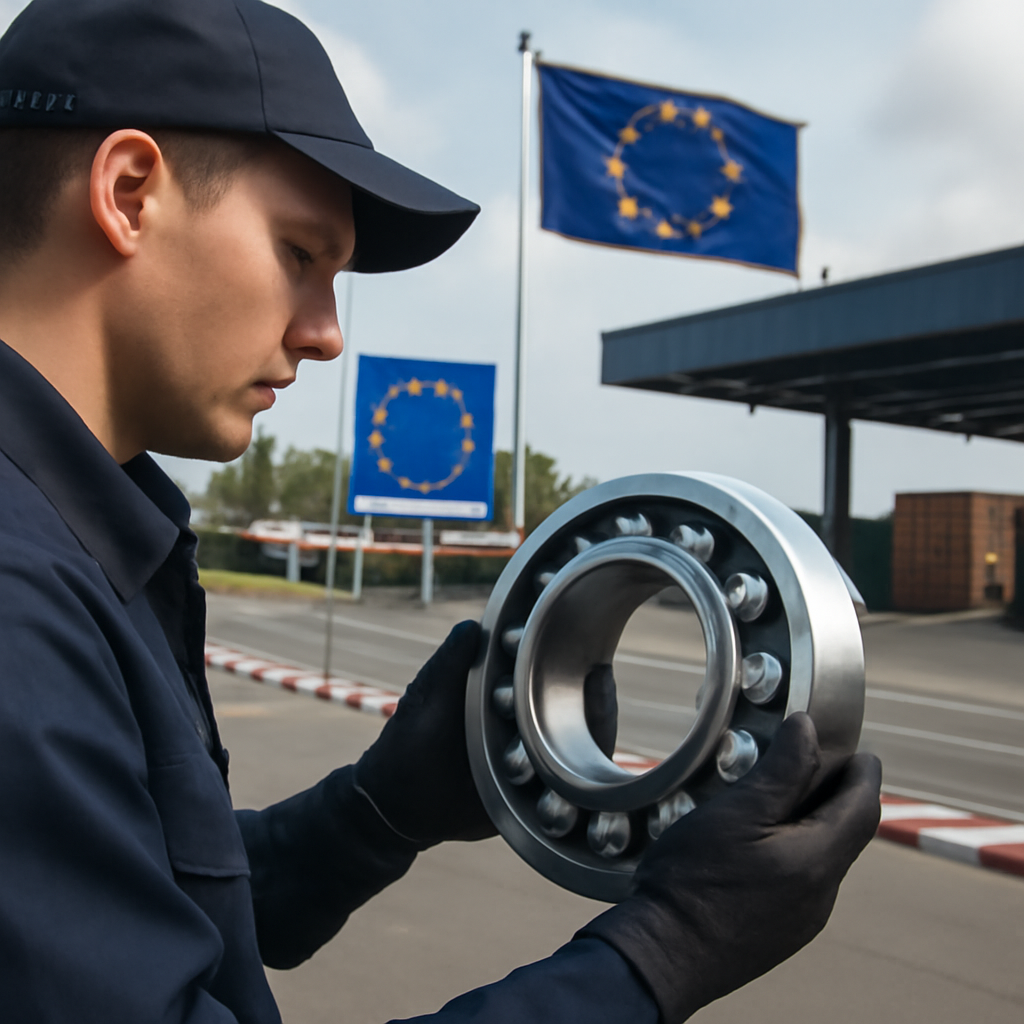
The European Union has been actively reshaping its trade defence instruments through 2025 and 2026 in response to global steel overcapacity, US tariff escalation, and shifting industrial supply chains. For bearing distributors, importers and OEM procurement teams, the EU regulatory environment is now a material variable in sourcing decisions. Here is the practical update on what has changed and what is being debated.
1. The EU steel safeguard mechanism
The EU’s steel safeguard quotas have been progressively tightened through 2025 and into 2026 in response to global trade pressure. Bearing steel imports — and finished bearing imports where they fall under steel-product classifications — are affected at the margin. Distributors importing from non-preferential origin should verify customs classifications carefully.
2. Anti-dumping duties on Chinese components
Several anti-dumping cases involving Chinese-origin industrial components have been investigated or extended in 2025-2026. While bearings themselves are not the primary target, adjacent product categories (housings, fasteners, certain seals) have been affected. The cumulative effect on bill-of-materials cost for European industrial assembly can be meaningful.
3. The carbon border adjustment mechanism (CBAM)
CBAM, in transitional phase through 2026 and entering full enforcement in 2026-2027 for selected product categories, adds a carbon-cost adjustment to imports from non-EU origins. Steel is a primary category. The mechanism is reshaping import economics for bearing-grade steel and for finished imports where the steel content is significant.
4. What this means for distributors
- Verify customs classifications on bearing imports — the difference between an HS code that captures CBAM and one that does not can be material.
- Document origin carefully — preferential origin rules (UK trade agreement, Korea, Japan) affect duty rates.
- For multi-origin product lines, the procurement decision now includes a regulatory complexity dimension that did not exist five years ago.
5. What this means for OEMs
- Bill-of-materials cost stability favours EU-origin or preferential-origin sourcing in 2026.
- Long-term supply agreements should include change-in-law clauses to allocate regulatory risk.
- Where bearings are integrated into machinery exported back to the US, the US-side tariff exposure adds another layer.
6. The watch list
- EU steel safeguards review and possible tightening in H2 2026.
- CBAM full enforcement timing for steel-containing products.
- EU response to US 50% steel tariff in force since June 2025.
- Possible anti-dumping investigations on additional bearing-adjacent product categories.
Conclusion
Regulatory complexity in EU bearing imports is materially higher than five years ago, and the trajectory is for further evolution rather than stabilisation. Distributors and OEMs that build regulatory capability into their procurement function — verifying classifications, documenting origin, modelling CBAM impact — will be the ones that maintain pricing discipline through the transition.
Related guides
- US Steel Tariffs at 50%
- Why Bearing Prices Are Still Rising
- EU Distributors Stockpiling
- Raw Material Costs Impact
- Top 5 Trends H2 2026
Need help with bearing selection? Our team supports you with cross-references and lead-times.