
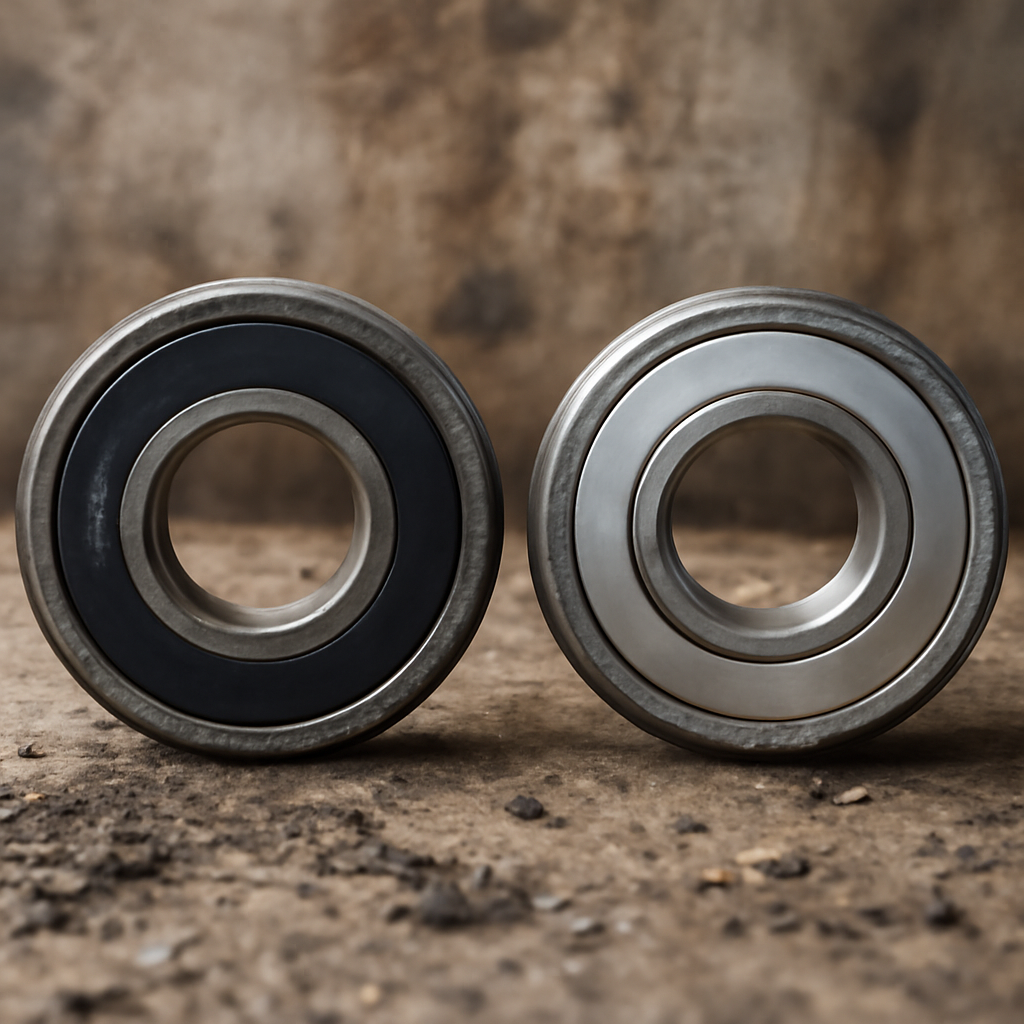
The 6207-2RS versus 6207-2Z decision on dirty industrial applications is a nuanced choice that shapes bearing service life meaningfully. Both variants of the 6207 deep groove ball bearing handle contamination differently and pay back differently across specific application characteristics. This piece walks through when each variant is the correct answer on European industrial dirty applications.
What each variant actually does
The 6207-2RS has rubber contact seals on both sides. The seal lip contacts the inner ring and provides friction-based sealing against contamination and grease loss. The 6207-2Z has metal shields on both sides that provide non-contact sealing with a narrow gap against the inner ring. Both variants protect the bearing internal from contamination but differ in seal effectiveness and running friction.
Where the 6207-2RS wins
On applications with fine contamination — cement dust, textile fibre, wood chips — the contact seal of the 2RS variant provides meaningfully better protection than the shielded 2Z variant. The seal lip physically prevents contamination migration into the bearing internal space. Applications with wet or moist environments similarly benefit from the contact seal that keeps water out. On these dirty applications the 2RS delivers 40 to 80 percent longer service life than the equivalent 2Z.
Where the 6207-2Z wins
On applications running at high shaft speed or in temperature-elevated environments, the 2Z variant’s lower running friction produces meaningful advantages. The metal shield does not contact the inner ring and does not generate friction heat. Applications running above 4,000 RPM on this size benefit from the shielded design. Applications running above 100 degrees C where the rubber seal material degrades similarly favour the metal shielded design.
The dirty-plus-fast complication
Applications that combine both dirty environment and high speed present a specification conflict. The 2RS variant handles the contamination but generates friction that limits maximum speed. The 2Z variant handles the speed but is more vulnerable to contamination. On these applications the pragmatic answer is often the 2RSH high-performance seal variant that balances both requirements better than either 2RS or 2Z standard variants. The SKF 6207-2RSH covers this application category.
The temperature limitation on 2RS variants
Standard NBR rubber seals on the 2RS variant handle temperature to approximately 100 degrees C above ambient continuous operation. On applications running hotter, the NBR seal material degrades and loses effectiveness within 6 to 12 months. For elevated temperature applications, FKM seal upgrade or metal shielded designs are appropriate. Getting this wrong produces seal failures at 3 to 6 months rather than expected multi-year service.
The maintenance re-lubrication consideration
Sealed 2RS bearings cannot be re-lubricated in the field because the seal cannot be removed without damage. Shielded 2Z bearings can be re-lubricated in some cases through the shield gap. On applications where re-lubrication is planned as part of maintenance schedule, this consideration favours the 2Z variant. On applications with lifetime-lubricated design intent, the 2RS variant is appropriate.
Cross-brand equivalency
The 6207-2RS and 6207-2Z designations translate across brands with generally clean equivalency. FAG 6207.2RSR is functionally equivalent to SKF 6207-2RS. FAG 6207.2ZR translates to SKF 6207-2Z. Cross-brand pricing runs 5 to 15 percent apart for equivalent variants. Choose by customer brand preference on standard applications.
The rolling-element bearing selection framework
Three questions determine the 2RS versus 2Z choice. Is the environment dirty? Is the shaft speed above 4,000 RPM? Is operating temperature above 80 degrees C? Answer these three and the correct variant falls out cleanly. Skip the questions and default to 6207-2RS/C3 for European industrial general applications — this covers about 70 percent of aftermarket demand acceptably.
The takeaway for procurement teams
The 6207-2RS remains the appropriate default for European industrial general aftermarket. Switch to 6207-2Z on high-speed or elevated-temperature applications where the shielded design serves better. Upgrade to 6207-2RSH on demanding dirty-plus-fast applications where the standard sealed variant does not provide adequate speed margin. Match the specification to the operating envelope rather than defaulting to one variant across all applications.
6207 bearings available on Eurobearing
The 6207 sealed and shielded variants covered in this article ship in both SKF and FAG lines with the C3 clearance code and stainless steel options for demanding applications.
- 6207 SKF variants: 1726207-2RS1 Y-bearing · E2.6207-2Z/C3 · 6207-2ZNR flanged
- 6207 FAG variants: S6207 stainless · S6207-2RSR sealed
- 6207 stainless variants: 6207-2RS1 stainless · 6207 stainless
- 6207 flanged/NR: 6207-2RS1NR · 6207-2ZNR
Related coverage on Eurobearing
- 6205 Bearing Variants
- Why 6208 in Gearboxes
- 6300 Series Decoded
- SKF Suffixes Cheat Sheet
- Reading Tolerance Codes
Need help specifying 6207 variants for European industrial applications? Our team supports distributor stocking decisions. Book a free consultation.