
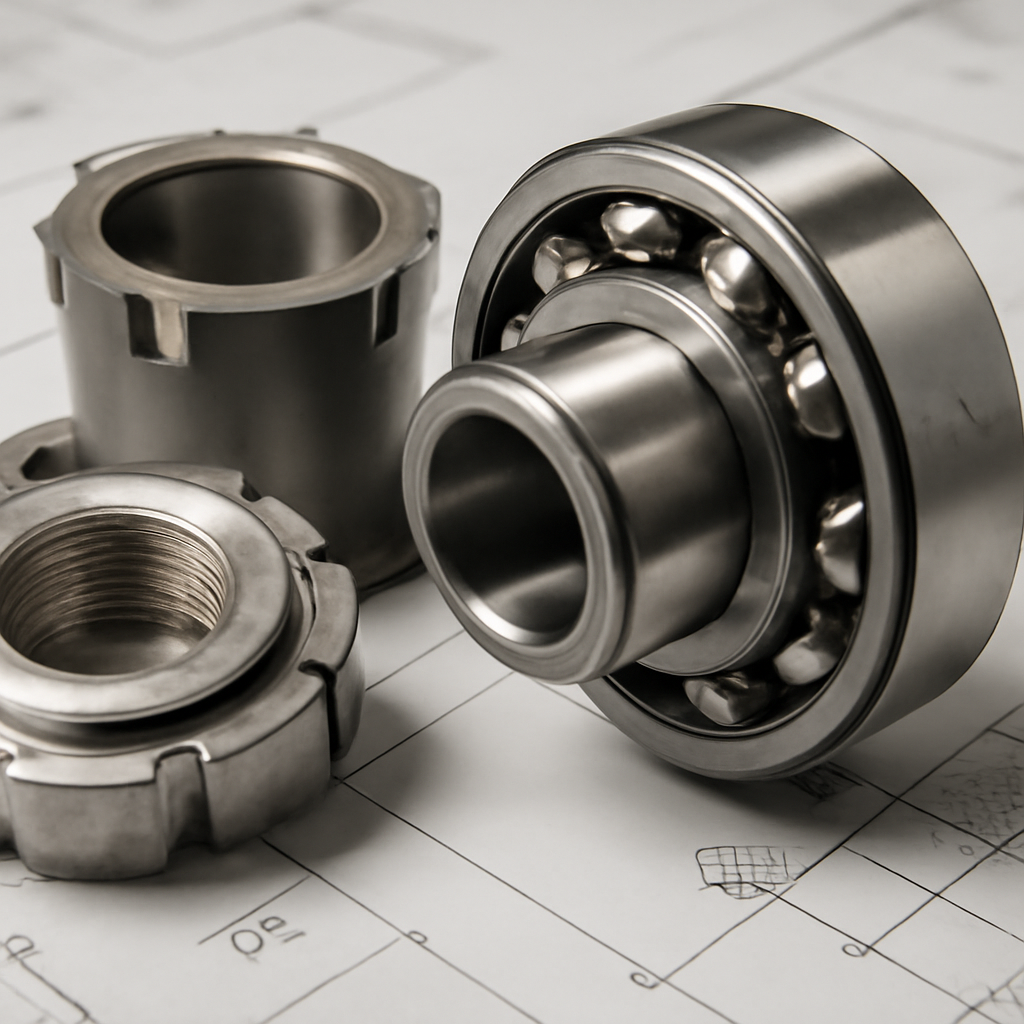
The adaptor sleeve with lock nut mounting for spherical roller and self-aligning ball bearings offers a specific mounting alternative to fixed shaft-shoulder mounting. Understanding when the adaptor sleeve approach beats fixed mounting for European industrial applications helps procurement teams specify the right hardware combination for the mounting scenario. This piece walks through the decision framework.
What adaptor sleeve mounting actually offers
An adaptor sleeve is a tapered sleeve that fits between a plain cylindrical shaft and the tapered bore of a spherical roller or self-aligning ball bearing. Tightening the lock nut compresses the sleeve against the shaft, creating the interference fit that grips the bearing. This approach allows the bearing to mount on a shaft without requiring the shaft to have a machined bearing seat with shoulder and step. The rolling-element bearing installation flexibility is meaningful.
Where adaptor sleeves beat fixed mounting
Three application scenarios favour adaptor sleeve mounting. First: retrofit installations where the shaft is already produced and cannot be re-machined to add a bearing seat. Second: applications requiring axial position adjustment during installation for alignment purposes. Third: applications with multiple bearing positions on the same shaft where machining multiple bearing seats would be prohibitively expensive.
Where fixed mounting beats adaptor sleeves
Fixed shaft-shoulder mounting delivers advantages on applications with high axial loads. The direct shoulder contact handles axial thrust better than the friction-based grip of the adaptor sleeve. Applications with high vibration also favour fixed mounting because the mechanical interlock is less susceptible to loosening than the frictional grip. On applications where the shaft is being machined anyway, spec the bearing seat with shoulder rather than accepting the adaptor sleeve compromise.
The sizing methodology
Adaptor sleeve sizing follows the SKF or FAG catalog cross-reference between shaft diameter and bearing bore. The sleeve designation typically starts with H followed by dimension codes. The sleeve outer taper matches the bearing tapered bore. Using the wrong sleeve size produces either loose fit that allows bearing creep or excessive tight fit that eliminates internal clearance.
The lock nut and tab washer specification
The lock nut and tab washer (typically KM and MB series) come as matched sets with each adaptor sleeve size. Fresh nut and washer with every installation — reused hardware does not reliably prevent loosening under vibration. Distributors selling adaptor sleeves should sell the complete kit rather than as separate components to ensure customers have everything needed for a proper installation.
Torquing the lock nut correctly
Torque specification for the lock nut comes from the catalog based on adaptor sleeve size. The KM series lock nut typically requires slugging wrench torque values that exceed what standard hand tools can deliver. On smaller sizes chain wrench or pipe extension methods work; on larger sizes the specialist slugging wrench is required. Getting the torque right delivers the correct grip without over-compressing the sleeve.
Verifying the installation
After torquing, verify that the bearing rotates freely without binding. Check radial play if accessible. Check that the tab washer is bent into the retaining nut slot for retention. Do not skip these verification steps — improperly installed adaptor sleeve bearings often fail within the first 200 to 400 operating hours regardless of catalog specification accuracy.
Common mistakes on adaptor sleeve installations
Three mistakes dominate. First: wrong sleeve size for the shaft-and-bearing combination. Second: reusing the lock nut and tab washer from previous installation. Third: over-torquing the lock nut and eliminating internal clearance. Getting any of these wrong produces early failure that appears as customer complaint about bearing quality rather than installation error.
The distributor stocking pattern
Distributors serving European industrial rebuild aftermarket should stock adaptor sleeves in the common H2xx series sizes matched to standard 22200 and 22300 spherical roller bearing lines. Include matching lock nut and tab washer as installation kits. This mix serves most adaptor sleeve aftermarket demand without excessive SKU count.
The takeaway for procurement teams
Adaptor sleeve mounting is the right answer for retrofit installations, applications requiring axial position adjustment, and multiple-bearing shafts. Fixed shaft-shoulder mounting is the right answer for high axial load and high vibration applications. Match the mounting approach to the specific application requirements rather than defaulting to one approach across all installations.
Related coverage on Eurobearing
- SKF Adaptor Sleeve Y-Bearing
- Freeing Locked Adaptor Sleeve
- KM Locknut Torque
- Four Fits Framework
- Installation Mistakes
Need help with adaptor sleeve versus fixed mounting decisions? Our team supports European mechanical engineers with mounting method selection. Book a free consultation.