
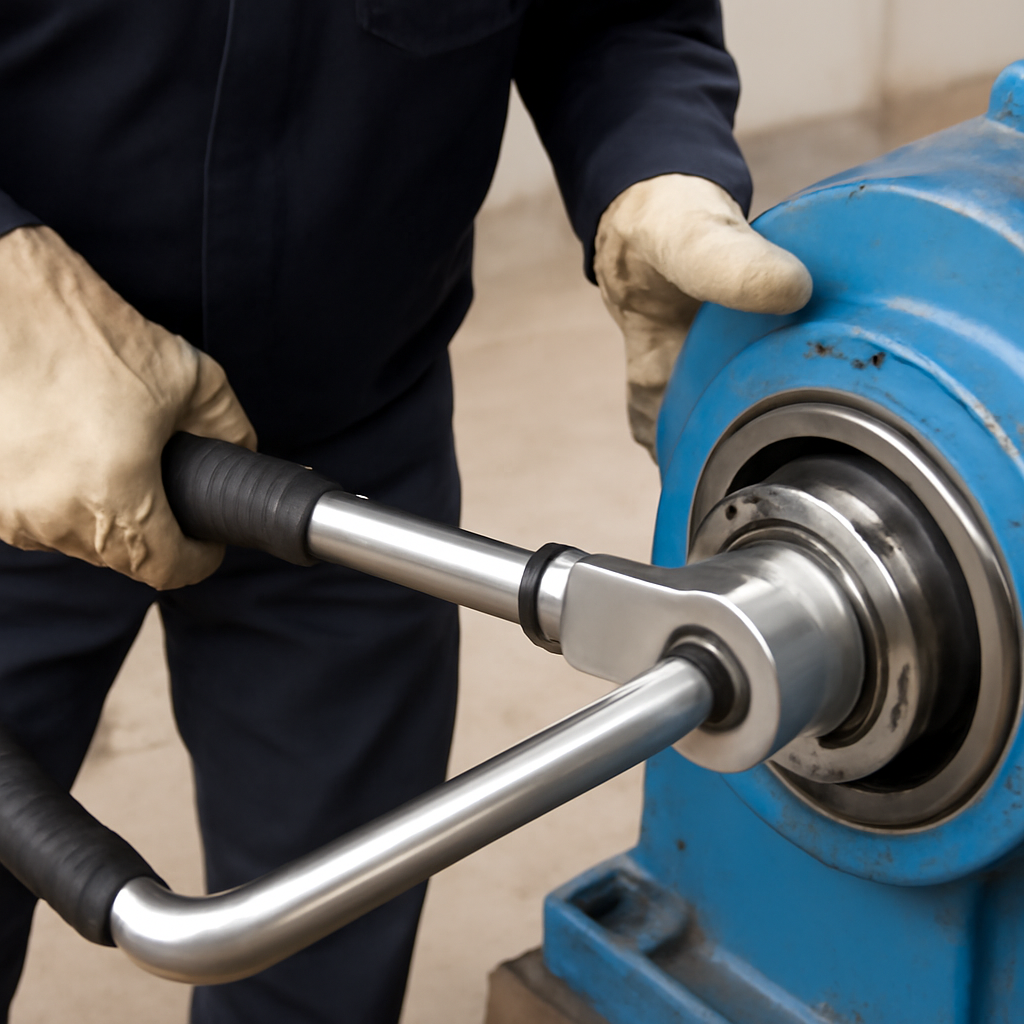
Every rebuild shop that has faced a taper roller bearing installation without the right tools has stared at a KM locknut wondering how to torque it properly without the specialist slugging wrench that the SKF and TIMKEN catalogs recommend. Slugging wrenches cost between 400 and 900 euros depending on size, and most shops do not have every size on the shelf. This piece walks through the field methods that produce correctly torqued KM locknuts without the specialist tool, plus when the shortcut becomes a false economy.
What the KM locknut actually does
The KM series locknut holds a bearing inner ring on a shaft by axial preload against a shoulder or spacer. The nut has slots that accept a tab washer (MB series) for retention against loosening under vibration. The torque specification on a KM nut is typically higher than what a standard socket wrench with hand pressure can deliver. The catalog specifies slugging wrench torque values that assume the specialist tool is available.
The chain wrench method
A heavy-duty chain wrench with a moment arm of 500 to 800 millimetres delivers enough torque for most KM sizes up to KM12. The wrench grips the octagonal head of the nut and the technician applies pressure through the arm. The method is not precise but produces adequate torque within roughly 15 percent of specification. Sufficient for most industrial applications where the exact preload is less critical than reliable retention.
The pipe extension method
A standard socket wrench with an extension pipe delivers surprisingly high torque on KM nuts up to KM10. Use a 6-point socket that fits the octagonal head of the KM nut. Attach a torque wrench and read the applied torque directly. Extend the wrench with a length of steel pipe to gain moment arm without changing the applied hand force. Read the torque on the wrench display or dial. This method is more precise than the chain wrench and delivers torque within 5 to 8 percent of specification.
The induction heater method for the large nuts
For KM14 and larger nuts where mechanical torque becomes impractical, some rebuild shops use the induction heater method. Heat the nut with an induction coil to expand it, thread it onto the shaft to the target position, and let it cool. The thermal contraction produces the axial preload without mechanical torque. This method requires accurate temperature control and is not a universal solution, but works well on specific applications like large bearing housings on rolling mill drive shafts.
When the shortcut becomes false economy
On critical applications where the exact preload matters — machine tool spindles, precision automotive wheel hubs, aerospace applications — the shortcut methods are not appropriate. The specialist slugging wrench is the correct tool. Trying to save the tool cost on these applications produces preload variance that shortens bearing life by 30 to 60 percent and costs far more in downtime and warranty than the wrench would have cost. The specialist tool pays for itself within 2 to 3 installations on critical applications.
The tab washer detail nobody discusses
The rolling-element bearing installation practice is to always use a fresh tab washer with a new nut installation. The tab washer plastically deforms on installation and cannot reliably prevent loosening on a second use. Reusing tab washers is a common mistake that produces retention failures at 200 to 400 operating hours regardless of how well the initial torque was applied. Fresh nut and washer every time.
What buyers should stock with the KM nut
Distributors serving industrial rebuild aftermarket should sell KM nut plus MB tab washer as a matched set. Include the appropriate SKF or FAG spec sheet with the torque specification for the installation. Distributors positioning the components as an installation kit rather than as separate parts differentiate on service depth. Customers rarely regret having the correct components on hand at installation time.
The takeaway for the workshop discipline
The KM locknut torque can be achieved without the specialist slugging wrench on standard industrial applications using chain wrench or pipe extension methods. On critical applications the shortcut becomes false economy and the specialist tool is required. Match the method to the application criticality rather than to the tool availability at the moment.
Related coverage on Eurobearing
- Taper Roller Preload Method
- Bearing Installation Mistakes
- Bearing Removal Without Damage
- TIMKEN Tapered Roller Heavy Industry
- SKF Adaptor Sleeve Y-Bearing Setup
Need help with KM locknut installation methods? Our team supports European rebuild shops with tool selection and technique training. Book a free consultation.