
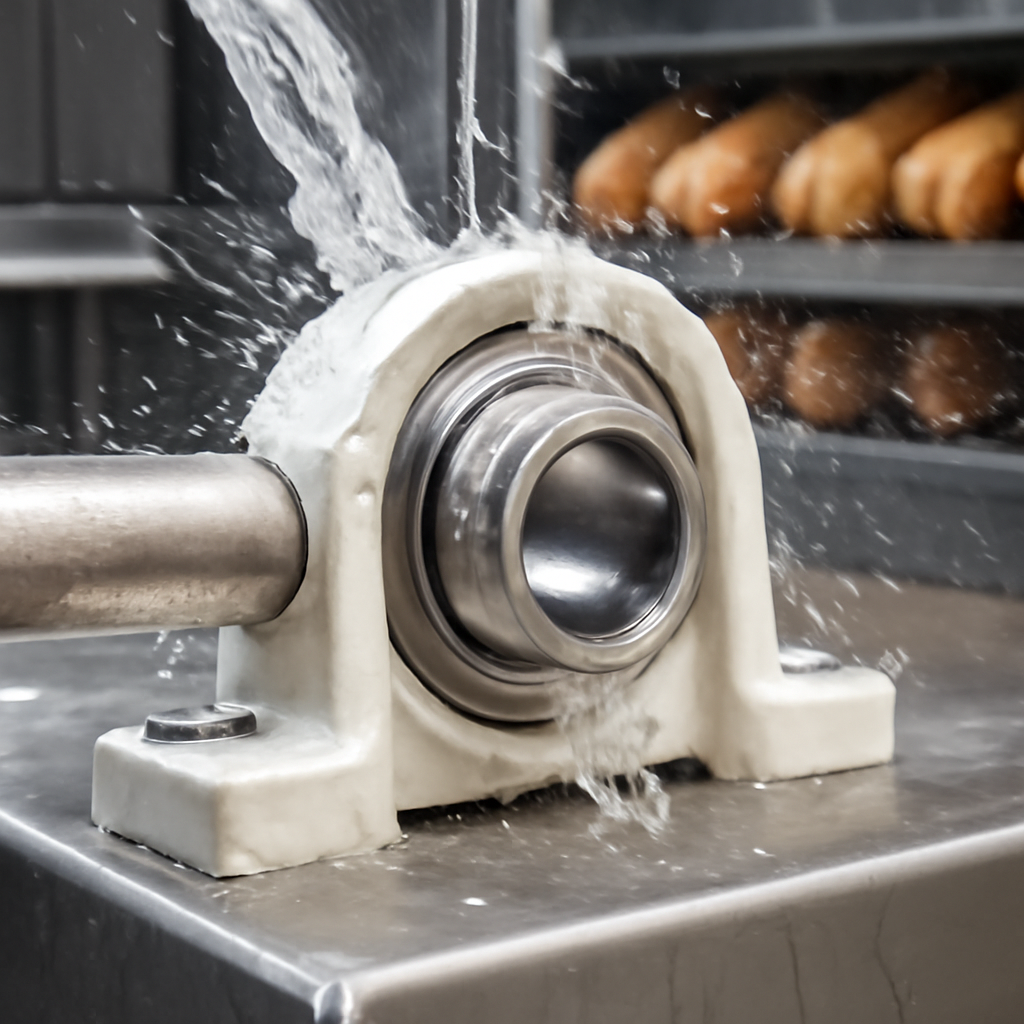
STI food-grade insert bearings occupy a specific niche in European food-processing aftermarket. The wash-down duty cycle characteristic of food-processing lines demands specific material and sealing choices that STI’s food-grade range addresses through combined stainless steel construction, H1 food-grade grease and appropriate seal material selection. This piece walks through when STI is the right specification for food-grade insert bearing applications and how the wash-down duty cycle actually shapes bearing life.
What food-grade insert bearings actually are
An insert bearing — also called Y-bearing — combines a spherical outer ring with a wider inner ring extension that grips a shaft through set screws, eccentric collar or adaptor sleeve. Food-grade insert bearings add stainless steel construction (either 440C martensitic or 316 austenitic), H1 food-grade grease certified for incidental food contact, and typically FKM or EPDM seal materials for wash-down chemistry compatibility. The rolling-element bearing specification framework applies with additional food-safety layers.
What the wash-down duty cycle actually is
Food-processing lines get washed down between production shifts — typically every 8 to 12 hours. The wash-down chemistry combines pressurised hot water (60-80 degrees C), caustic detergent solutions and sometimes acidic sanitisers. Bearings in wash-down zones receive direct spray exposure with these chemistries multiple times per week over years of service. Standard industrial bearings deteriorate rapidly under this exposure — often within weeks rather than years.
Where STI food-grade wins
STI’s food-grade insert bearing range delivers the correct specification for European food-processing wash-down applications at competitive pricing versus premium alternatives. The 316 stainless option handles acidic environments (citrus juice, tomato acid) better than 440C. The 440C option delivers higher load capacity for heavier-duty applications. Both grades combined with H1 grease and FKM seals produce bearing service life of 12 to 24 months in wash-down duty, compared to 2 to 6 weeks for standard industrial bearings in the same environment.
Where the stainless steel grade choice matters
316 austenitic stainless outperforms 440C martensitic stainless on acidic environments — citrus juice processing lines, tomato processing, vinegar production. 440C martensitic stainless outperforms 316 austenitic on higher-load applications where the martensitic hardness advantage translates to bearing life. Most European fruit and vegetable processing applications favour 316 grade. Heavier meat processing applications sometimes favour 440C for the load capacity.
The seal material choice
FKM fluoroelastomer seals handle both acidic and caustic wash-down chemistry well. Service life on FKM seals in wash-down duty typically 12 to 18 months before replacement needed. EPDM seals handle caustic chemistry well but degrade in fatty acid contact — not usually a problem on fruit and vegetable lines but a factor on meat processing where fatty acids concentrate. Both materials meaningfully outperform standard NBR nitrile rubber in wash-down environments.
The grease specification
H1 food-grade grease is the specification for insert bearing applications where incidental food contact is possible. STI’s food-grade insert bearings ship with H1 grease pre-filled. Re-lubrication should use H1 grease from the same or equivalent supplier to maintain the food-safety compliance. Cross-contaminating H1-specified applications with non-H1 grease during maintenance creates food-safety audit issues that can shut down production lines.
The mounting hardware considerations
STI food-grade insert bearings mount through pillow block or flange housings that also require food-grade specification. Standard cast iron housings develop corrosion under wash-down chemistry and become food-safety issues themselves. The correct specification includes stainless steel or thermoplastic housings matched to the bearing grade. Do not spec food-grade bearing in cast iron housing — the housing becomes the failure point.
Cross-brand comparison
STI food-grade insert bearings compete against SKF Y-TECH food-grade range and specific specialty ranges from other manufacturers. STI typically delivers competitive pricing at acceptable quality for European food-processing aftermarket. On critical applications where premium range payback matters, SKF Y-TECH is worth the price premium. On general food-processing rebuild applications, STI serves well at meaningfully better pricing.
The stocking pattern for European food distributors
Distributors serving European food-processing aftermarket should carry STI stainless insert bearings in the UC205 through UC209 range in both 316 and 440C variants. Match with stainless steel pillow block housings and H1 grease supply. This mix serves most food-processing aftermarket demand.
The takeaway for procurement teams
STI food-grade insert bearings are the right specification for European food-processing wash-down applications where competitive pricing matters. Match the stainless steel grade to the specific chemistry exposure — 316 for acidic, 440C for higher-load. Match the seal material to the wash-down chemistry — FKM as default, EPDM for specific applications. Spec matching food-grade housings and H1 grease. Get the complete specification right rather than saving cost on components that create the failure points.
Related coverage on Eurobearing
- Fruit Sorting Bearings Food-Grade
- Food Industry Bearings
- SKF Y-Bearings Selection
- Schaeffler INA Stainless Insert
- SKF Adaptor Sleeve Y-Bearing
Need help specifying STI food-grade insert bearings? Our team supports European food-processing aftermarket. Book a free consultation.