
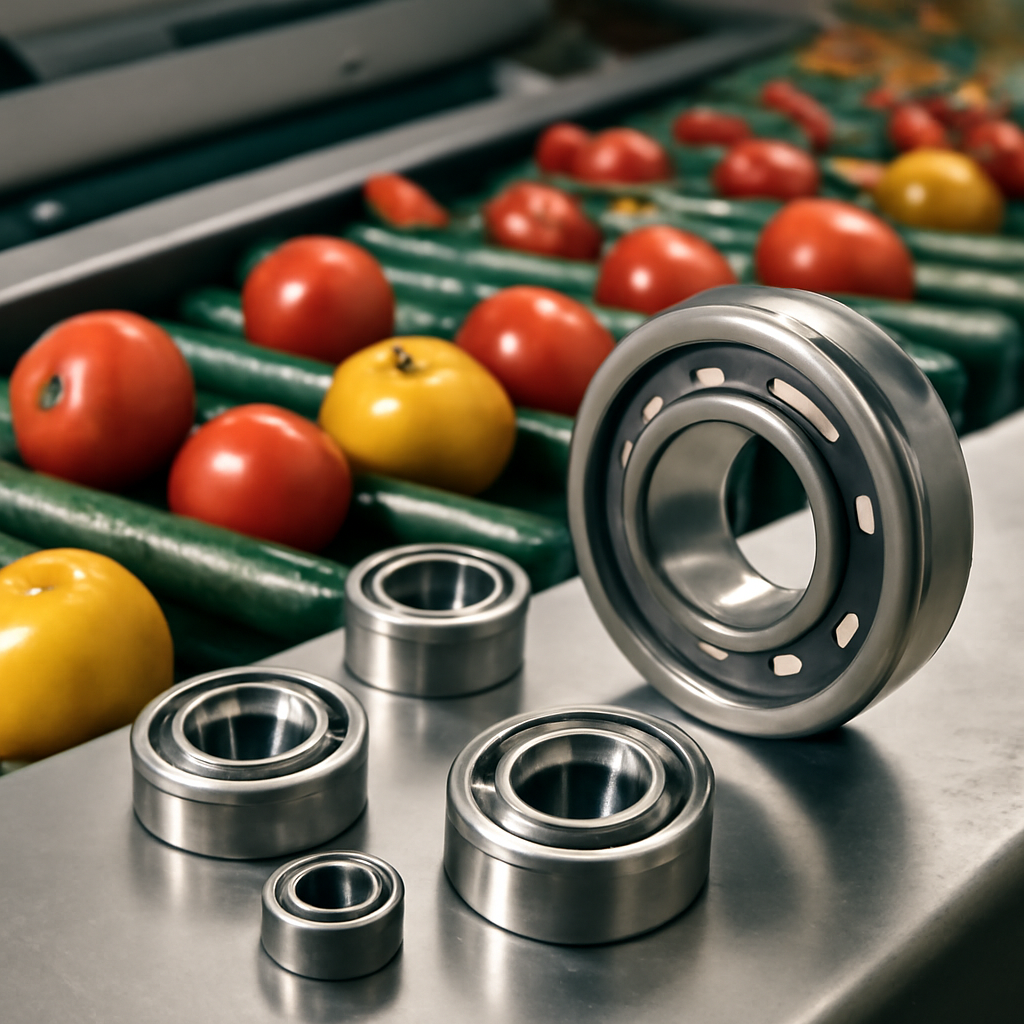
A fruit and vegetable sorting line handling eight tonnes an hour of apples, tomatoes or citrus fruit puts specific demands on the bearings for fruit sorting machines that most industrial bearing specifications don’t anticipate. Wash-down water, acidic fruit juice, high humidity, low temperature operation for cold storage lines, and food-safety audit requirements combine into a specification challenge that eliminates standard industrial ball bearings almost immediately. This piece walks through what actually works on European fruit sorting installations, what fails predictably, and how distributors should stock for this specific aftermarket segment.
Why standard bearings fail on fruit sorting lines
Sorting machines run continuously during harvest seasons that last six to twelve weeks. During those weeks the line gets washed down every eight to twelve hours with detergent solutions containing chlorinated or caustic ingredients. The bearings on rollers, drive shafts and vibration decks sit within splash zones for these wash cycles. Standard grease and standard cage materials tolerate this environment for maybe two to three weeks before contamination and corrosion start visibly. Standard steel bearings develop surface rust within a season. Standard NBR seals soften from repeated exposure to detergent solutions. The result is a maintenance nightmare unless the bearing specification is designed for wash-down duty from the start.
What food-grade actually means in a bearing catalogue
The NSF International registration system defines food-safety categories for lubricants and components in food-processing equipment. H1 rated lubricants are approved for incidental food contact — the standard for anything that could touch product. 3H rated release agents are approved for direct food contact. The bearing itself needs to combine three specifications: stainless steel rings and balls for corrosion resistance, food-grade grease certified H1 for incidental contact tolerance, and a seal material compatible with cleaning chemistry. The SKF Solid Oil and TIMKEN Superior food-grade ranges both meet this specification. The distributor cost premium over standard industrial bearings runs 60 to 120 percent, but the maintenance cost saved during harvest season justifies it easily.
Stainless steel grade selection
Two stainless grades dominate food-grade bearing specifications. AISI 440C martensitic stainless has the highest hardness and is the reference for rolling element bearings requiring load capacity comparable to standard bearing steel. AISI 316 austenitic stainless has better corrosion resistance in acidic environments — citrus juice, tomato acid — but lower hardness and reduced load capacity. For general fruit sorting applications where load is moderate, 316 grade wins on the acidic fruit tolerance. For higher-load applications on drive shafts and vibration decks, 440C is the practical choice with acceptance of slightly higher corrosion maintenance. Distributors stocking food-grade bearings should carry both grades on the common size lines.
Seal package for wash-down duty
NBR (nitrile) seals — the standard industrial rubber compound — dissolve slowly in caustic wash chemistry over a season. The upgrade for wash-down duty is FKM fluoroelastomer (Viton) or EPDM. FKM handles both acidic and caustic exposure and gives 5 to 10 times the service life of NBR in wash-down environments. EPDM handles caustic exposure well but degrades in fatty acid contact — not usually a problem on fruit lines but a factor if the sorting equipment is later repurposed for oily foods. The DICHTOMATIK catalogue carries the wash-down seal specifications in both FKM and EPDM configurations at prices roughly 3 to 4 times NBR list.
Grease selection for continuous wash-down operation
H1 food-grade grease is not a single specification. Base oil types range from mineral to synthetic PAO to polyalphaolefin blends. Thickener types range from aluminum complex to calcium sulfonate. Each has different water resistance characteristics. For continuous wash-down operation the pragmatic choice is a synthetic PAO base oil with aluminum complex thickener rated H1. This combination has the best water washout resistance and the widest service temperature range. Chevron FM ALC, Mobil SHC Cibus and equivalent Klueber and Shell H1 formulations all fit this specification. Base oil viscosity typically 220 to 460 cSt at 40°C depending on shaft speed and operating temperature.
The specific machine locations that matter
A typical fruit sorting line has bearing locations in six categories. Roller table bearings — highest count, mostly small deep groove ball bearings 6205 to 6208 size range. Drive shaft bearings for the sorting reject actuators — moderate count, often 6206 or 6207 with heavier duty seals. Vibration deck bearings — high load, typically spherical roller or heavy duty ball. Camera and imaging system bearings — small precision bearings for optical alignment. Optical grader index bearings — precision applications. Conveyor drive bearings feeding the sorting section — standard industrial specification. Each location has different specification requirements, and treating all six as one specification saves procurement time but creates maintenance headaches downstream.
Cold storage variant considerations
Some fruit sorting lines feed directly into cold storage rooms, which means bearings run at -2 to +4°C for extended periods. Standard grease at these temperatures gets stiff enough to cause bearing startup torque issues. The grease specification for cold-storage-adjacent installations shifts to lower base oil viscosity — 100 to 150 cSt — with the same H1 food-grade certification. Low-temperature grease options exist but at significantly higher cost. For lines that transition between ambient sorting and cold storage the specification tradeoff sits between two-grease strategies (different specifications for different sections) versus single-grease compromise. The two-grease approach costs more in inventory but delivers better performance in each zone.
What distributors should stock for the fruit season
A working stocking pattern for a distributor serving Italian, Spanish and French fruit and vegetable processing customers: food-grade stainless deep groove ball bearings in 6205, 6206, 6207 and 6208 sizes with FKM sealed variants; food-grade insert bearings in UC205 and UC206 sizes for pillow block applications; H1 food-grade grease in 400-gram tubes for on-site relubrication; DICHTOMATIK FKM shaft seals in the common sizes matching the bearing lines. This inventory mix covers most of the aftermarket volume during harvest seasons and positions the distributor for the seasonal order surge without over-committing working capital.
The takeaway for the aftermarket procurement pattern
Fruit sorting bearings are not a general industrial bearing conversation. The specification requirements — stainless materials, H1 grease, FKM sealing, wash-down tolerance — combine into a specialty aftermarket that rewards distributors who understand the pattern and penalises those who try to serve it with standard industrial parts. The customer paying 60 to 120 percent premium for food-grade specification does so because the total operating cost — season labour, food-safety compliance, downtime during harvest — dominates the bearing price. Distributors positioned for this segment build meaningful margin on relatively small unit volumes.
Related coverage on Eurobearing
- Bearings for the Food Industry: Hygienic Standards
- How to Choose the Right Grease for Marine Bearings
- Sealing Rings and Oil Seals: Materials Used in 2026
- Schaeffler INA Stainless Steel Insert Ball Bearings
- Bearing Storage Best Practices in Hot and Humid Summer Months
Need help stocking food-grade bearings for the harvest season? Our technical team supports European agri-food distributors with wash-down specification and pre-season sizing. Book a free consultation.