
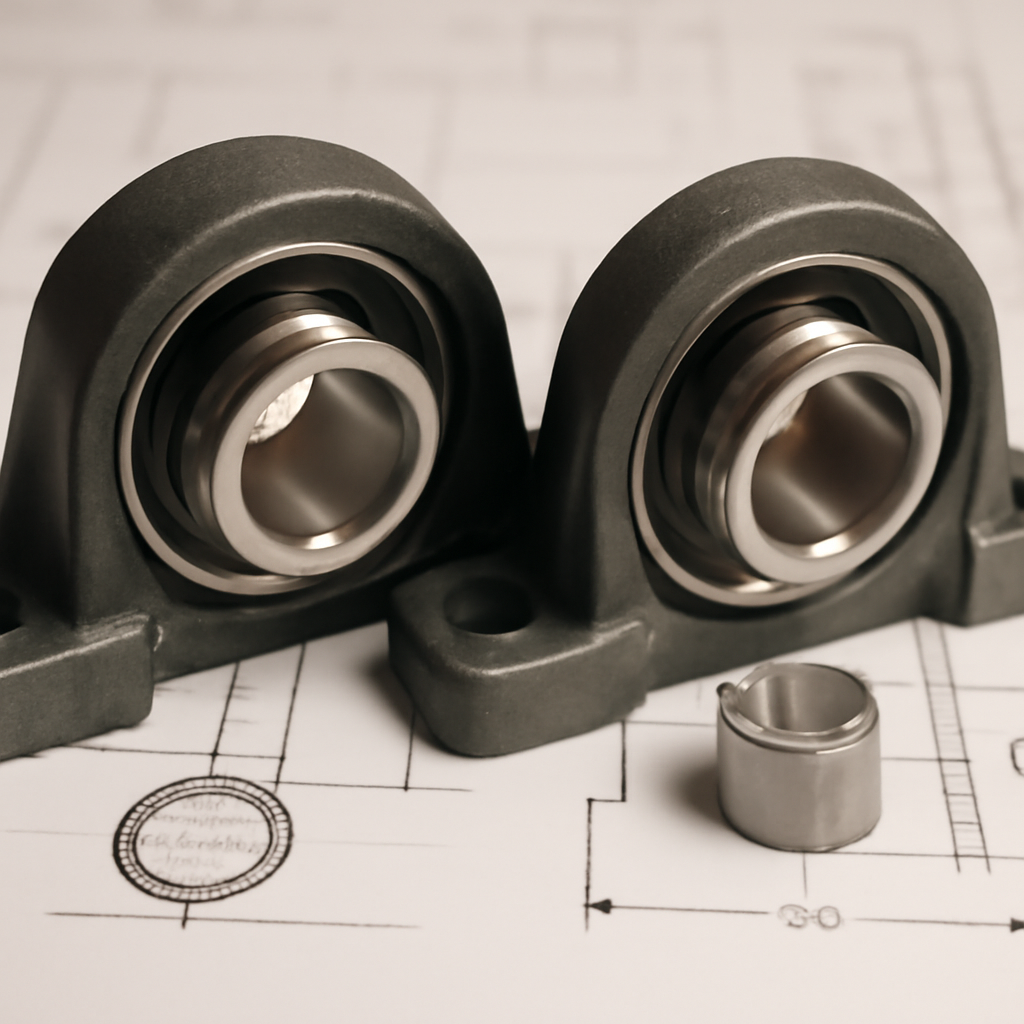
The 6000 series versus 6200 series bearing decision confuses more parts counter conversations than most other specification choices. Both series serve overlapping shaft diameter ranges but with meaningfully different load capacity and physical envelope characteristics. Getting the choice right requires understanding what the series numbers actually mean and where each series delivers advantages.
What the series numbers mean
The 6000 series (extra light) and 6200 series (light) both include deep groove ball bearings for the same nominal bore diameter — 6205 and 6005 both have 25 millimetre bore. The difference sits in the outside diameter and width. 6005 has 47 millimetre OD and 12 width. 6205 has 52 millimetre OD and 15 width. The 6200 series carries meaningfully more material and consequently higher load capacity for the same shaft diameter.
Where the 6000 series wins
Applications with tight radial envelope constraints favour the 6000 series. When the machine design cannot accommodate the larger outside diameter of the 6200 equivalent, the 6000 series enables the installation. Applications with lower load requirements — instrument panels, appliance drives, small conveyor rollers — the 6000 series delivers adequate load capacity at reduced envelope. Higher-speed applications benefit from the 6000 series lower mass and consequent lower centrifugal loading on the rolling elements.
Where the 6200 series wins
General industrial applications where load capacity matters favour the 6200 series. Electric motor bearings, industrial pump bearings, standard gearbox input shaft applications all typically use 6200 series. The additional load capacity — roughly 30 to 45 percent above the equivalent 6000 series — translates directly to longer L10 life at typical operating conditions. Radial envelope is usually not the binding constraint on these applications.
The shaft speed comparison
The 6000 series carries somewhat higher shaft speed limit than the 6200 equivalent for the same bore diameter. The reduced roller mass generates less centrifugal loading at high speed. Applications running above 4,000 to 5,000 RPM on smaller bore diameters may benefit from the 6000 series speed advantage. Below these speeds the 6200 series serves acceptably.
The temperature considerations
Both series handle typical industrial operating temperatures similarly. Neither series delivers meaningful temperature advantage over the other. Match temperature specification through clearance code (C3, C4) and seal material rather than series selection.
The seal package availability
Both 6000 and 6200 series ship in similar seal variant configurations. 2RS sealed, 2Z shielded, open, single-side variants all available across both series. The specification choices apply similarly regardless of series. Do not choose between series based on seal availability — the choices are equivalent.
The pricing pattern
The 6200 series typically prices 15 to 25 percent higher than the equivalent 6000 series at European aftermarket distributor level. The pricing gap reflects the additional material content. On applications where the 6000 series serves acceptably, the pricing advantage matters. On applications where load capacity requires the 6200 series, the additional cost is not optional.
The SKF and FAG cross-brand consistency
Both SKF and FAG offer complete 6000 and 6200 series ranges with equivalent geometry. Cross-brand equivalency is clean on standard variants. Pricing runs similar across the two brands. Choice by customer preference or by distributor availability drives the decision on standard applications.
The rolling-element bearing series selection framework
Ask three questions to make the 6000-versus-6200 choice cleanly. Does the machine design constrain the outside diameter to below the 6200 equivalent? Is the operating load above 60 percent of the 6000 series dynamic rating? Is the shaft speed above 4,000 RPM on this size? Positive answers to the first and third favour 6000; positive answer to the second favours 6200.
The parts counter conversation pattern
When a customer arrives with a 6205 replacement need and asks about switching to 6005 to save cost, verify the machine design accommodates the smaller outside diameter and check the load conditions. Many electric motor applications will not accept the substitution because the housing bore is machined for the 6205 outside diameter. Some smaller equipment applications will accept the substitution. The specific application determines whether the substitution works.
The takeaway for procurement teams
6000 series and 6200 series serve different application niches within the same shaft diameter range. Match the series choice to envelope constraints, load requirements and speed conditions rather than to price optimization alone. Substitution between the series requires verification that the machine design accommodates the alternative outside diameter. Do not treat the two series as freely interchangeable.
6000 and 6200 series bearings available on Eurobearing
Both 6000 series (extra light) and 6200 series (light) deep groove ball bearings covered in this article ship in the top common sizes. Below are the reference SKUs for the 6205 and 6206 sizes that dominate European industrial demand.
- 6205 SKF (25x52x15): E2.6205-2RSH/C3 · E2.6205-2Z/C3 · 6205 TN9/C3
- 6205 FAG stainless: S6205 · S6205-2RSR
- 6206 SKF (30x62x16): E2.6206-2Z/C3 · 6206 ETN9 · 6206 TN9/C3
- 6206 FAG: 6206-TVH-C3 · S6206 stainless
Contact our team for the 6207, 6208 and 6209 sizes in the 6200 series, or for the smaller 6000, 6001, 6002, 6003 and 6004 sizes in the 6000 series where the envelope constraint matters.
Related coverage on Eurobearing
- 6205 Bearing Variants
- 6300 Series Decoded
- Why 6208 in Gearboxes
- 6207-2RS vs 2Z
- SKF Suffixes Cheat Sheet
Need help with 6000 versus 6200 series selection? Our team supports European procurement teams. Book a free consultation.