
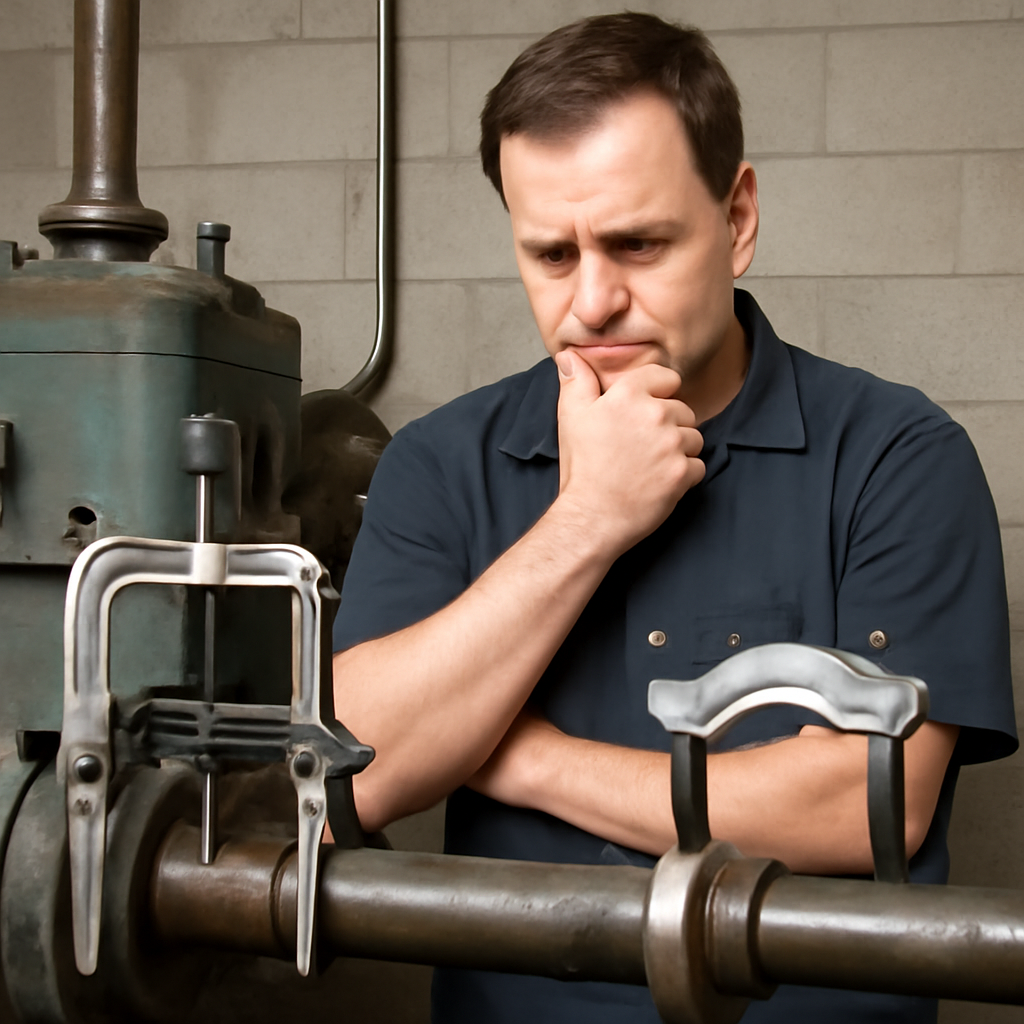
Every industrial rebuild technician faces the specific challenge of removing a bearing from a shaft that cannot be moved to the workbench. The puller versus induction separator decision on shaft-in-place jobs affects both the bearing removal success rate and the shaft condition after removal. This piece walks through the practical decision framework that produces successful removals without shaft damage.
What each tool actually does
A bearing puller uses mechanical leverage to apply axial force against the bearing inner ring, pulling it off the shaft against the interference fit. An induction bearing separator uses electromagnetic induction to heat the bearing rapidly, expanding the inner ring enough to slide off without mechanical force. Both approaches serve legitimate applications but with different characteristics that shape the choice.
Where mechanical pullers win
Mechanical pullers work reliably on bearings with moderate interference fits, accessible shaft configurations and adequate space for the puller tool. Cost is meaningfully lower than induction separators. Setup time is shorter. For most standard rebuild applications on industrial equipment with straightforward shaft geometry, the mechanical puller is the pragmatic choice.
Where induction separators win
Induction separators deliver advantages on three specific scenarios. First: bearings with heavy interference fits that require mechanical force beyond safe puller capacity. Second: shaft configurations where puller access is restricted by adjacent components. Third: applications where the shaft surface must be preserved carefully — the induction approach applies no mechanical force to the shaft. The induction heating approach avoids the mechanical damage risk entirely.
The shaft damage consideration
Mechanical pullers applied incorrectly damage shafts. Puller jaws slipping under load can score the shaft outer surface. Excessive puller force can bend the shaft. Applications where the shaft is critical component of a larger assembly — machine tool spindles, precision pump shafts, generator rotor shafts — favour the induction separator specifically to avoid the shaft damage risk.
The bearing damage consideration
Mechanical pullers preserve the bearing for potential inspection or reuse. Induction heating damages the bearing beyond reuse because the tempering and lubrication are affected. On applications where the removed bearing needs to be inspected for failure analysis, the mechanical puller is required regardless of other considerations.
The tool cost consideration
Basic mechanical bearing pullers cost 100 to 400 euros depending on capacity. Specialty pullers for large bearings cost 800 to 2,500 euros. Induction bearing separators cost 3,500 to 8,000 euros depending on capacity. The initial tool investment for induction is meaningfully higher. Distributors serving European rebuild aftermarket should stock both approaches for customer selection based on specific job requirements.
The rolling-element bearing size considerations
Small bearings up to 6210 size respond to mechanical puller consistently. Medium bearings 6210 to 6218 may require induction depending on interference fit. Larger bearings above 6218 typically require induction because mechanical puller capacity limitations become binding. Match the tool to the bearing size range on the specific job.
The workshop training consideration
Both mechanical pullers and induction separators require training to use safely and effectively. Incorrect puller application produces bearing and shaft damage. Incorrect induction application can overheat surrounding components or damage the shaft through thermal shock. Distributors should train customers on both approaches when selling the tools.
The workflow integration
Mechanical pullers integrate into standard workshop workflow without additional infrastructure. Induction separators require electrical power supply and appropriate workshop safety practices. Field applications favour mechanical pullers because of the infrastructure simplicity. Workshop applications with dedicated bearing removal stations favour induction for the performance advantages.
The takeaway for the workshop
Both mechanical pullers and induction separators deserve a place in the professional rebuild workshop toolkit. Match the tool to the specific job characteristics. Mechanical pullers for standard applications with moderate interference and accessible shaft geometry. Induction separators for critical shaft preservation, heavy interference or large bearing applications. Distributors selling to rebuild aftermarket should offer both approaches with appropriate training support.
Related coverage on Eurobearing
- Bearing Removal Without Damage
- Seized Spherical Roller Removal
- Freeing Locked Sleeve
- Installation Mistakes
- Bearings After Long Inactivity
Need help specifying bearing removal tools? Our team supports European rebuild shops with tool selection. Book a free consultation.