
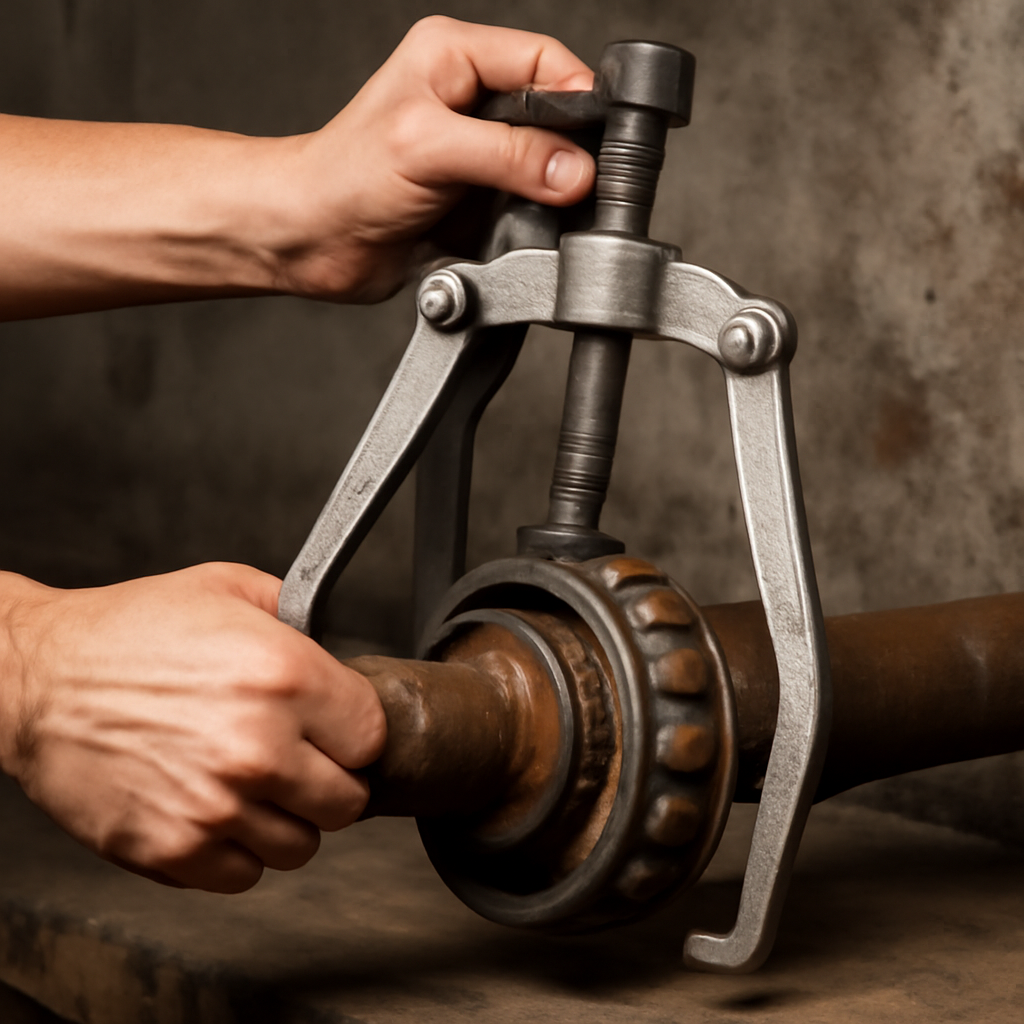
Every workshop technician has met the same wall: a seized spherical roller bearing sitting on a shaft that will not move no matter what a standard puller throws at it. The jaws slip off the ring face, the shaft picks up fresh score marks, the bearing cracks in the wrong plane, and half a shift disappears into a job that was quoted at ninety minutes. The problem is almost never the amount of force available in the workshop. It is that the force is being applied to the wrong component, in the wrong direction, against a bond nobody took the trouble to identify first. Getting the bearing off intact — and far more importantly, getting the shaft off intact — is a diagnostic exercise long before it becomes a mechanical one.
Why bearings seize on shafts in the first place
Three mechanisms account for almost every seizure that reaches a rebuild bench. The first is corrosion between the bearing inner ring and the shaft seat, the standard outcome on outdoor conveyor drives, marine deck equipment and any installation where condensation cycles through the fit for years. The second is a heat-induced interference fit: the bearing went on hot, the shaft never expanded to match, and the assembly cooled into a grip far tighter than the drawing ever specified. The third is mechanical damage, where a bearing that has already failed has welded debris into the shaft surface and locked its own inner ring in place. Each mechanism responds to a completely different removal technique, and applying the wrong one is how shafts get destroyed.
Diagnostic first: understand what you are pulling against
Before any force is applied, spend five minutes reading the interface. Rust bleeding out from the edge of the inner ring points squarely at corrosion seizure, and it usually means the bond is brittle and chemically attackable. Blue or straw discolouration on the ring surface points at heat, which means the interference is elastic and will respond to a temperature differential rather than a solvent. Bright metal debris suspended in the surrounding grease, together with a rough or galled shaft shoulder, points at mechanical damage — and tells you the bearing is already scrap, which changes what you are allowed to do to it. This five-minute check decides which of the three methods below you reach for, and it is the single highest-return step in the whole job. Reference the rolling-element bearing geometry when you are unsure which ring is actually carrying the interference.
Where the puller itself is the problem
A large share of the jobs that end in a mangled shaft never had a mechanical chance, because the puller was gripping the wrong ring. On a spherical roller bearing, a two-jaw or three-jaw puller clamped on the outer ring transmits its entire load through the rollers and into the inner ring, and that path collapses long before the seizure bond does. The rollers brinell, the cage folds, and the jaws slide off the ring radius. Force has to be applied to the inner ring, which is the ring actually gripping the shaft. If the inner ring face is not accessible behind a shoulder, a bearing separator wedged between the inner ring and the shoulder is not optional — it is the only correct way to establish the load path.
The corrosion-seizure method: penetrating oil plus heat
For a corrosion-seized bearing, chemistry does most of the work if you let it. Flood the inner ring edge with penetrating oil and leave it to wick overnight; a second application in the morning is worth more than another ton of puller force. Then apply controlled heat to the inner ring only, using an induction heater with a suitable coil where possible, or a gently moving flame if not, aiming for a rapid rise of roughly 80 to 100 °C above the shaft. The point is differential expansion: the inner ring must grow before the shaft under it does, which cracks the oxide bond in shear. Keep the puller under moderate preload the entire time, so that the moment the bond releases the bearing walks off rather than re-seizing as it cools.
The heat-seizure method: cold contraction plus tap-out
When the bearing was mounted hot and shrank onto an undersized-in-practice shaft seat, penetrating oil has nothing to attack — the bond is pure elastic interference and it obeys the arithmetic of an interference fit. The technique is the mounting process run backwards. Apply the same rapid, localised heat to the inner ring while keeping the shaft as cool as you can, and if the geometry allows, chill the shaft end with dry ice or a cold spray to widen the temperature gap. Hold steady puller preload throughout. Where a puller cannot be rigged, a soft drift and a controlled tap-out against the inner ring face — never the outer ring, never the cage — will move the bearing once the differential opens the fit. Tolerance grades from ISO 286 tell you how much interference you are actually fighting.
The mechanically-damaged method: cut and remove
If the diagnostic says mechanical damage, the bearing is already scrap and you should stop trying to preserve it. Sacrificing the bearing to save the shaft is the correct trade every single time. Cut the outer ring at two opposing points with an angle grinder, using a backing shim so the disc cannot reach the shaft, then lift the outer ring and cage away and remove the rollers. That leaves the inner ring alone on the shaft, where you can work on it properly: drill a relief hole most of the way through the ring wall at one point, then split it with a cold chisel struck into the drilled weak point. The ring will crack open along the drilling and release with almost no load transmitted to the shaft surface underneath.
The tools that make the difference
A workshop serving the European industrial rebuild aftermarket earns back three specific tools within a handful of jobs. First, an induction heater with a range of coils, because it puts heat into the inner ring quickly and selectively in a way a torch never manages cleanly. Second, a proper bearing separator, which is what makes the inner-ring load path possible on shafts with tight shoulders. Third, a set of drift punches and a graduated pusher sized around the bore diameters your shop actually sees, so that nobody improvises with a screwdriver at the end of a long shift. Add a decent set of hydraulic pullers with a threaded centre bolt, and the proportion of jobs that end in shaft repair falls sharply.
Safety limits worth respecting
A puller under high preload is a stored-energy device, and spherical roller bearings on large shafts hold a great deal of it. Keep a chain or a heavy cloth draped over the assembly so that a jaw letting go throws nothing across the bay, and never stand in line with the puller screw. Heat brings its own limits: taking a bearing ring far above roughly 120 °C risks tempering it, and heating a bearing you intend to reuse effectively converts it into a bearing you must scrap. If a bearing you meant to save has been cooked or hammered on the outer ring, retire it. A replacement costs less than the unplanned outage it will otherwise cause three months later.
What to do about the shaft after removal
The shaft, not the bearing, is what decides whether the machine runs tomorrow. Clean the seat and measure it properly with a micrometer at several angular positions, comparing against the original drawing rather than against a neighbouring section. Score marks below roughly 50 microns deep can be polished out with fine emery and a strip-lapping motion. Anything deeper, and any measurable loss of roundness or diameter, needs a genuine repair — metal spray build-up followed by regrinding to size, or a shaft sleeve fitted and machined. Do not install a fresh bearing over a scored or undersized seat. A fit that is too loose lets the inner ring creep, and creep is what generates the next seizure you will be reading this article about.
The takeaway on the workshop procedure
Bearing rescue is diagnostic before it is mechanical. Read the interface, name the seizure mechanism, then apply the one technique that mechanism responds to, and put the force through the inner ring where it belongs. Preserve the shaft even where that means destroying the bearing, and finish by verifying the seat before anything new goes on. When you specify the replacement, a matching SKF or FAG spherical roller alongside a fresh CORTECO shaft seal keeps the moisture out of the fit that seized it in the first place.
Related coverage on Eurobearing
- Bearing Removal Without Damage
- Bearing Installation Mistakes
- Bearings After Long Inactivity
- Bearing Failure Modes
- CORTECO Seal in Warped Housing
Need help with bearing rescue tools? Our team supports the European rebuild aftermarket with tool selection and replacement sourcing. Book a free consultation.