
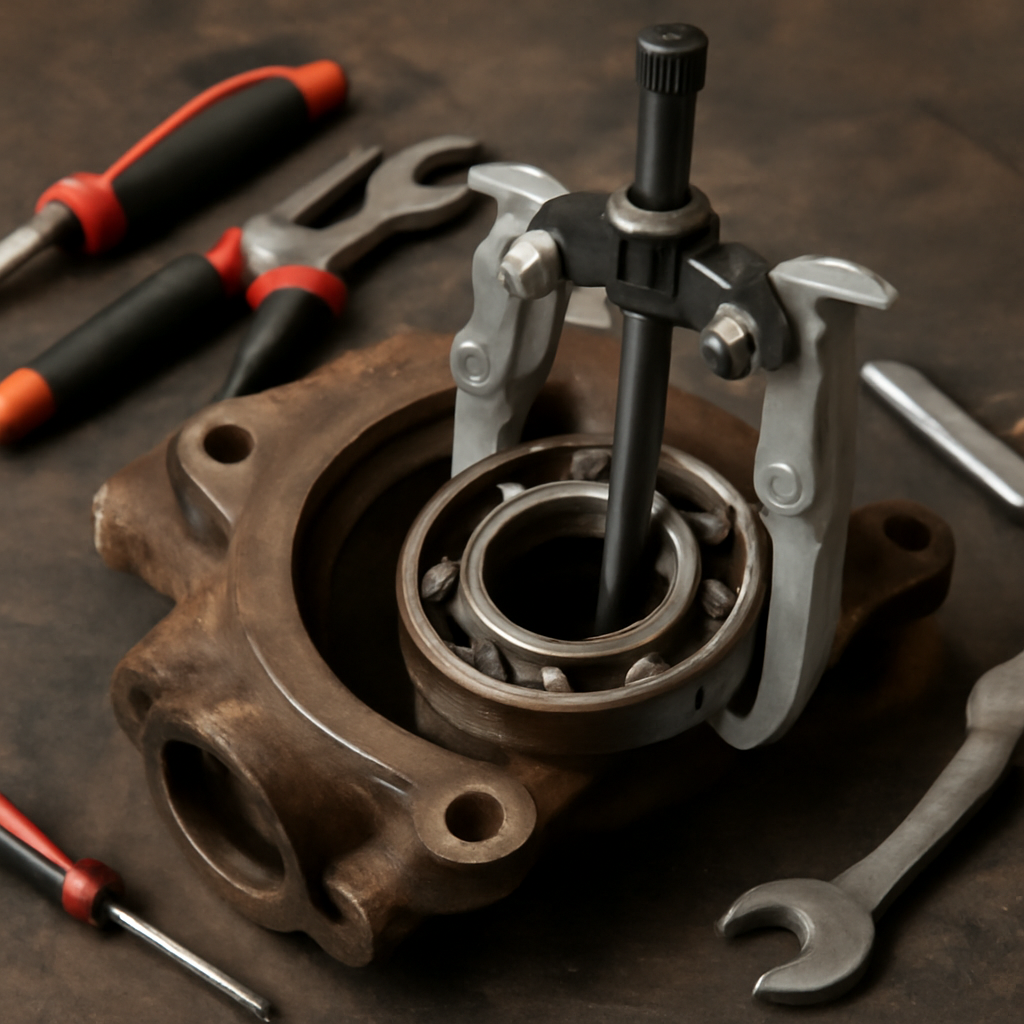
Removing a bearing from a shaft or housing without damaging the surrounding components — and often without damaging the bearing itself, if it can be reused — is a fundamental maintenance skill. The wrong technique creates collateral damage that costs far more than the bearing being replaced. Here is the practical kit list and the procedures for the most common removal scenarios.
1. The principle: pull on the right ring
The single most important rule. If the bearing is mounted on a shaft, pull on the inner ring. If it is mounted in a housing, push on the outer ring. Force transmitted through the rolling elements damages the raceway every time — even if the damage is not immediately visible.
2. The tool kit
2.1 Two-jaw and three-jaw pullers
The basic shop tool for pulling bearings off shafts. Two-jaw is faster; three-jaw distributes load more evenly and is safer for delicate components. Capacity rating: choose larger than you think you need; the actual force can be surprising.
2.2 Bearing-specific puller (back-puller)
Designed to grip behind the inner ring, even when the rolling elements and outer ring obstruct access. SKF TMMR, FAG/Schaeffler equivalents. The professional tool for routine bearing removal.
2.3 Hydraulic puller
Hydraulically actuated for bearings above ~50 mm bore or where corrosion has frozen the joint. SKF TMMA series. Much safer than manually applying high force with a screw puller.
2.4 Bearing heaters (for reverse application)
If the bearing is to be reused, heating it slightly above shaft temperature can ease removal. Same induction heater used for installation.
2.5 Penetrating fluids
For corroded joints, a penetrating fluid (Loctite Freeze and Release, Plus Gas, WD-40 Specialist) applied 24 hours before removal can save hours of struggle.
2.6 Bearing dolly / removal sleeves
For pressing bearings out of housings without distorting the housing bore. Match the sleeve diameter to the bearing outer ring.
3. Procedure: bearing on a shaft
- Apply penetrating fluid 24 hours before if the joint has been in service or corrosion is suspected.
- Choose a puller that grips behind the inner ring. Avoid pullers that grip the outer ring or rolling elements.
- Centre the puller’s centre screw on the shaft end; protect the shaft end with a soft brass insert.
- Apply force gradually. Tap the puller body lightly with a soft hammer to break the static friction.
- If force does not break the joint, apply more penetrating fluid and wait.
- Never use heat (open flame) on a bearing being removed for inspection — it will obscure failure-mode evidence.
4. Procedure: bearing in a housing
- Choose a removal sleeve matched to the bearing outer ring.
- Press from the opposite side of the housing using a hydraulic press or arbor press.
- Support the housing on flat parallel surfaces, not on its rim.
- Apply force perpendicular to the bearing face; off-axis force jams the bearing in the bore.
5. Difficult cases
- Corroded joints: penetrating fluid, heat (small amount, just on the inner ring or housing — not above 100 °C), patience.
- Bearings with adapter sleeves: loosen the locking nut, drift the adapter sleeve toward the smaller end. Manufacturer-specific tools available.
- Bearings welded to shafts by overheating: usually requires shaft replacement.
- Inner rings stuck on tapered shafts: hydraulic injection — pump oil through a port to lift the inner ring. The professional method.
6. Common mistakes
- Pulling on the outer ring of a bearing mounted on a shaft — damages the rolling elements and raceways.
- Using too small a puller — slips off under load and damages the components.
- No penetrating fluid on suspected corroded joints — turns a 5-minute job into 2 hours.
- Using a screw puller where hydraulic is needed — risk of injury when the puller releases under load.
- Not protecting the shaft end — damages the shaft and complicates the next bearing installation.
7. Safety
- Wear safety glasses. Pullers under load can release suddenly.
- Never place hands between puller jaws and the work piece.
- For hydraulic pullers, ensure the relief valve is correctly set.
- Inspect pullers before each use — worn jaws and stripped threads cause failures under load.
Conclusion
Removing a bearing cleanly is a skill that pays back continuously. The right tool kit (manual and hydraulic pullers, removal sleeves, penetrating fluid) costs €500-2000 and lasts for years. The cost of a damaged shaft because someone tried to pull a bearing with a hammer and a chisel is far higher.
The 2026 reliability investment thesis
For European industrial customers in 2026, the broader reliability investment thesis is decisive. The combination of affordable IoT sensors (under $50 per node, an 85% cost reduction since 2019), mature AI analytics platforms, documented ROI cases (6-18 month payback in mid-size plants), and supplier ecosystem support makes condition monitoring deployment economically realistic for virtually any plant with critical rotating equipment. The cumulative effect across years of deployment is meaningful: 30-50% reduction in unplanned downtime, 15-25% reduction in maintenance labour, and extended equipment service life.
For procurement leadership specifically, the reliability investment changes the supplier relationship dynamic. Bearing supply becomes part of an integrated reliability conversation rather than a transactional component supply. Engineering services, condition monitoring platforms, training programmes, and roadmap visibility all flow from strategic supplier relationships. The companies building these relationships now position themselves for the post-2028 industry structure where smart bearings and integrated reliability solutions become standard rather than premium.
What the next 18 months will tell us
The next 18 months will clarify several major industry questions. NSK + NTN antitrust filings progress through Q3-Q4 2026 will reveal the regulatory burden and possible remedies. SKF Automotive spin-off mechanics will be confirmed, with implications for both the SKF industrial businesses and the new standalone automotive entity. Schaeffler Yinchuan capacity ramp will reach steady-state output, affecting standard catalogue lead times and pricing dynamics. EU industrial demand recovery will be tested through H2 2026 and into 2027.
For organisations operating in this environment, active engagement with these developments — through industry events, supplier conversations, and trade press monitoring — supports informed strategic decisions. The bearing industry in 2026-2027 is not on autopilot; the strategic decisions made during this period set competitive positioning for years to come.
Industry consolidation effects on the European market
The European bearing market in 2026 is experiencing one of the most active consolidation periods in three decades. NSK and NTN signed a Memorandum of Understanding on 12 May 2026 to integrate by October 2027, creating a combined entity that will challenge SKF and Schaeffler for the global #1 position. SKF announced and is operationally preparing the separation of its Automotive business under a new three-segment structure (Bearing Solutions, Specialized Industrial Solutions, Automotive). Schaeffler completed major capacity expansion at its Yinchuan (China) facility, doubling manufacturing capacity for high-volume FAG deep groove ball bearings. SKF acquired G-Tech Instruments in March 2026, deepening condition monitoring capability.
For European industrial customers, these consolidation effects translate into specific operational implications. Lead times on standard catalogue ranges should normalise through H2 2026 as the Yinchuan capacity reaches steady-state output. Framework agreement negotiations should incorporate the consolidation context, with provisions for SKU continuity, substitution rights, and engineering support continuity through the transition period. Multi-supplier qualification becomes more important as the industry restructures around fewer larger entities.
Raw material costs and pricing dynamics
Bearing pricing dynamics in 2026 reflect several converging cost drivers. US steel tariffs at 50% (in force since June 2025) reshape global trade flows, with Asian bearing exporters redirecting volume away from the US into Europe and other markets. Bearing-grade alloy premiums continue to widen as demand for cleaner steel chemistry grows faster than supply. EU regulatory developments (CBAM, REACH SVHC updates, steel safeguards) add complexity to import economics.
For procurement teams, the practical posture is active engagement with these dynamics. Lock pricing on top-50 SKUs in framework agreements where leverage exists. Build steel-cost adjustment mechanisms into multi-year contracts rather than fixed pricing. Verify customs classifications carefully — the difference between an HS code that captures CBAM and one that does not can be material. Document supplier origin certifications for preferential trade agreement benefits.
The smart bearing transition and procurement implications
The bearing industry’s transition from component supply to integrated reliability platform delivery represents the defining strategic shift of the decade. Every major manufacturer (SKF Insight, Schaeffler OPTIME, NSK SAT, NTN smart bearing platforms) has built or acquired platform capability. The integrated offering combines instrumented bearings, cloud analytics, AI-based anomaly detection, prescriptive workflow integration, and integrated services.
For procurement leadership, the smart bearing transition reshapes the supplier evaluation criteria. Beyond bearing specifications and pricing, evaluation now includes platform capability, integration with existing CMMS and ERP systems, data ownership and portability terms, and ongoing software roadmap visibility. The platform commitment is multi-year — selecting a smart bearing platform is more consequential than selecting a bearing brand because the platform decision is harder to reverse.
Condition monitoring deployment economics in 2026
The deployment economics for IoT-based condition monitoring in 2026 are particularly favourable for European mid-size industrial plants. Sensor hardware costs have collapsed (under $50 per node, 85% reduction since 2019). Cloud platforms have matured into turnkey SaaS offerings with predictable subscription pricing. AI analytics layer adds capability that human analysts alone cannot match. Documented payback periods converge on 6-18 months for typical deployments.
For a mid-size plant with 50-100 critical assets, deployment economics typically run: €15,000-30,000 first-year capex for sensors, gateways, and integration; €10,000-20,000 annual recurring for cloud platform and ongoing services. Total 5-year cost: €55,000-130,000. Documented savings: 30-50% reduction in unplanned downtime, typically valued at €100,000-500,000 annually. The capital justification is straightforward; the organisational change to operate alongside the technology is the actual implementation challenge.
Related guides
- Bearing Installation: 7 Mistakes
- Common Installation Mistakes
- Bearing Shrink Fitting
- Bearing Maintenance Long-Term
- AB-TOOLS Hand Tools
Need help with bearing selection? Our team supports you with cross-references and lead-times.