
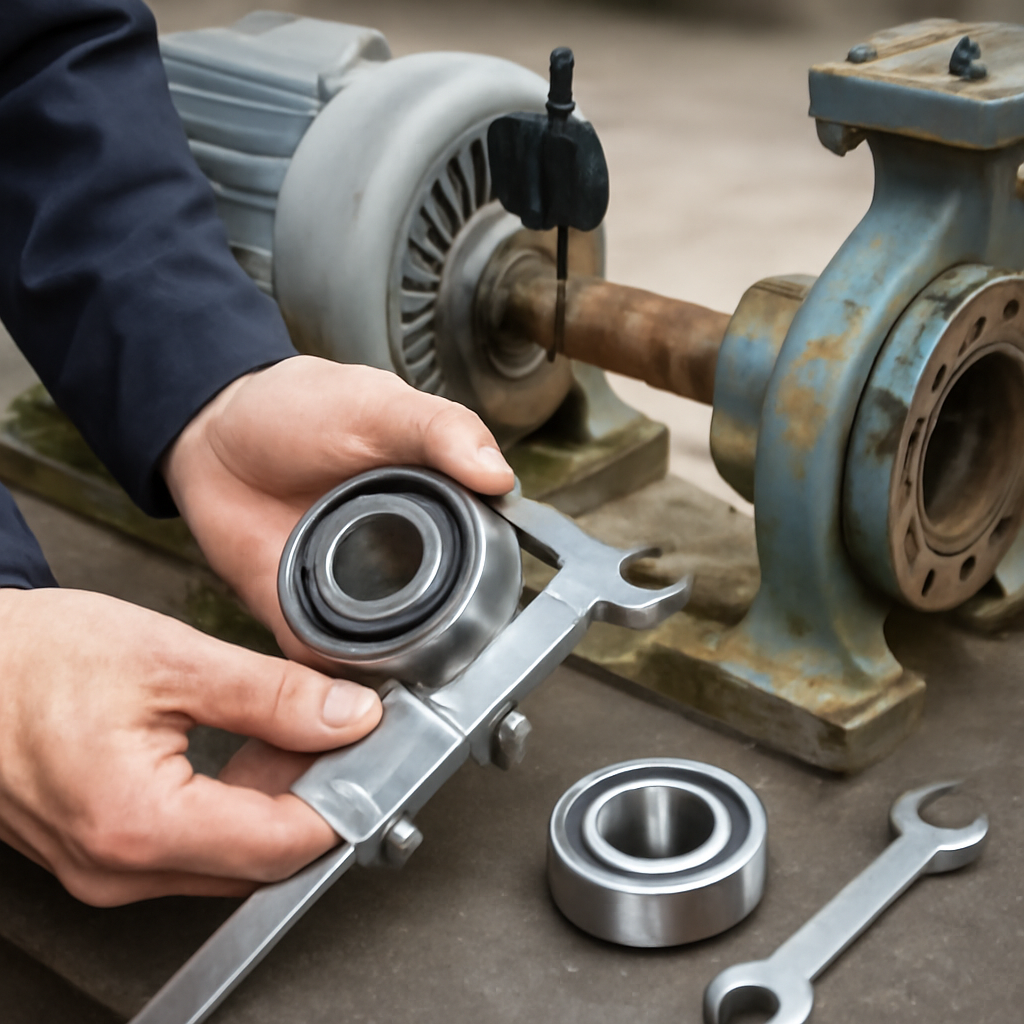
Shaft misalignment is invisible until it isn’t. The bearing pays the price first — uneven wear, accelerated raceway fatigue, asymmetric heating, and ultimately premature failure. Coupling wear, vibration, and sometimes catastrophic seal failure follow. The good news is that misalignment is one of the easiest faults to diagnose and one of the cheapest to correct, provided you do it before damage is done. This guide is the practical playbook every reliability technician should know in 2026.
1. The two types of misalignment
- Parallel (offset) misalignment: the two shaft centrelines are parallel but offset by some distance. Visible as a side-to-side offset between the coupling halves.
- Angular misalignment: the two shaft centrelines meet at an angle. Visible as a gap between coupling halves that is wider on one side.
Real machinery almost always shows a combination of both, with one usually dominant. The diagnostic and correction techniques handle both simultaneously.
2. Why misalignment kills bearings
A misaligned shaft generates parasitic loads on the bearings:
- Asymmetric radial load that concentrates the contact patch on one side of the raceway, accelerating fatigue.
- Axial load that single-row deep groove bearings were not designed to carry continuously.
- Tilting moments that load the bearing in ways outside the calculated L10 envelope.
The net effect: calculated L10 service life can drop to a fraction of the design value. Field studies consistently put misalignment in the top 3 root causes of premature bearing failure, behind only improper lubrication and contamination.
3. Signs that point to misalignment
- Asymmetric housing temperature: one end of the bearing housing hotter than the other by 10 °C or more.
- Strong axial vibration component: misalignment produces axial vibration that radial-only meters often miss. Use a tri-axial sensor or rotate the meter on the axial face.
- Vibration at 2× shaft speed: misalignment characteristically produces a strong 2× harmonic in the FFT spectrum.
- Coupling wear: flexible couplings tear themselves apart on misaligned shafts. Visible loss of rubber, broken bolts, scoring on hub faces.
- Asymmetric raceway wear at strip-down: one side of the raceway shows more spalling than the other when the bearing is dismantled.
- Persistent re-greasing requirement: misaligned bearings need re-greasing more frequently than calculation predicts.
- Seal leakage: the seal lip is loaded unevenly and wears asymmetrically, leading to leakage on the loaded side.
4. How to measure misalignment
4.1 Without a laser: dial indicators
The classical “rim-and-face” or “reverse-dial” method uses two dial indicators on a clamped bracket spanning the coupling. Rotate both shafts together and measure the readings at four cardinal positions. The math produces precise offset and angular values. This technique requires care but produces results well within the tolerance bands of most rotating equipment.
4.2 With a laser tool
Modern laser alignment systems (Pruftechnik, Easy-Laser, SKF TKSA series) have become inexpensive enough to be standard tools in maintenance shops. They are faster, eliminate the math, and reduce error.
4.3 Verifying soft foot first
A “soft foot” is a machine base that does not sit flat on its mounting surface. Tightening hold-down bolts deforms the base and re-introduces misalignment. Check soft foot before any alignment work: loosen each bolt in turn and measure how much the foot rises. More than 0.05 mm rise = soft foot, correct with shimming or machining of the base surface.
5. Tolerance bands
- General-purpose industrial drives: parallel offset within 0.1 mm, angular within 0.1 mm/100 mm.
- High-speed equipment (3000+ rpm): tighter — 0.05 mm offset, 0.05 mm/100 mm angular.
- Precision machine tools and turbo machinery: per the OEM spec, sometimes 0.01-0.02 mm.
- Wind turbine gearboxes: per the manufacturer’s commissioning protocol.
6. The correction procedure
- Measure offset and angular misalignment in both vertical and horizontal planes.
- Calculate the shim adjustments needed at the motor (or driven equipment) feet.
- Tighten the hold-down bolts in the correct sequence to avoid re-introducing soft foot.
- Re-measure after the machine has run for 30-60 minutes at operating temperature — thermal growth shifts alignment.
- Document the final readings in the CMMS for next time.
7. Thermal growth — the often-overlooked factor
A motor and a pump or gearbox grow at different rates as they reach operating temperature. The OEM data sheet usually specifies a cold offset that compensates for the expected thermal growth — ignoring this leads to a machine that is well-aligned cold and misaligned hot. For high-temperature applications, target the OEM-specified cold offset, not zero.
8. Continuous monitoring in 2026
Sub-$50 IoT vibration nodes deployed on critical assets pick up the 2× harmonic signature of misalignment within hours of its appearance. Trending the 2× component over time turns alignment from an episodic intervention into a continuously monitored parameter — particularly valuable on assets where thermal growth makes ageing alignment a recurring issue.
9. Common alignment mistakes
- Aligning to the motor shaft when the OEM data sheet calls for thermal-growth offset.
- Tightening bolts in the wrong order, re-introducing soft foot.
- Skipping the soft-foot check before measurement.
- Using worn shims that compress under load.
- Not re-measuring after hot operation.
- Treating misalignment as a one-time fix when foundation movement keeps re-introducing it.
Conclusion
Misalignment is one of the easiest preventable causes of premature bearing failure. The diagnostic signs are clear, the measurement technique is well-established, and the correction is mechanical. With continuous condition monitoring picking up the characteristic 2× signature early, there is no excuse in 2026 for losing a bearing to misalignment that could have been corrected with a few hours of skilled work.
The H2 2026 market context
Looking ahead to H2 2026, the European bearing market enters the period with several specific dynamics worth tracking. Industrial production indicators point toward moderate recovery; raw material costs remain elevated but stable; supply chain rebalancing continues as Schaeffler Yinchuan capacity reaches steady-state output. The NSK + NTN antitrust filings expected in Q3 2026 will be the most-watched ongoing story; SKF Automotive spin-off mechanics provide additional industry restructuring context.
For distributors and end-users operating in this environment, the practical posture is active engagement with supplier strategic developments combined with disciplined operational execution. Framework agreement negotiations during H2 2026 should incorporate the consolidation context; inventory positioning should reflect the lead-time normalisation; condition monitoring deployments should accelerate while implementation capacity is available. The window for proactive positioning ahead of the 2027 industry structure is narrow but real.
The application engineering depth
Beyond catalogue selection, application engineering for this product category benefits from manufacturer engineering consultation. Specialised duty profiles, non-standard environments, and integrated multi-component solutions all benefit from manufacturer engineering involvement during the design phase. The investment pays back through extended service life and reduced operational risk across the equipment lifecycle.
The 2026 European market context
The European bearing market in 2026 enters a period of structural change. Industry consolidation (NSK + NTN, SKF Automotive spin-off), capacity expansions (Schaeffler Yinchuan), regulatory evolution (REACH, CBAM, trade defence), and end-market shifts (EV, wind, robotics) all reshape the operational environment. For procurement teams, the strategic posture is active engagement rather than passive reaction.
Supplier relationships and substitution capability
Beyond product specification, the supplier relationship and substitution capability matter as much as the bearing choice. Multi-supplier qualification, cross-reference database maintenance, and engineering equivalence documentation deliver procurement leverage and supply resilience. For European industrial customers, this capability investment is one of the highest-ROI strategic decisions available in 2026.
The 2026 reliability investment thesis
For European industrial customers in 2026, the broader reliability investment thesis is decisive. The combination of affordable IoT sensors (under $50 per node, an 85% cost reduction since 2019), mature AI analytics platforms, documented ROI cases (6-18 month payback in mid-size plants), and supplier ecosystem support makes condition monitoring deployment economically realistic for virtually any plant with critical rotating equipment. The cumulative effect across years of deployment is meaningful: 30-50% reduction in unplanned downtime, 15-25% reduction in maintenance labour, and extended equipment service life.
For procurement leadership specifically, the reliability investment changes the supplier relationship dynamic. Bearing supply becomes part of an integrated reliability conversation rather than a transactional component supply. Engineering services, condition monitoring platforms, training programmes, and roadmap visibility all flow from strategic supplier relationships. The companies building these relationships now position themselves for the post-2028 industry structure where smart bearings and integrated reliability solutions become standard rather than premium.
What the next 18 months will tell us
The next 18 months will clarify several major industry questions. NSK + NTN antitrust filings progress through Q3-Q4 2026 will reveal the regulatory burden and possible remedies. SKF Automotive spin-off mechanics will be confirmed, with implications for both the SKF industrial businesses and the new standalone automotive entity. Schaeffler Yinchuan capacity ramp will reach steady-state output, affecting standard catalogue lead times and pricing dynamics. EU industrial demand recovery will be tested through H2 2026 and into 2027.
For organisations operating in this environment, active engagement with these developments — through industry events, supplier conversations, and trade press monitoring — supports informed strategic decisions. The bearing industry in 2026-2027 is not on autopilot; the strategic decisions made during this period set competitive positioning for years to come.
Related guides on Eurobearing
- How to Detect Bearing Wear by Vibration
- How to Address Bearing Overheating
- Secrets to Proper Belt Drive Alignment
- Bearing Installation: 7 Mistakes
- Reducing Machine Downtime
Need help with bearing selection or maintenance? Our technical team supports you with cross-references, selection and lead-times.