
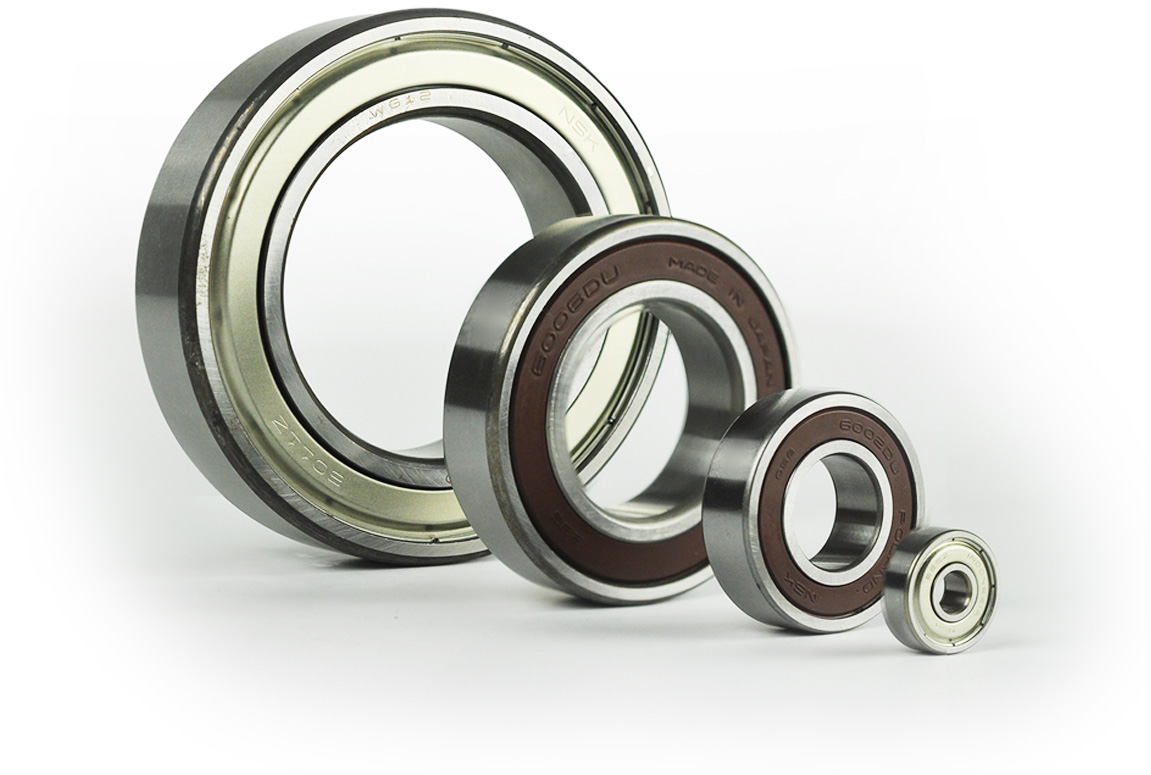
Bearings rarely fail because of design defects — they fail because of how they are operated and maintained. Multi-year field studies from SKF, FAG, NSK and independent reliability engineering firms consistently point to improper lubrication and contamination ingress as the root cause of more than 50% of premature bearing failures, with misalignment and overloading taking most of the rest. The good news: all four are controllable through a disciplined, low-cost maintenance routine. This guide is the practical playbook every maintenance team should know in 2026.
1. Why bearing service life is mostly about maintenance, not procurement
A modern deep groove ball bearing — say a SKF 6205 or FAG 6205 — is engineered for a calculated L10 life of tens of thousands of hours when properly applied. Yet the median observed service life in unmaintained or poorly maintained industrial equipment is often a small fraction of that number. The gap is closed by routine, not by buying a more expensive bearing.
The 2026 cost equation makes the point even sharper: with bearing list prices up 8-12% over the last 24 months under raw-material and tariff pressure, the case for stretching the life of installed bearings has rarely been stronger.
2. The three levers of bearing service life
Lever 1 — Lubrication: the right grease, the right amount, the right interval
Grease selection is the single most consequential maintenance decision. Get it right and a standard deep groove bearing runs trouble-free for 10,000+ hours; get it wrong and it fails in months.
- Thickener compatibility matters above all when re-greasing. Lithium soap and polyurea thickeners are not compatible. Lithium and calcium-complex can soften. Always re-grease with the same thickener family, or fully purge before changing.
- Quantity: target 30-50% of the bearing free space. Over-greasing causes churning and overheating; under-greasing causes metal-to-metal contact and accelerated wear.
- Re-lubrication interval: depends on speed, temperature and contamination. Manufacturers offer calculators — SKF DialSet, Schaeffler GreaseApp, NSK Bearing Doctor — that produce reliable starting intervals. Refine by observation.
- Base oil viscosity: the lubrication regime in the bearing depends on the base oil. Specify ISO VG grades matched to speed and load, not just “grease”.
Lever 2 — Contamination control: keep dirt and water out
A single 10-micron particle can initiate raceway spalling within hundreds of thousands of revolutions. Practical defences:
- Verify seal lip integrity at every inspection. Replace seals showing wear, hardening or splitting.
- For wet or dusty environments, specify double-lip contact seals (2RS or 2RSR) rather than shields.
- For wash-down food and beverage applications, consider the INA stainless insert range (BSA Award 2025 winner) that uses fully stainless rings and housings.
- Pressurise the housing slightly if the duty cycle permits.
- Never reuse grease that has contacted the environment.
Lever 3 — Load and alignment
A bearing operating at its rated load lasts a calculable number of hours. Shaft misalignment of just 0.2 mm over a 200 mm shaft effectively doubles the dynamic load on the bearing — halving service life. Check alignment at installation and after any disassembly. Soft-foot conditions are the hidden source of recurring misalignment; address them with shimming or remachining of the base.
3. The monthly inspection routine
- Visual: any oil leakage, grease migration, discoloration of the housing?
- Audible: a chassis-mounted stethoscope catches early raceway distress that a microphone misses.
- Thermal: a non-contact IR thermometer logs the housing temperature trend. Establish a healthy baseline; investigate any 10 °C sustained rise above that baseline.
- Vibration: a handheld meter (even a $200 unit) tracks overall RMS. With IoT vibration nodes now under $50/unit (an 85% cost drop since 2019), continuous monitoring is realistic for any plant with critical rotating equipment.
- Document: log every inspection in the CMMS. The next technician to look at this asset will thank you.
4. The annual deep-dive
Once per year, plan a full lubrication change on critical equipment:
- Drain or repack with fresh grease per spec.
- Inspect the seal; replace if degraded.
- Sample the old grease and analyse for water content, metal particles, viscosity drop.
- If used oil analysis shows iron above 50 ppm, plan a bearing replacement at the next planned outage.
5. When to replace rather than service
Signs that a bearing has reached end-of-life:
- Housing temperature 10 °C above its baseline and stable there.
- Rising vibration trend, with defect frequencies appearing in the FFT spectrum.
- Oil sample analysis showing iron particles above threshold.
- Audible noise that does not improve after re-lubrication.
- Rough or notchy rotation when checked by hand.
The cost of a planned bearing swap is always cheaper than the cost of an unplanned breakdown — typically a factor of 10 to 100 on critical production lines.
6. The 2026 enablers: condition monitoring and predictive maintenance
Two technology shifts in 2026 fundamentally change what a maintenance team can do:
- Sub-$50 IoT vibration nodes have moved condition monitoring from large-enterprise toy to mainstream tool. A plant-wide deployment on the 20 most critical assets fits in a 5-figure capex budget.
- Agentic AI on the maintenance layer takes condition monitoring from “alert” to “act”: auto-issued work orders, auto-ordered spare parts, AI-generated root-cause analyses. Studies show 65% of maintenance teams plan to adopt AI tools by year-end 2026.
7. A pragmatic monthly checklist
- Walk-around visual on all critical bearings.
- IR temperature reading on housings.
- Vibration RMS check.
- Verify lubrication schedule adherence.
- Review trend data and flag any asset moving away from baseline.
- Update CMMS with findings.
Conclusion
Bearing service life is mostly a function of three things you can control: lubrication, contamination, and load. A disciplined routine, modest investment in monitoring, and a documented inspection cadence are worth more than premium components installed and then ignored. In 2026 the tools to do this well — IoT sensors, AI analytics, manufacturer apps for re-lubrication calculation — have never been more accessible or affordable.
The cost of “guessed” maintenance intervals
Industrial plants that operate on fixed maintenance schedules — quarterly inspection, semi-annual lubrication, annual overhaul — without considering actual asset condition systematically over-maintain healthy assets and under-maintain stressed ones. The result: wasted labour on equipment that did not need attention, and missed degradation on equipment that did. Published European industrial reliability studies consistently put the cost of fixed-schedule maintenance at 20-40% above condition-based maintenance for equivalent uptime outcomes.
The transition from fixed to condition-based maintenance is one of the highest-return projects most plants can undertake. The required investment: condition monitoring infrastructure (sensors, platform, integration), maintenance team training, and process redesign. The payback: 6-18 months in most documented cases. The cumulative effect over years: 30-50% reduction in unplanned downtime plus 15-25% reduction in maintenance labour.
The contamination prevention checklist
Beyond the high-level principles, the practical contamination prevention checklist for a typical industrial bearing position covers: pre-installation cleaning of shaft and housing, seal integrity verification at every inspection, proper grease tool hygiene (dedicated tools per grease type, cleaned grease nipples), atmospheric control where feasible (filtration, pressure differential), and used-grease disposal discipline (never re-using grease that has contacted the environment).
Built into the maintenance routine, the checklist takes 5-10 minutes per inspection point. The cumulative effect across hundreds of bearings is the difference between calculated L10 service life and a fraction of it.
How AI condition monitoring changes the calculation
The single largest shift in industrial bearing maintenance in 2026 is the integration of AI analytics with affordable IoT sensors. Sub-$50 vibration nodes, mature cloud platforms, and AI-driven anomaly detection together change what a maintenance team can achieve. Continuous monitoring of every critical bearing becomes economically realistic; the AI handles routine pattern recognition while skilled technicians concentrate on the cases AI flags as ambiguous.
For maintenance organisations, the implication is a productivity step-change. The same team can monitor 5-10× more assets at the same staffing level — or maintain the existing fleet with deeper diagnostic coverage and faster response. Both translate into better reliability outcomes and lower total maintenance cost.
The OEM partnership opportunity
The major bearing OEMs (SKF, Schaeffler, NSK, NTN) all offer reliability service programmes that go beyond bearing supply. Engineering consulting, vibration analysis, lubrication audits, and integrated condition monitoring programmes are available to industrial customers willing to engage at the system level rather than the component level.
For mid-size industrial plants without dedicated reliability engineering capability, these OEM programmes can deliver measurable improvement in maintenance effectiveness — particularly during the transition from fixed-schedule to condition-based maintenance. The supplier relationship evolves from transactional to consultative.
The asset-level lubrication strategy that pays back
Treating lubrication as an asset-level strategic decision rather than a maintenance task changes outcomes. The strategy considers: lubricant selection for each bearing position, automatic vs manual lubrication delivery, monitoring approach for lubricant condition, and replacement schedule integrated with broader maintenance planning. For critical assets, the strategy may include grease analysis programmes, automatic lubrication systems, and integration with condition monitoring data.
The cumulative effect of this strategic approach across years is measurable: lubrication-related bearing failures decline, lubrication labour costs decline, and total maintenance hours decline. For mid-size industrial plants, the savings often exceed the cost of the lubrication strategy investment within the first year.
Related guides on Eurobearing
- Reducing Machine Downtime through Proper Bearing Maintenance
- Guide to Choosing Lubricants for Bearings
- Complete Checklist for Periodic Bearing Maintenance
- IoT Vibration Sensors Under $50
- How to Detect Bearing Wear by Vibration
Need help with bearing selection or maintenance? Our technical team supports you with cross-references, selection and lead-times.