
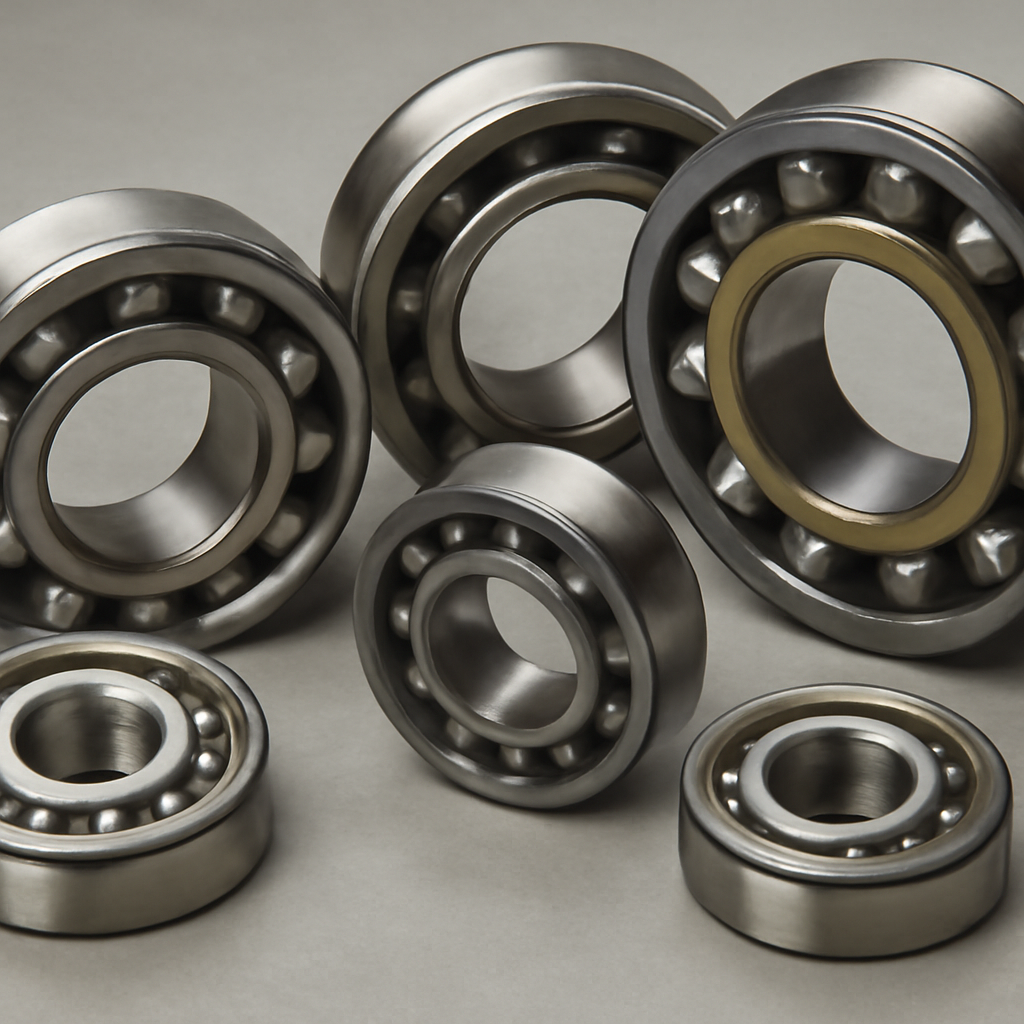
Six brands dominate the global industrial bearing market: SKF, Schaeffler (FAG and INA), NTN, NSK, TIMKEN — together they account for the vast majority of premium and engineering-class bearings specified across European industry. Each has a distinct heritage, strengths, and positioning. This side-by-side comparison is the practical reference for procurement and specification decisions.
1. SKF (Sweden)
- Heritage: founded 1907 in Gothenburg.
- Position: largest bearing manufacturer globally by revenue.
- Strengths: complete portfolio, broadest condition monitoring ecosystem, strong marine/aerospace/wind presence, global engineering support.
- Premium ranges: Explorer (enhanced life), Insocoat (insulated), Super-precision (machine tools).
- 2026 context: Automotive spin-off in progress; restructuring around Bearing Solutions and Specialized Industrial Solutions segments; G-Tech Instruments acquired for condition monitoring.
- Where it wins: integrated industrial reliability programmes, condition monitoring, wind energy, large industrial bearings.
2. Schaeffler FAG (Germany)
- Heritage: FAG founded 1883 in Schweinfurt by Friedrich Fischer.
- Position: shared platform with INA under Schaeffler Group.
- Strengths: ball bearings core competence, Generation C standard, X-life enhanced range, broad European industrial coverage.
- Premium ranges: X-life, Generation C, INSOCOAT.
- 2026 context: Yinchuan capacity expansion doubling standard catalogue capacity; CES 2026 humanoid robotics push.
- Where it wins: electric motor bearings, automotive transmissions, broad industrial.
3. Schaeffler INA (Germany)
- Heritage: founded 1946, pioneer of modern needle roller bearings.
- Position: needle and specialty roller leader, part of Schaeffler Group.
- Strengths: needle roller bearings, cam followers, combined bearings, specialty industrial.
- Premium ranges: X-life, BSA Award-winning stainless insert range.
- 2026 context: BSA 2025 Innovation Award; expanding stainless and insert ranges.
- Where it wins: transmissions, gearboxes, needle and combined bearings, food-grade applications.
4. NSK (Japan)
- Heritage: founded 1916, first Japanese bearing manufacturer.
- Position: top global player, particularly strong in automotive and industrial.
- Strengths: precision-grade ball bearings, material engineering, automotive integration.
- Premium ranges: HPS High-Performance Standard, Spacea.
- 2026 context: MoU signed 12 May 2026 to merge with NTN — closing target October 2027.
- Where it wins: precision ball bearings, automotive, Asian OEM relationships.
5. NTN (Japan)
- Heritage: founded 1918.
- Position: top global player, particularly strong in automotive wheel hubs and agricultural.
- Strengths: tapered roller bearings, wheel hub assemblies, agricultural specialty range.
- Premium ranges: ULTAGE long-life range.
- 2026 context: integrating with NSK; agricultural range continues development.
- Where it wins: wheel hubs, agricultural equipment, automotive aftermarket.
6. TIMKEN (USA)
- Heritage: founded 1899 by Henry Timken, inventor of the tapered roller bearing.
- Position: tapered roller bearing specialist, broader portfolio in heavy industry.
- Strengths: tapered roller bearings (the global reference), heavy industrial duty, mining and aerospace.
- Premium ranges: SPEXX enhanced fatigue life.
- 2026 context: continues independent strategic direction; sustained M&A activity in heavy industrial.
- Where it wins: heavy industrial duty, truck wheel ends, mining, rolling mills, aerospace.
7. Quick selection matrix
- General industrial motor: SKF or FAG.
- Automotive transmission: FAG or NTN.
- Wheel hub bearings: NTN or SKF.
- Machine tool spindles: SKF Super-precision or FAG X-life.
- Heavy industry (mining, mills): TIMKEN or SKF.
- Needle roller and gearbox: INA.
- Wash-down food grade: INA stainless or SKF Y-bearings stainless.
- EV traction motor: SKF (hybrid/Insocoat) or NSK.
- Wind turbine main shaft: SKF or Schaeffler.
- Agricultural: NTN or SKF.
Conclusion
The six dominant industrial bearing brands each have distinct strengths and natural application territories. Specifying by strength rather than by habit produces better matched selections and better service life. For 2026 procurement, the multi-brand qualification approach — with each brand specified where its strengths align — delivers the best combination of performance and supply resilience.
The European bearing industry 2026 landscape
The European bearing industry in 2026 enters one of the most active strategic transformation periods in three decades. The NSK + NTN MoU (12 May 2026, target closing October 2027), SKF Automotive spin-off preparation, Schaeffler Yinchuan capacity doubling, and SKF G-Tech Instruments acquisition (March 2026) collectively reshape the supplier landscape. The industry market projection from $151.8B (2026) to $301B (2033) reflects structural drivers operating in parallel: EV adoption acceleration, wind energy capacity expansion, industrial robotics growth, and smart bearing technology maturation.
For European industrial procurement teams, the practical implications converge on five operational priorities. Multi-supplier qualification across critical SKUs supports substitution agility through consolidation. Framework agreement renegotiation captures pricing leverage during the competitive window. Condition monitoring deployment delivers 6-18 month payback ROI on mid-size plant deployments. Smart bearing qualification positions for the 2028+ industry structure. Master data discipline supports informed substitution decisions during supply disruptions.
The smart bearing and condition monitoring transition
The bearing industry’s transition from component supply to integrated reliability platform delivery represents the defining strategic shift of the decade. Every major manufacturer (SKF Insight, Schaeffler OPTIME, NSK SAT, NTN smart bearing platforms) has built or acquired platform capability. The integrated offering combines instrumented bearings, cloud analytics, AI-based anomaly detection, prescriptive workflow integration, and reliability services. For European industrial customers, qualifying smart bearings on critical applications during 2026 positions the organisation for the post-2028 industry structure where smart bearings become standard rather than premium.
Industry surveys converge on 65% of maintenance teams planning AI adoption by year-end 2026 — a documented adoption signal that the industry transition is real and accelerating. For procurement and reliability leadership, the strategic question is no longer whether to deploy but how fast, at what scale, and on which platform.
Raw material costs and tariff dynamics
Bearing pricing dynamics in 2026 reflect converging cost drivers. US steel tariffs at 50% (in force since June 2025) reshape global trade flows, with Asian bearing exporters redirecting volume into Europe and other markets. Bearing-grade alloy premiums continue widening. EU regulatory developments (CBAM transitional phase, REACH SVHC updates, steel safeguards review activity) add complexity to import economics.
For procurement teams, the practical response combines tactical and strategic actions: lock pricing on critical SKU framework agreements during the H2 2026 window; build steel-cost adjustment mechanisms into multi-year contracts; verify customs classifications carefully on cross-border purchases; document supplier origin certifications for preferential trade agreement benefits; build inventory depth on critical references where carrying cost favours stock vs expected H2 2026 price step.
The European bearing industry 2026 strategic landscape
The European bearing industry in 2026 enters one of the most active strategic transformation periods in three decades. NSK + NTN MoU (12 May 2026, target closing October 2027), SKF Automotive spin-off preparation, Schaeffler Yinchuan capacity doubling, and SKF G-Tech Instruments acquisition (March 2026) collectively reshape the supplier landscape. The industry market projection from $151.8B (2026) to $301B (2033) reflects structural drivers operating in parallel: EV adoption acceleration, wind energy capacity expansion, industrial robotics growth, and smart bearing technology maturation.
For European industrial procurement teams, the practical implications converge on five operational priorities: multi-supplier qualification supports substitution agility through consolidation; framework agreement renegotiation captures pricing leverage during the competitive window; condition monitoring deployment delivers 6-18 month payback ROI on mid-size plant deployments; smart bearing qualification positions for the 2028+ industry structure; master data discipline supports informed substitution decisions during supply disruptions.
Smart bearing and condition monitoring transition
The bearing industry’s transition from component supply to integrated reliability platform delivery represents the defining strategic shift of the decade. Every major manufacturer (SKF Insight, Schaeffler OPTIME, NSK SAT, NTN smart bearing platforms) has built or acquired platform capability. The integrated offering combines instrumented bearings, cloud analytics, AI-based anomaly detection, prescriptive workflow integration, and reliability services. For European industrial customers, qualifying smart bearings on critical applications during 2026 positions the organisation for the post-2028 industry structure where smart bearings become standard.
Industry surveys converge on 65% of maintenance teams planning AI adoption by year-end 2026 — a documented adoption signal that the industry transition is real and accelerating. For procurement and reliability leadership, the strategic question is no longer whether to deploy but how fast, at what scale, and on which platform.
Raw material costs and pricing trajectory
Bearing pricing dynamics in 2026 reflect converging cost drivers. US steel tariffs at 50% (in force since June 2025) reshape global trade flows. Bearing-grade alloy premiums continue widening. EU regulatory developments (CBAM, REACH SVHC updates, steel safeguards) add complexity to import economics. For procurement teams, the practical posture is active engagement: lock pricing on top-50 SKUs in framework agreements; build steel-cost adjustment mechanisms; verify customs classifications; document supplier origin certifications; build inventory depth on critical references where carrying cost favours stock vs expected price step.
The H2 2026 procurement action list
For European industrial procurement leadership in H2 2026, the action list converges on five operational priorities. First, multi-supplier qualification across critical SKUs supports substitution agility through the NSK + NTN consolidation period. Second, framework agreement renegotiation captures pricing leverage during the competitive window before the integration closes. Third, condition monitoring deployment delivers documented 6-18 month payback on typical mid-size plant deployments. Fourth, smart bearing qualification on critical applications positions the organisation for the post-2028 industry structure. Fifth, master data discipline supports informed substitution decisions during supply disruptions.
The cumulative effect of disciplined execution across these priorities compounds across years. Organisations that build the capability now position themselves for the post-consolidation industry structure; those that delay will be implementing in 2028 against competitors who already have the foundation in place. The strategic window for proactive positioning is open through 2026 with diminishing returns thereafter.
Related guides
- SKF Bearings Complete 2026 Guide
- FAG Ball Bearings 2026
- INA Roller Bearings 2026
- TIMKEN Tapered Roller
- NSK + NTN Merger Analysis
Need help with bearing selection? Our team supports you with cross-references and lead-times.