
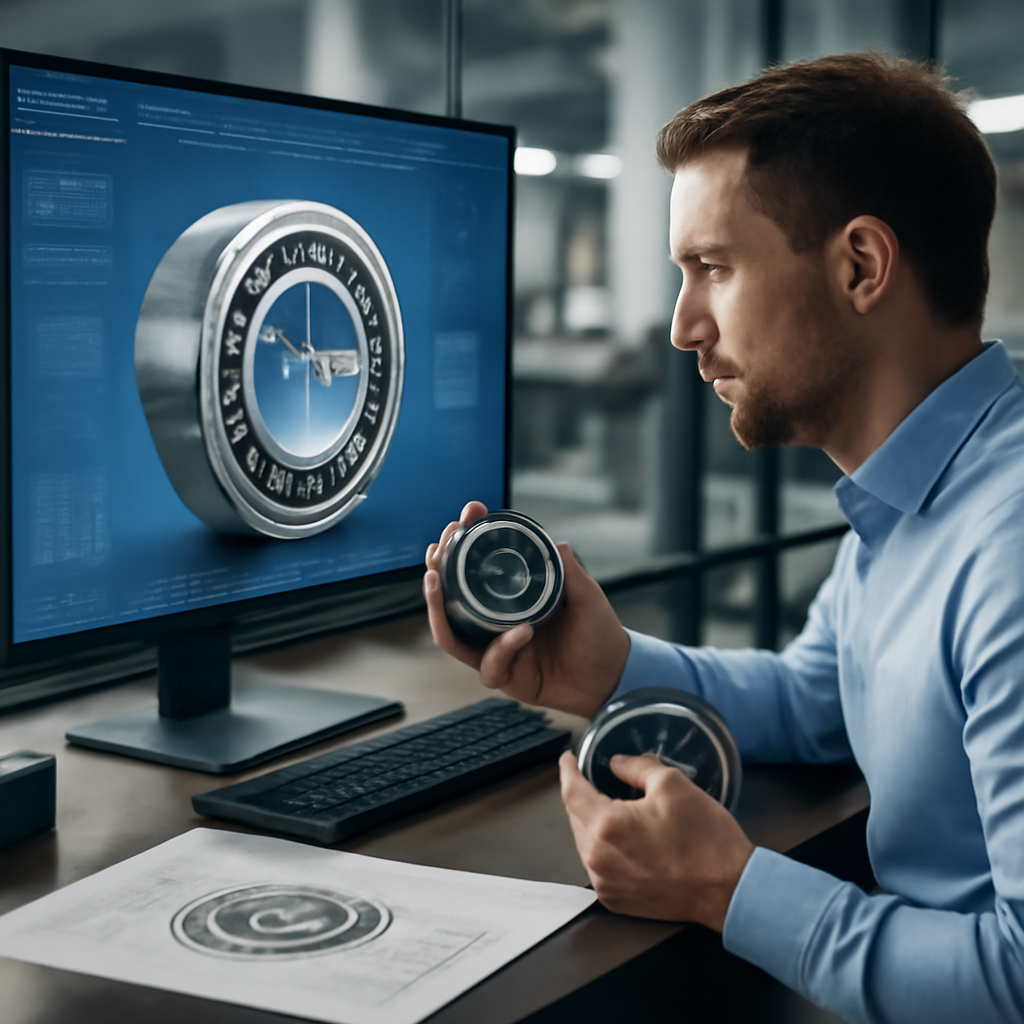
Every bearing manufacturer with a marketing department has been talking about digital twin technology for bearing selection since 2023. Vendors demo interactive dashboards showing bearing life predictions under simulated load conditions. Industry publications call it the future of technical bearing procurement. In practice, most European bearing buyers have neither used a digital twin tool nor asked their distributor for one. This piece walks through what digital twins actually deliver in bearing selection, where the hype exceeds reality, and where buyers genuinely benefit today.
What a bearing digital twin actually is
A digital twin in bearing selection creates a computational model of the specific bearing plus its operating conditions — load spectrum, shaft speed, temperature, contamination exposure, lubrication regime. The model predicts bearing life, failure modes and maintenance interval using the input parameters. Some tools update the model with real-time sensor data from installed bearings. Others run static simulation on catalog specifications. The technical sophistication ranges from simple L10 life calculator with a nice interface to genuinely predictive systems that learn from field data.
What the vendor demos actually show
The impressive demonstrations from SKF, Schaeffler and TIMKEN vendor teams typically show the static simulation category. Input the application parameters, get a life prediction, compare across bearing specifications, produce a selection recommendation. The interface is polished and the output looks authoritative. What the demos rarely show is the sensitivity of the output to input assumption changes — a 15 percent variation in load spectrum estimate can produce a 50 percent variation in life prediction. This matters because most industrial applications operate with load spectrum uncertainty greater than 15 percent.
Where digital twins deliver value today
Digital twins add value in three specific scenarios. First: precision applications where the load spectrum is well-characterised and the bearing selection cost of ownership is significant — machine tool spindle applications, aerospace precision, semiconductor equipment. Second: applications with sensor instrumentation already installed where the twin can update its predictions based on real vibration and temperature data. Third: engineering design phase where the twin helps compare bearing specification alternatives without physical prototyping. On these three categories the tool pays for itself.
Where digital twins do not add value
For general industrial applications — pumps, motors, gearboxes, conveyor drives — the traditional rolling-element bearing selection method delivers acceptable results at a fraction of the tool cost. The digital twin sophistication does not translate to better selection decisions when the input data uncertainty dominates the prediction accuracy. Distributors serving general industrial customers rarely find that digital twin capability wins commercial engagements against competitors who serve customers well without the tool.
What buyers actually ask for
Distributor commercial teams surveyed across Europe report that customer questions concentrate in three areas. First: cross-brand equivalency between SKF, TIMKEN and FAG. Second: seal package recommendations for specific contamination environments. Third: lubrication interval and grease compatibility. None of these questions require a digital twin. All three require domain expertise and access to good cross-reference data.
The 2026 digital twin market reality
Digital twin adoption in European bearing procurement remains under 10 percent of industrial buyers as of mid-2026. Growth has been slower than vendor forecasts predicted three years ago. The barriers are not technical but organisational — buyers do not have the sensor infrastructure to feed the twin with real-time data, do not have the load spectrum characterisation to make the static simulation meaningful, and do not have the technical staff to interpret the output. Vendors underestimate these barriers.
Where the market is heading through 2028
Two forces will drive digital twin adoption over the next 24 months. First: sensor cost reduction — the $50 vibration sensor category makes real-time data feeds practical for mid-size industrial applications. Second: cross-vendor tooling that combines multiple brand catalogs into one twin interface, removing the vendor lock-in barrier. When both forces mature the adoption rate accelerates. Neither is a 2026 story yet.
The takeaway for procurement teams
Digital twin technology is worth investigating for precision applications and for engineering design work. It is not worth investing in for general industrial bearing procurement. The traditional selection method with good cross-reference data delivers 90 percent of the value at 10 percent of the cost. Buyers should push distributors on cross-reference quality and technical expertise rather than on digital twin capability for now.
Related coverage on Eurobearing
- Bearing Cross-Reference Software 2026
- AI in Mechanical Transmission Monitoring
- Predictive Maintenance ROI
- Industrial IoT Sensors Buyers Guide
- IoT Vibration Sensors Under $50
Need help evaluating digital twin tools for your bearing procurement? Our team supports European buyers with tool selection and pragmatic ROI analysis. Book a free consultation.