
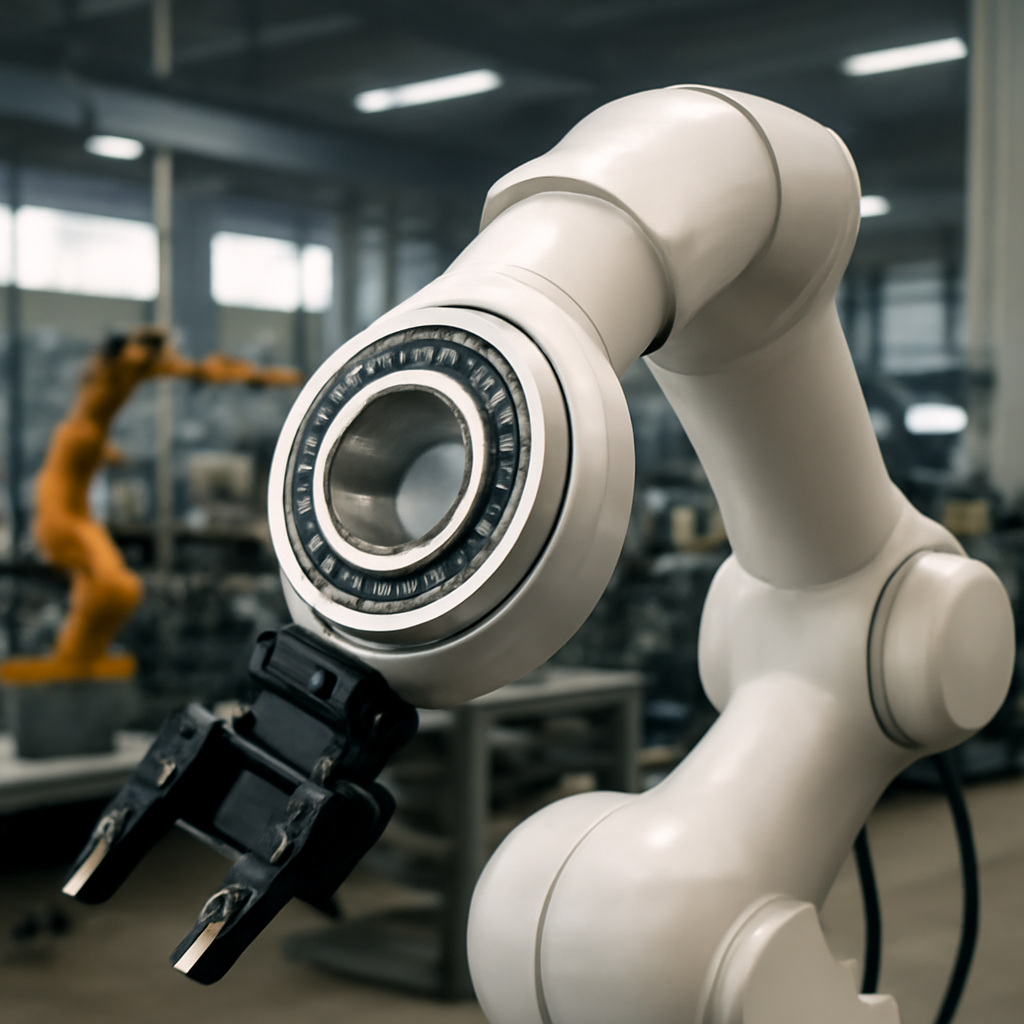
The industrial robotics market reached USD 54.28 billion in 2026 and is projected to grow at an 11.7% CAGR to USD 94.38 billion by 2031. Behind the headline number is a structural growth story for several adjacent component markets — and the bearing industry is one of the biggest beneficiaries.
The bearing content of an industrial robot
A standard six-axis industrial robot contains:
- One or two crossed-roller bearings per axis in the rotary joints, providing both stiffness and precision.
- Harmonic drive components (wave generator + flexspline + circular spline), each containing precision deep groove or angular contact bearings.
- Cycloidal reducers in heavier robots, with high-load needle and angular contact bearings.
- Motor bearings — high-speed deep groove or angular contact bearings, often insulated against bearing currents.
Total bearing content per robot: 30-60 individual bearings depending on size and configuration. Per six-axis robot, the bearing bill-of-materials runs into the high three figures of euros.
Cobots — the fast-growing segment
Collaborative robots (cobots) are growing faster than the broader industrial robotics market. Cobots use the same bearing categories but are biased toward miniature crossed-roller and slim-section angular contact designs to keep weight down.
The crossed-roller bearing market specifically
Crossed-roller bearings are an unusual category — small in absolute size compared to deep groove or tapered ranges, but high in value per unit because of the precision requirement. THK, Schaeffler INA, NSK and IKO dominate the supply, with high-quality Chinese suppliers entering the market.
Where the next growth wave is coming from
- Humanoid robotics: still small in 2026 but with strong forward momentum (see also our analysis of Schaeffler’s CES 2026 announcement).
- Mobile robotics and AMRs: warehouse and logistics robots use linear bearings, slewing rings and motor bearings.
- Surgical and medical robotics: very high-margin niche, with stringent bearing specifications.
- Agricultural robotics: an emerging segment with very different environmental demands.
What distributors should know
The robotics bearing market is not served well through general industrial distribution. Most volume goes direct from manufacturers to the major robotics OEMs under long-term supply agreements. The aftermarket opportunity is smaller but real — older industrial robots being refurbished, machine builders integrating robotic axes into custom equipment, and specialised systems integrators all source through distribution.
Related guides on Eurobearing
- Robotics and Automation: The Role of Bearings
- Schaeffler at CES 2026: Humanoid Robotics Pivot
- Linear Motion Market to Hit $22 Billion by 2033
Need help choosing the right bearing for your application? Our technical team can support you with selection, cross-references, and lead-time information.