
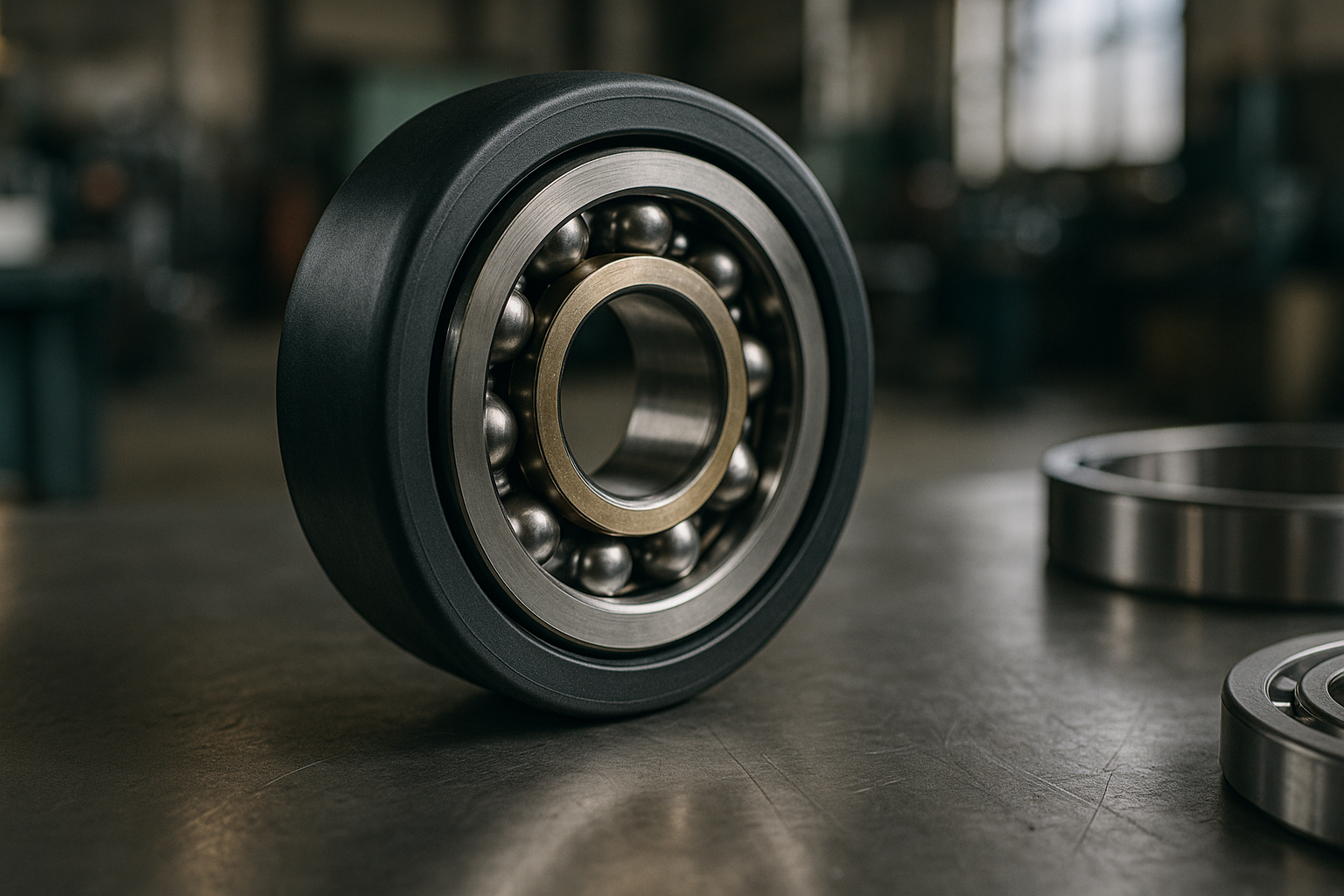
Spherical roller bearings in heavy industry fail for one reason far more often than any other, and it is not fatigue. It is contamination getting past an inadequate seal and then grinding the raceway from the inside. TIMKEN Hyguard sealed spherical roller bearings exist to address exactly that failure mode, replacing the open bearing plus separate labyrinth arrangement with an integrated seal designed as part of the bearing. Whether that integration is worth the premium depends almost entirely on how dirty and how wet the position actually is.
The failure mode the design is aimed at
An open spherical roller in a conveyor pulley, a crusher or a kiln support depends on external sealing to keep abrasive material away from the rollers. That external arrangement is usually a labyrinth or a felt seal fitted during assembly, and its effectiveness varies with how carefully it was installed and how much the housing has worn since. Once fine abrasive material reaches the raceway it embeds, and from that point the bearing is consuming its own surface. Service lives that should run years collapse to months, and the post-mortem almost always shows contamination rather than overload. Integrating the seal into the bearing removes the assembly variable, which is most of where the benefit comes from.
Where it genuinely earns the premium
Quarrying and aggregate handling, cement production, mining conveyors, bulk material handling outdoors, steel plant positions exposed to scale and water, and pulp and paper positions in wet sections. The common factor is continuous exposure to abrasive material or moisture combined with access that makes replacement expensive. In these environments the extended service life is not a marginal improvement; it frequently doubles or better against an open bearing with a mediocre external seal, and the intervention it avoids costs far more than the bearing did. Grease consumption also falls sharply, because a sealed unit retains what it is given instead of pushing it out past a labyrinth.
Where an open bearing remains the sensible choice
Clean indoor environments, positions with effective existing sealing arrangements, applications where the housing design already provides genuine protection, and anywhere the duty is light enough that fatigue rather than contamination will eventually end the bearing’s life. There is also a specific case against sealed units: where the operation relies on continuous grease purging to flush contamination outward, a sealed bearing removes a mechanism the maintenance strategy was built around. Substituting one for the other without thinking that through can make things worse rather than better.
Fitting it correctly matters more than usual
Integrated seals contact the inner ring, which means shaft finish and concentricity affect seal life directly. A shaft with a rough seat or run-out will destroy the seal long before the bearing wears, and at that point you have paid a premium for protection you no longer have. Adapter sleeve mounting, which is how many of these are fitted, needs the drive-up distance right — too loose and the ring creeps, too tight and the internal clearance disappears. The mounting technique for sleeve-fitted units is covered in our piece on adapter sleeve setup on stepped shafts, and the principles transfer directly.
How it compares against the alternatives
Both SKF and FAG offer sealed spherical roller ranges addressing the same problem, and in most industrial applications the three are functionally comparable at equivalent designation. Selection tends to come down to availability, existing relationship and the depth of application support behind local distribution rather than to a decisive technical difference. For distributors carrying more than one brand, holding qualified equivalents protects against the lead times that sealed variants sometimes carry, since they are made in smaller volumes than the open versions. The broader spherical roller category covers both open and sealed executions across the common sizes.
Working out whether it pays on a specific position
Take the current replacement frequency and multiply by the true cost of each intervention — labour, downtime, crane or access equipment, the seals and hardware that go with it. Then estimate the frequency with a sealed unit; in genuinely contaminated environments, halving is a reasonable starting assumption and the field evidence often supports better. The premium is typically forty to seventy percent on the bearing. On a conveyor pulley in a quarry the arithmetic is not close. On a clean indoor drive it does not work at all. The point is to run it per position rather than adopting a policy, which is the same discipline that governs premium tier decisions generally.
The practical test before you specify
Open the current bearing when it next comes out and look at the raceway. Dull grey abrasive wear, embedded particles, or a grease sample full of fines tells you contamination is the active failure mode and a sealed unit will help. Clean surfaces with classic fatigue spalling at the end of a reasonable service life tells you the sealing is already adequate and the money should go elsewhere. That single inspection answers the question more reliably than any specification comparison, and it costs nothing beyond paying attention during a replacement you were doing anyway.
Deciding whether sealed spherical rollers pay on your positions? Our team supports European heavy industry on bearing specification and contamination management. Book a free consultation.