
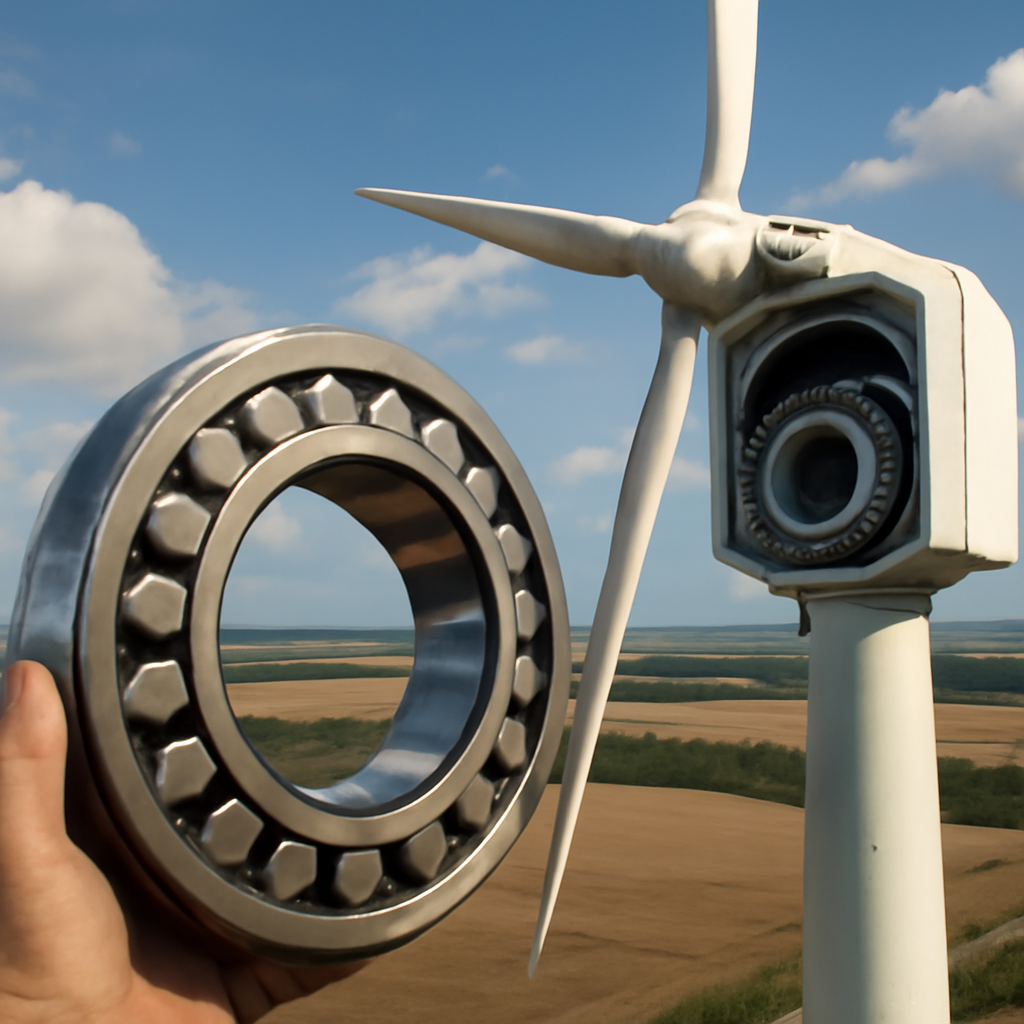
The wind turbine industry consumes more large-diameter bearings, by tonnage, than almost any other application. A single 5 MW offshore turbine carries roughly 1-2 tonnes of bearings spread across the main shaft, the gearbox stages, the pitch bearings on each blade root, the yaw bearing under the nacelle, and the generator. Scale that across the 110+ GW of new wind capacity added globally every year, and bearings become a structural constraint on the energy transition.
Where the bearings sit in a turbine
- Main shaft bearing(s): large spherical roller or cylindrical roller bearings carrying the rotor weight and aerodynamic thrust.
- Gearbox bearings: high-speed, planetary, and intermediate-stage rolling bearings — the most failure-prone position by far.
- Pitch bearings (one per blade): large slewing bearings allowing each blade to rotate about its long axis.
- Yaw bearing: a single very large slewing ring that allows the entire nacelle to turn into the wind.
- Generator bearings: high-speed deep groove bearings, often insulated against shaft currents.
Why this market is a bottleneck
1. Manufacturing capacity is concentrated
Very few facilities globally can produce a 5-metre slewing ring to wind-grade specifications. SKF, Schaeffler, NSK, NTN, Liebherr-Bearings and a small number of Chinese specialists own most of the capacity.
2. Lead times are long
Custom-engineered wind-grade slewing rings have lead times of 9-18 months. Turbine manufacturers commit to bearing supply years in advance.
3. Quality bar is unforgiving
Offshore turbines must run for 20+ years at sea, with maintenance access measured in tens of euros per hour. The bearing specifications — fatigue life, sealing, corrosion resistance, condition monitoring — are among the toughest in the industrial world.
The gearbox bearing problem
Wind turbine gearboxes are still the leading cause of premature drivetrain failure, and bearings inside the gearbox are usually the proximate cause. The industry response is a combination of:
- Material upgrades — through-hardened, carburised, or case-hardened bearing steels chosen for the specific load profile.
- Coating technologies — black oxide and DLC coatings to mitigate micropitting.
- Drivetrain redesign — direct-drive and medium-speed permanent magnet generators that eliminate or simplify the gearbox.
What is changing in 2026
Schaeffler, SKF and NSK are all investing in larger-bearing manufacturing capacity, but the constraints will not disappear in the near term. For the bearing industry as a whole, wind energy is one of the largest single growth drivers through the end of the decade.
The wind turbine main bearing engineering challenge
Wind turbine main bearings are among the most demanding bearings in industrial design. A 5 MW turbine main bearing carries 100-200 tonnes of rotor weight plus aerodynamic thrust that varies dynamically with wind conditions. The bearing must operate continuously for 20+ years with maintenance access measured in tens of euros per hour. The engineering specifications — fatigue life, sealing, corrosion resistance, condition monitoring — are among the toughest in the industrial world.
The dominant suppliers for wind main bearings are SKF, Schaeffler, NSK, NTN, and Liebherr-Bearings. Each invests heavily in materials engineering, manufacturing capacity, and product development to maintain wind market positioning. The competitive dynamic among these suppliers benefits wind turbine OEMs through technology improvement and pricing discipline.
The pitch and yaw bearing market
Beyond the main shaft bearing, every wind turbine carries pitch bearings (one per blade, allowing blade angle adjustment) and a yaw bearing (allowing the entire nacelle to rotate). Pitch and yaw bearings are large slewing rings — sometimes 3-5 metres in diameter for the largest turbines. Lead times on custom-engineered slewing rings remain at 9-18 months. The capacity is concentrated among a small number of suppliers globally.
For wind project developers, the slewing ring supply chain is a critical path constraint that affects project schedules. Capacity expansions at major suppliers are in progress but cannot fully match the demand growth from 110+ GW/year of new wind capacity globally. The supply constraint is structural for the rest of the decade.
Offshore wind specific considerations
Offshore wind turbines operate in a particularly hostile environment: salt water and salt spray, fluctuating temperature, limited maintenance access, and design lives of 20-25 years. Bearings for offshore applications carry additional engineering specifications: stainless or coated raceways, specialty marine-grade greases, robust sealing systems, and condition monitoring integration. The bearing cost per offshore turbine is meaningfully higher than onshore equivalent capacity.
The offshore wind market is expanding rapidly across Europe (UK, Netherlands, Germany, France, Denmark) and Asia (Taiwan, Vietnam, Japan, South Korea). The bearing demand growth from offshore expansion is one of the structural growth stories for the bearing industry through 2030.
The gearbox bearing reliability legacy
Wind turbine gearbox bearings have historically been the Achilles heel of wind drivetrain reliability. The combination of variable load, lubrication challenges, and material specifications creates a duty profile that has caused premature bearing failures across the industry. The response: material upgrades, surface coatings (black oxide, DLC), and drivetrain redesign toward direct-drive and medium-speed permanent magnet generators that eliminate or simplify the gearbox.
For wind turbine OEMs, the gearbox bearing reliability is a strategic priority. For bearing manufacturers, it is an engineering challenge that has driven innovation across the industry. The cumulative effect through 2026 has been measurable improvement in gearbox bearing reliability — though the historical legacy of failures continues to affect aftermarket dynamics.
The 2026-2030 wind bearing market outlook
Wind capacity additions globally are forecast above 110 GW/year through 2030, with offshore representing the fastest-growing sub-segment. The cumulative bearing tonnage demand is substantial — roughly 1-2 tonnes of bearings per MW of new capacity installed. For the bearing industry, wind energy is one of the largest single growth drivers through the end of the decade. For wind project developers, supplier relationships and capacity allocation become strategic considerations.
The 5-year structural outlook
Looking through 2030, the structural drivers of bearing market evolution remain robust. EV adoption acceleration, wind energy capacity expansion, industrial robotics growth, linear motion market expansion, and smart bearing technology maturation all combine to drive sustained demand growth above the broader industrial GDP rate. The bearing market projection (from $151.8B in 2026 to $301B by 2033) reflects these structural drivers operating in parallel.
For distributors and OEMs operating in this environment, the strategic question is not whether the market grows but how to position to capture share of the growth. Investment in smart bearing capability, condition monitoring platforms, EV-specific product knowledge, and integrated reliability services positions the participant for the post-2028 industry structure.
Risk factors and scenario planning
Beyond the base case, scenario planning identifies the risk factors that could change the trajectory. Downside scenarios include: global recession affecting industrial production, supply chain disruption from geopolitical events, trade barrier escalation reshaping competitive economics, or technology adoption slower than forecasted. Upside scenarios include: accelerated EV adoption, faster humanoid robotics commercialisation, sustained wind capacity expansion above current forecasts.
For sound strategic planning, the appropriate posture is preparation for multiple scenarios with strategies that perform reasonably across scenarios rather than optimisation for any single scenario. Build supplier substitution agility, condition monitoring capability, and master data discipline — these pay back regardless of which scenario unfolds.
Regional dynamics and supply chain implications
The bearing market dynamics vary by region. Asia Pacific dominates volume; Europe leads premium positioning; North America benefits from tariff protection but faces smaller scale. The competitive interplay across regions affects pricing, technology adoption, and supplier strategic positioning. For European distributors and OEMs, navigating the regional dynamics — particularly the impact of US tariff regime and EU regulatory complexity — is increasingly part of strategic planning.
The investment thesis for industrial reliability
For European industrial customers, the broader investment thesis for reliability capability — smart bearings, condition monitoring, predictive maintenance — is decisive. The economic case is documented; the technology is mature; the implementation pathway is well-understood. The strategic question is the pace and depth of investment, not whether to invest.
The cumulative effect across years of investment is meaningful: 30-50% reduction in unplanned downtime, 15-25% reduction in maintenance labour, extended equipment life, and operational benefits across virtually every dimension. The reliability investment is the single highest-leverage operational improvement available to most industrial plants in 2026.
Practical procurement guidance for 2026
For European industrial procurement teams operating in 2026, the practical guidance distils to a few key principles. First, build multi-supplier qualification across critical SKUs — supplier substitution agility is the most valuable procurement capability through the consolidation period. Second, lock pricing on framework agreements where leverage exists — bearing list prices continue upward trajectory through H2 2026 on most ranges. Third, invest in condition monitoring capability — the technology is mature and the ROI is documented. Fourth, build cross-reference databases that support informed substitution decisions during supply disruptions.
The cumulative effect of these procurement disciplines compounds across years. Organisations that build the capability now position themselves to outperform through the industry transition; those that delay will be implementing in 2028 against competitors who already have the foundation in place. The strategic window is open through 2026; the practical actions are well-defined.
Related guides on Eurobearing
- Industrial Applications of SKF Bearings
- High-Performance Bearings for Heavy Industry
- Bearing Market Outlook 2026-2033
Need help choosing the right bearing for your application? Our technical team can support you with selection, cross-references, and lead-time information.